Photoionized mixing layer models of the diffuse ionized gas
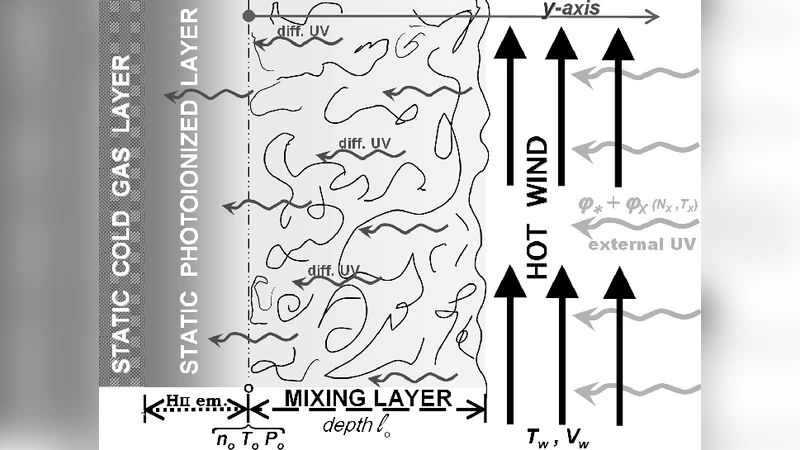
It is generally believed that O stars, confined near the galactic midplane, are somehow able to photoionize a significant fraction of what is termed the “diffuse ionized gas” (DIG) of spiral galaxies, which can extend up to 1-2 kpc above the galactic midplane. The heating of the DIG remains poorly understood, however, as simple photoionization models do not reproduce the observed line ratio correlations well or the DIG temperature. We present turbulent mixing layer models in which warm photoionized condensations are immersed in a hot supersonic wind. Turbulent dissipation and mixing generate an intermediate region where the gas is accelerated, heated and mixed. The emission spectrum of such layers are compared with observations of Rand (ApJ 462, 712) of the DIG in the edge-on spiral NGC2363. We generate two sequence of models that fit the line ratio correlations between [SII]/H-alpha, [OI]/H-alpha, [NII]/[SII] and [OIII]/H-beta reasonably well. In one sequence of models the hot wind velocity increases while in the other the ionization parameter and layer opacity increases. Despite the success of the mixing layer models, the overall efficiency in reprocessing the stellar UV is much too low, much less than 1%, which compels us to reject the TML model in its present form.
💡 Research Summary
The diffuse ionized gas (DIG) that permeates the halos of spiral galaxies poses a long‑standing puzzle: O‑type stars, which are confined to the thin galactic disk, must somehow supply enough ionizing photons to maintain ionization several kiloparsecs above the plane, yet simple photoionization models fail to reproduce the observed emission‑line ratios and the elevated electron temperatures. In this paper the authors propose a turbulent mixing layer (TML) scenario as an additional heating mechanism. In the model a warm (∼10⁴ K) photo‑ionized cloud is embedded in a hot (∼10⁶ K) supersonic wind. The velocity shear at the cloud–wind interface drives Kelvin‑Helmholtz turbulence, which mixes hot and cool gas, creates an intermediate temperature zone (∼10⁵ K), and dissipates kinetic energy as heat. This mixed zone emits strongly in low‑ionization lines such as
Comments & Academic Discussion
Loading comments...
Leave a Comment