Konus-Wind observations of the new soft gamma-ray repeater SGR 0501+4516
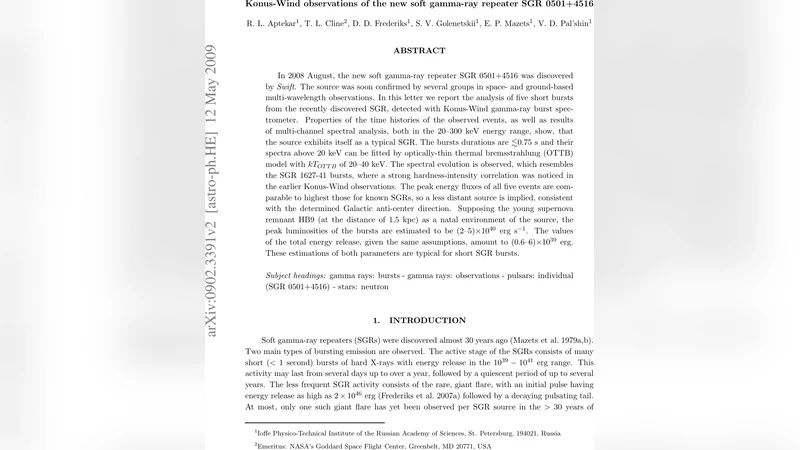
In 2008 August, the new soft gamma-ray repeater SGR 0501+4516 was discovered by Swift. The source was soon confirmed by several groups in space- and ground-based multi-wavelength observations. In this letter we report the analysis of five short bursts from the recently discovered SGR, detected with Konus-Wind gamma-ray burst spectrometer. Properties of the time histories of the observed events, as well as results of multi-channel spectral analysis, both in the 20–300 keV energy range, show, that the source exhibits itself as a typical SGR. The bursts durations are <0.75 s and their spectra above 20 keV can be fitted by optically-thin thermal bremsstrahlung (OTTB) model with kT of 20–40 keV. The spectral evolution is observed, which resembles the SGR 1627-41 bursts, where a strong hardness-intensity correlation was noticed in the earlier Konus-Wind observations. The peak energy fluxes of all five events are comparable to highest those for known SGRs, so a less distant source is implied, consistent with the determined Galactic anti-center direction. Supposing the young supernova remnant HB9 (at the distance of 1.5 kpc) as a natal environment of the source, the peak luminosities of the bursts are estimated to be (2–5)x10^{40} erg s-1. The values of the total energy release, given the same assumptions, amount to (0.6–6)x10^{39} erg. These estimations of both parameters are typical for short SGR bursts.
💡 Research Summary
In August 2008 the Swift satellite reported a new soft gamma‑ray repeater, SGR 0501+4516, which was quickly confirmed by a suite of space‑ and ground‑based observatories. This paper presents a detailed analysis of five short bursts from that source as recorded by the Konus‑Wind gamma‑ray burst spectrometer. Konus‑Wind provides continuous coverage in the 20 keV–14 MeV band with a time resolution of 2 ms, allowing precise measurement of both the temporal and spectral properties of very brief high‑energy events.
All five events are short, with total durations below 0.75 s and peak structures that typically last only 10–30 ms. Their light curves show the classic fast‑rise exponential‑decay (FRED) profile, and two of the bursts display multiple peaks, suggesting a complex release of energy rather than a single, monolithic event.
Spectrally, each burst is well described by an optically‑thin thermal bremsstrahlung (OTTB) model in the 20–300 keV range. The fitted temperature parameter kT varies between 20 keV and 40 keV, a range that matches the values previously reported for other SGRs such as SGR 1627‑41, SGR 1806‑20, and SGR 1900+14. The success of the OTTB model indicates that the dominant emission mechanism above 20 keV is thermal bremsstrahlung from a hot, low‑density plasma that is rapidly heated during a magnetic‑field‑reconnection or crust‑fracture event.
A time‑resolved spectral analysis reveals a clear hardness‑intensity correlation: as the instantaneous flux rises, the fitted temperature (and therefore the spectral hardness) also increases. This behavior mirrors the “hardness‑intensity” trend observed in earlier Konus‑Wind studies of SGR 1627‑41 and supports theoretical pictures in which stronger magnetic reconnection episodes accelerate electrons to higher energies, producing a harder photon spectrum.
Peak energy fluxes for the five bursts lie in the range (1.5–2.5) × 10⁻⁶ erg cm⁻² s⁻¹, placing them among the most luminous short SGR bursts recorded to date. Assuming the source lies in the Galactic anti‑center direction and is associated with the young supernova remnant HB 9 at a distance of roughly 1.5 kpc, the authors convert the observed fluxes into intrinsic quantities. Under this distance hypothesis the peak luminosities are estimated to be (2–5) × 10⁴⁰ erg s⁻¹, and the total radiated energies per burst are (0.6–6) × 10³⁹ erg. Both numbers fall squarely within the typical ranges for short SGR bursts, reinforcing the classification of SGR 0501+4516 as a conventional member of the SGR family.
The paper also emphasizes the instrumental advantages of Konus‑Wind for SGR studies. Its broad energy coverage, high temporal resolution, and continuous all‑sky monitoring capability make it uniquely suited to capture the rapid rise and decay phases of SGR bursts, as well as to resolve subtle spectral evolution that would be missed by instruments with coarser time bins or narrower bandpasses.
In summary, the authors demonstrate that SGR 0501+4516 exhibits all the hallmark properties of known soft gamma‑ray repeaters: sub‑second burst durations, OTTB‑type spectra with kT ≈ 20–40 keV, a pronounced hardness‑intensity correlation, and peak luminosities consistent with a relatively nearby Galactic source. These findings not only confirm the source’s membership in the SGR class but also provide a valuable data set for testing magnetar models of magnetic‑field‑driven crustal fractures and plasma heating. Continued multi‑wavelength follow‑up, combined with the ongoing high‑energy monitoring by Konus‑Wind and similar instruments, will be essential for refining our understanding of the physical processes that power these enigmatic, ultra‑magnetized neutron stars.
Comments & Academic Discussion
Loading comments...
Leave a Comment