Asymptotic structure of Poynting dominated jets
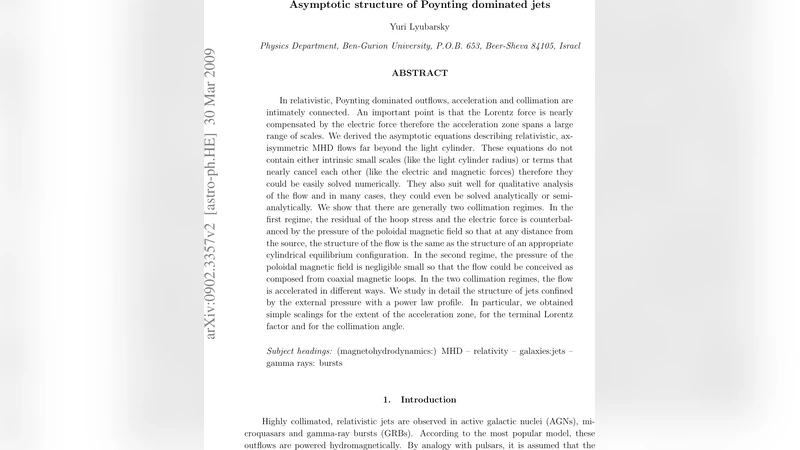
In relativistic, Poynting dominated outflows, acceleration and collimation are intimately connected. An important point is that the Lorentz force is nearly compensated by the electric force therefore the acceleration zone spans a large range of scales. We derived the asymptotic equations describing relativistic, axisymmetric MHD flows far beyond the light cylinder. These equations do not contain either intrinsic small scales (like the light cylinder radius) or terms that nearly cancel each other (like the electric and magnetic forces) therefore they could be easily solved numerically. They also suit well for qualitative analysis of the flow and in many cases, they could even be solved analytically or semi-analytically. We show that there are generally two collimation regimes. In the first regime, the residual of the hoop stress and the electric force is counterbalanced by the pressure of the poloidal magnetic field so that at any distance from the source, the structure of the flow is the same as the structure of an appropriate cylindrical equilibrium configuration. In the second regime, the pressure of the poloidal magnetic field is negligible small so that the flow could be conceived as composed from coaxial shrinking magnetic loops. In the two collimation regimes, the flow is accelerated in different ways. We study in detail the structure of jets confined by the external pressure with a power law profile. In particular, we obtained simple scalings for the extent of the acceleration zone, for the terminal Lorentz factor and for the collimation angle.
💡 Research Summary
The paper tackles the long‑standing problem of describing relativistic, Poynting‑dominated jets far beyond the light‑cylinder, where the electric and magnetic forces almost cancel and the acceleration zone extends over many orders of magnitude in distance. By systematically eliminating the small‑scale parameter (r_{\rm LC}/r) and the nearly cancelling terms from the full axisymmetric MHD equations, the authors derive a set of asymptotic equations that retain only the residual forces: the hoop stress (magnetic tension) and the poloidal magnetic pressure. These equations are free of intrinsic small scales, making them both analytically tractable and numerically stable.
Two distinct collimation regimes emerge from the analysis. In the first regime the residual hoop stress is balanced by the pressure of the poloidal magnetic field. Consequently, at any axial distance the jet cross‑section reproduces the equilibrium of an appropriate cylindrical configuration. When the external confining pressure follows a power‑law (p_{\rm ext}(z)\propto z^{-\kappa}), the jet half‑opening angle scales as (\theta\propto z^{-(\kappa-2)/4}) and the Lorentz factor grows as (\gamma\propto z^{(\kappa-2)/2}). For (\kappa<2) the acceleration can, in principle, continue indefinitely, allowing the jet to convert essentially all of its initial magnetization (\sigma_0) into kinetic energy ((\gamma_{\infty}\sim\sigma_0)).
In the second regime the poloidal magnetic pressure is negligible; the flow can be visualized as a series of coaxial magnetic loops that shrink under the unbalanced hoop stress. Here the acceleration is driven directly by the residual magnetic tension, leading to a slower growth (\gamma\propto z^{1/3}). The extent of the acceleration zone and the terminal Lorentz factor now depend sensitively on the external pressure index: for (\kappa>2) the acceleration is limited, yielding (\gamma_{\infty}\propto\sigma_0^{(2-\kappa)/(4-2\kappa)}).
The authors further explore special cases such as constant external pressure ((\kappa=0)), where the jet maintains a fixed radius and rapidly reaches (\gamma\sim\sigma_0), and very steep pressure declines ((\kappa>4)), where collimation is ineffective and the jet remains essentially ballistic. Numerical experiments based on the asymptotic equations confirm that the traditional difficulties associated with near‑cancellation of electric and magnetic forces disappear, allowing accurate long‑range simulations of jet acceleration and collimation.
Overall, the work provides a unified, scale‑free framework for understanding how relativistic, magnetically dominated outflows convert magnetic energy into bulk motion, how they are shaped by external confinement, and how observable quantities such as opening angle and terminal Lorentz factor depend on the ambient pressure profile. These results are directly applicable to interpreting observations of AGN jets, gamma‑ray burst outflows, and pulsar wind nebulae.
Comments & Academic Discussion
Loading comments...
Leave a Comment