The Extended Environment of M17: A Star Formation History
M17 is one of the youngest and most massive nearby star-formation regions in the Galaxy. It features a bright H II region erupting as a blister from the side of a giant molecular cloud (GMC). Combining photometry from the Spitzer GLIMPSE survey with complementary infrared (IR) surveys, we identify candidate young stellar objects (YSOs) throughout a 1.5 deg x 1 deg field that includes the M17 complex. The long sightline through the Galaxy behind M17 creates significant contamination in our YSO sample from unassociated sources with similar IR colors. Removing contaminants, we produce a highly-reliable catalog of 96 candidate YSOs with a high probability of association with the M17 complex. We fit model spectral energy distributions to these sources and constrain their physical properties. Extrapolating the mass function of 62 intermediate-mass YSOs (M >3 Msun), we estimate that >1000 stars are in the process of forming in the extended outer regions of M17. From IR survey images from IRAS and GLIMPSE, we find that M17 lies on the rim of a large shell structure ~0.5 deg in diameter (~20 pc at 2.1 kpc). We present new maps of CO and 13CO (J=2-1) emission, which show that the shell is a coherent, kinematic structure associated with M17 at v = 19 km/s. The shell is an extended bubble outlining the photodissociation region of a faint, diffuse H II region several Myr old. We provide evidence that massive star formation has been triggered by the expansion of the bubble. The formation of the massive cluster ionizing the M17 H II region itself may have been similarly triggered. We conclude that the star formation history in the extended environment of M17 has been punctuated by successive waves of massive star formation propagating through a GMC complex.
💡 Research Summary
The paper presents a comprehensive multi‑wavelength investigation of the extended environment of the massive star‑forming complex M17, aiming to reconstruct its recent star‑formation history. M17, located at a distance of ~2.1 kpc in the inner Galaxy, is a classic blister H II region that has broken out of the side of a giant molecular cloud (GMC). Because the line of sight traverses a large portion of the Galactic disk, infrared (IR) source catalogs are heavily contaminated by unrelated foreground and background objects that share similar colors with genuine young stellar objects (YSOs).
To address this, the authors combined photometry from the Spitzer GLIMPSE survey (3.6–8 µm) with ancillary data from 2MASS, MSX, and IRAS, constructing a catalog of IR sources over a 1.5° × 1° field that encompasses the entire M17 complex. Initial color–color and color–magnitude cuts yielded several hundred YSO candidates. Using a Galactic population synthesis model, they statistically estimated the level of contamination and applied a spatial filtering technique that compared source densities inside the M17 region with those in adjacent control fields. After this rigorous cleaning, a highly reliable sample of 96 YSO candidates remained, each with a high probability of physical association with M17.
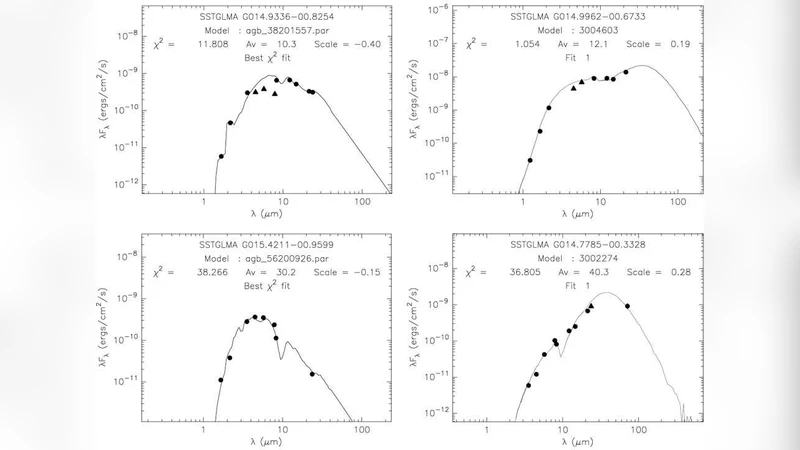
For each of the 96 sources, the authors performed spectral energy distribution (SED) fitting using the extensive grid of radiative‑transfer models developed by Robitaille et al. (2006). The fitting procedure provided estimates of stellar mass, bolometric luminosity, envelope accretion rate, and evolutionary stage. Sixty‑two of the objects were identified as intermediate‑mass YSOs (M > 3 M⊙). By constructing a mass function for this subsample and extrapolating it with a Salpeter‑type initial mass function (IMF), the authors inferred that more than 1 000 stars are currently in the process of forming throughout the extended outer regions of M17, a number that rivals or exceeds the stellar content of the well‑studied central cluster.
The morphological context was explored using far‑infrared images from IRAS (60 µm and 100 µm) and the 8 µm PAH map from GLIMPSE. These data reveal a large, roughly circular shell or bubble with a diameter of ~0.5° (≈20 pc at 2.1 kpc) that encircles M17 on its southern side. To test whether this feature is a coherent physical structure, the authors obtained new maps of the CO (J = 2–1) and 13CO (J = 2–1) lines with the Heinrich Hertz Telescope. The molecular data show a well‑defined velocity component at v_LSR ≈ 19 km s⁻¹ that is spatially coincident with the infrared shell, confirming that the bubble is a kinematically coherent structure associated with M17. The interior of the bubble exhibits weak free‑free emission and a faint H II region, indicating that it is an older (several Myr) photodissociation region (PDR) created by an earlier generation of massive stars.
A central hypothesis of the paper is that the expansion of this bubble has triggered successive episodes of massive star formation. Evidence supporting this includes: (i) a marked increase in YSO surface density along the bubble rim; (ii) broadened CO line widths and elevated velocity dispersions at the interface, suggestive of shock‑driven compression; and (iii) the spatial coincidence of the massive ionizing cluster NGC 6618 (which powers the bright M17 H II region) with the inner edge of the bubble. The authors argue that the original generation of massive stars that created the bubble compressed the surrounding GMC, leading to the formation of the next generation of massive stars—including the cluster that now illuminates M17. This “collect‑and‑collapse” or “radiation‑driven implosion” scenario provides a natural explanation for the observed age gradient and the spatial distribution of YSOs.
By integrating infrared photometry, SED modeling, and molecular line kinematics, the study delivers a coherent picture in which the star‑formation history of M17 is not a single burst but a series of wave‑like events propagating outward from the original bubble. The authors conclude that the extended environment of M17 has experienced punctuated, successive waves of massive star formation, each triggered by the mechanical and radiative feedback of the previous generation. This work not only quantifies the current star‑forming population in the outer M17 region but also illustrates a methodological framework—combining statistical contamination removal, SED fitting, and high‑resolution molecular spectroscopy—that can be applied to other complex star‑forming complexes embedded in the Galactic plane.
Comments & Academic Discussion
Loading comments...
Leave a Comment