The Physics of Protoplanetesimal Dust Agglomerates. III. Compaction in Multiple Collisions
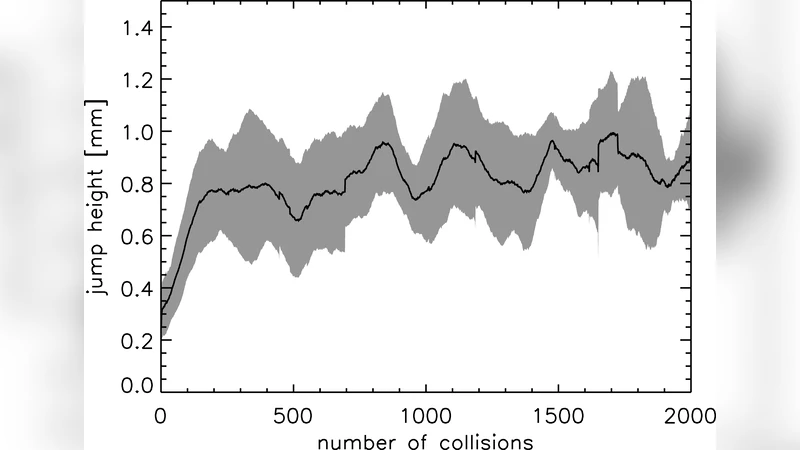
To study the evolution of protoplanetary dust aggregates, we performed experiments with up to 2600 collisions between single, highly-porous dust aggregates and a solid plate. The dust aggregates consisted of spherical SiO$_2$ grains with 1.5$\mu$m diameter and had an initial volume filling factor (the volume fraction of material) of $\phi_0=0.15$. The aggregates were put onto a vibrating baseplate and, thus, performed multiple collisions with the plate at a mean velocity of 0.2 m s$^{-1}$. The dust aggregates were observed by a high-speed camera to measure their size which apparently decreased over time as a measure for their compaction. After 1000 collisions the volume filling factor was increased by a factor of two, while after $\sim2000$ collisions it converged to an equilibrium of $\phi\approx0.36$. In few experiments the aggregate fragmented, although the collision velocity was well below the canonical fragmentation threshold of $\sim1$ m s$^{-1}$. The compaction of the aggregate has an influence on the surface-to-mass ratio and thereby the dynamic behavior and relative velocities of dust aggregates in the protoplanetary nebula. Moreover, macroscopic material parameters, namely the tensile strength, shear strength, and compressive strength, are altered by the compaction of the aggregates, which has an influence on their further collisional behavior. The occurrence of fragmentation requires a reassessment of the fragmentation threshold velocity.
💡 Research Summary
The paper investigates how repeated low‑velocity impacts affect the internal structure and mechanical properties of highly porous dust aggregates that are thought to be the building blocks of planetesimals in protoplanetary disks. The authors produced aggregates from monodisperse spherical silica (SiO₂) grains of 1.5 µm diameter, achieving an initial volume filling factor φ₀ = 0.15, which corresponds to a very low bulk density typical of early‑stage dust clumps. These aggregates, roughly 1 mm in size, were placed on a vibrating base plate that induced collisions at an average speed of about 0.2 m s⁻¹. Each experiment allowed up to 2600 collisions, and a high‑speed camera (10 000 fps) recorded the aggregate’s silhouette before and after each impact. By measuring the apparent size reduction, the authors inferred the evolution of the filling factor φ as a proxy for compaction.
The results show a rapid increase in φ during the first thousand collisions, doubling from 0.15 to roughly 0.30. After about 2000 collisions the filling factor approaches a plateau near φ ≈ 0.36, indicating that the aggregates reach a compacted equilibrium state where further compression is inefficient. This behavior suggests that internal grain contacts proliferate quickly at first, then saturate as the aggregate’s pore network becomes increasingly constrained.
Unexpectedly, a few runs exhibited fragmentation despite collision velocities well below the commonly cited fragmentation threshold of ~1 m s⁻¹. In those cases, fragmentation occurred after more than 1500 impacts, implying that cumulative stress and internal strain—rather than instantaneous impact speed alone—can trigger break‑up. The fragments measured 10–30 % of the original mass, indicating partial, not catastrophic, disruption.
The authors discuss the broader implications for dust dynamics in a nebular environment. Compaction reduces the surface‑to‑mass ratio, thereby lowering aerodynamic drag and altering settling velocities. Moreover, the mechanical strengths (tensile, shear, compressive) increase by factors of two to three as φ rises, which influences the outcome of subsequent collisions: more compact aggregates are more likely to bounce or stick rather than fragment, but they also become more brittle once internal stresses exceed a critical level. Consequently, the simple velocity‑based fragmentation criterion used in many coagulation models is insufficient; a more nuanced threshold that incorporates filling factor, cumulative impact energy, and internal stress history is required.
Methodologically, the study excels in controlling collision frequency and speed, and in using high‑speed imaging to quantify compaction. However, it is limited to plate‑aggregate impacts; true dust evolution involves many grain‑grain collisions with a distribution of impact angles and velocities. The experiments were also conducted under ambient conditions, so gas pressure effects were not fully isolated. Future work should extend to two‑body collisions, explore a broader range of grain materials and sizes, and perform analogous tests under low‑pressure, gas‑rich environments that better mimic protoplanetary disks.
In summary, the paper demonstrates that (1) repeated low‑speed impacts can double the filling factor of highly porous aggregates within a few thousand collisions, (2) the compaction process saturates at φ ≈ 0.36, (3) cumulative stress can cause fragmentation even below the nominal velocity threshold, and (4) these structural changes have significant consequences for dust aerodynamics and collisional evolution. The findings call for revisions of dust coagulation models to include compaction‑dependent mechanical properties and a more complex fragmentation criterion.
Comments & Academic Discussion
Loading comments...
Leave a Comment