Optical constants of silicon carbide for astrophysical applications. II. Extending optical functions from IR to UV using single-crystal absorption spectra
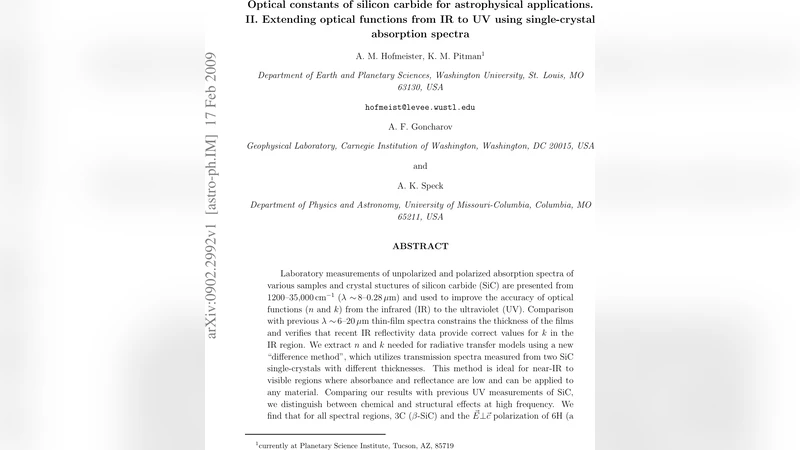
Laboratory measurements of unpolarized and polarized absorption spectra of various samples and crystal stuctures of silicon carbide (SiC) are presented from 1200–35,000 cm$^{-1}$ ($\lambda \sim$ 8–0.28 $\mu$m) and used to improve the accuracy of optical functions ($n$ and $k$) from the infrared (IR) to the ultraviolet (UV). Comparison with previous $\lambda \sim$ 6–20 $\mu$m thin-film spectra constrains the thickness of the films and verifies that recent IR reflectivity data provide correct values for $k$ in the IR region. We extract $n$ and $k$ needed for radiative transfer models using a new ``difference method’’, which utilizes transmission spectra measured from two SiC single-crystals with different thicknesses. This method is ideal for near-IR to visible regions where absorbance and reflectance are low and can be applied to any material. Comparing our results with previous UV measurements of SiC, we distinguish between chemical and structural effects at high frequency. We find that for all spectral regions, 3C ($\beta$-SiC) and the $\vec{E}\bot \vec{c}$ polarization of 6H (a type of $\alpha$-SiC) have almost identical optical functions that can be substituted for each other in modeling astronomical environments. Optical functions for $\vec{E} | \vec{c}$ of 6H SiC have peaks shifted to lower frequency, permitting identification of this structure below $\lambda \sim4\mu$m. The onset of strong UV absorption for pure SiC occurs near 0.2 $\mu$m, but the presence of impurities redshifts the rise to 0.33 $\mu$m. Optical functions are similarly impacted. Such large differences in spectral characteristics due to structural and chemical effects should be observable and provide a means to distinguish chemical variation of SiC dust in space.
💡 Research Summary
This paper presents a comprehensive set of optical constants (the real part of the refractive index, n, and the extinction coefficient, k) for silicon carbide (SiC) spanning from the infrared (IR) to the ultraviolet (UV). The authors measured unpolarized and polarized absorption spectra of single‑crystal SiC samples covering the wavenumber range 1 200–35 000 cm⁻¹ (λ ≈ 8–0.28 µm). Two crystal structures were investigated: cubic 3C (β‑SiC) and hexagonal 6H (α‑SiC). For the 6H material both electric‑field orientations relative to the c‑axis—E ⊥ c and E ∥ c—were examined, allowing a direct assessment of anisotropic optical behavior.
A central methodological advance is the “difference method,” which derives n and k from transmission spectra of two crystals of the same composition but different thicknesses. By taking the difference in absorbance (ΔA) and dividing by the thickness difference (Δd), the authors obtain the absorption coefficient directly, while a separate measurement or calculation of surface reflectance (R) supplies the necessary correction for reflected light. This approach is especially powerful in the near‑IR to visible region where both absorption and reflectance are weak, conditions that render traditional Kramers‑Kronig or thin‑film techniques unreliable. The method also enables an independent verification of the thickness of previously used thin‑film samples, confirming that earlier IR reflectivity data provide accurate k values in the IR.
The resulting optical constants reveal several astrophysically relevant trends. First, the n(λ) and k(λ) curves for 3C β‑SiC and for 6H α‑SiC with E ⊥ c are virtually indistinguishable across the entire spectral range. Consequently, either crystal structure can be used interchangeably in radiative‑transfer models of circumstellar or interstellar dust without introducing systematic errors. Second, the E ∥ c polarization of 6H SiC exhibits distinct absorption peaks that are shifted to lower frequencies (longer wavelengths) compared with the E ⊥ c case. These features become prominent below λ ≈ 4 µm and provide a diagnostic tool for identifying the crystal orientation of SiC grains in astronomical spectra.
In the UV, pure SiC shows a sharp rise in k near 0.20 µm (≈5 eV), marking the onset of strong electronic absorption. However, the presence of trace impurities (e.g., nitrogen or boron at the ~0.1 % level) red‑shifts this absorption edge to ≈0.33 µm (≈3.8 eV). The impurity‑induced shift is accompanied by corresponding changes in n, altering the overall UV‑optical depth and color of SiC‑containing dust clouds. This sensitivity to chemical composition suggests that high‑resolution UV–optical observations could discriminate between pristine and impurity‑laden SiC grains, offering a new probe of dust processing in stellar outflows and the interstellar medium.
The authors conclude that the combination of (i) a robust, thickness‑independent extraction technique, (ii) a validated set of n and k values for both cubic and hexagonal SiC, (iii) clear polarization‑dependent signatures, and (iv) a quantifiable impurity effect in the UV, furnishes the astrophysical community with the most reliable SiC optical constants to date. These data can be directly implemented in dust‑radiative‑transfer codes, improving the fidelity of model spectra for carbon‑rich AGB stars, planetary nebulae, and supernova remnants. Moreover, the methodology is generic and can be applied to other refractory materials where thin‑film fabrication is challenging, thereby broadening its impact beyond SiC.
Comments & Academic Discussion
Loading comments...
Leave a Comment