Formation, Survival, and Detectability of Planets Beyond 100 AU
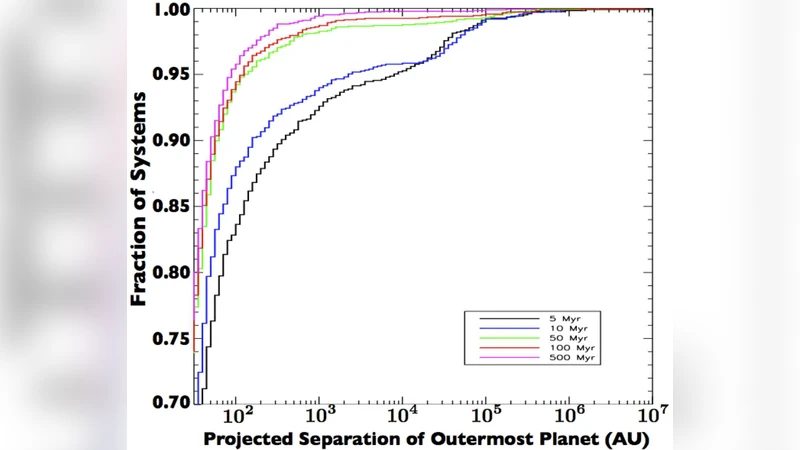
Direct imaging searches have begun to detect planetary and brown dwarf companions and to place constraints on the presence of giant planets at large separations from their host star. This work helps to motivate such planet searches by predicting a population of young giant planets that could be detectable by direct imaging campaigns. Both the classical core accretion and the gravitational instability model for planet formation are hard-pressed to form long-period planets in situ. Here, we show that dynamical instabilities among planetary systems that originally formed multiple giant planets much closer to the host star could produce a population of giant planets at large (~100 AU - 100000 AU) separations. We estimate the limits within which these planets may survive, quantify the efficiency of gravitational scattering into both stable and unstable wide orbits, and demonstrate that population analyses must take into account the age of the system. We predict that planet scattering creates a population of detectable giant planets on wide orbits that decreases in number on timescales of ~10 Myr. We demonstrate that several members of such populations should be detectable with current technology, quantify the prospects for future instruments, and suggest how they could place interesting constraints on planet formation models.
💡 Research Summary
The paper addresses a pressing question in exoplanet science: how can giant planets be found at separations of 100 AU to 10⁵ AU, where traditional formation theories struggle. The authors argue that neither core‑accretion nor disk‑gravitational‑instability can efficiently produce such distant planets in situ because of insufficient solid surface density and cooling times at large radii. Instead, they propose a dynamical‑scattering scenario in which multiple massive planets (1–10 M_J) first form within the inner few tens of AU of a protoplanetary disk. Once the system becomes dynamically unstable—typically when the orbital spacing falls below ~3–5 mutual Hill radii—close encounters trigger strong gravitational kicks that fling one or more planets onto very wide orbits.
Using a suite of N‑body integrations (≈10⁴ realizations, each followed for up to 100 Myr), the authors map out the outcomes of such instabilities. They find that the efficiency of scattering depends primarily on the initial planetary masses and spacing: more massive planets acquire larger kinetic energy and are more likely to be scattered to >10³ AU, while tightly packed systems become unstable within a few Myr. The final orbital distribution separates into two regimes. (1) “Stable ultra‑wide” orbits with semi‑major axes of 10³–10⁴ AU remain bound to the host star for the lifetime of the system because the stellar gravitational potential dominates over galactic tides. (2) “Unstable” orbits beyond ≈10⁴ AU are vulnerable to galactic tidal forces, passing stars, and subsequent scattering events, leading to ejection or star‑planet collisions on timescales of ≲10 Myr.
A key insight is the strong age dependence of the observable population. Immediately after scattering (≤1 Myr) the number of planets on wide orbits peaks, but as the system ages, the fraction on unstable trajectories declines sharply. By ~10 Myr roughly 60–70 % of the scattered planets have settled onto stable, low‑eccentricity ultra‑wide orbits, while the remainder have been lost. Consequently, young stellar associations (≤30 Myr) are the most promising hunting grounds for direct imaging surveys.
The authors then translate these dynamical results into detection prospects. They model the intrinsic luminosity of young giant planets as a function of mass and age, and combine these spectra with contrast curves for current high‑contrast imagers (VLT/SPHERE, Gemini/GPI) and upcoming extremely large telescopes (ELTs). In the L‑band (3.5 µm) and M‑band (4.8 µm), present‑day instruments can achieve ~10⁻⁶ contrast at separations of 0.5–1″, sufficient to detect 5–10 M_J planets at 100–300 AU around stars younger than ~30 Myr. The simulations suggest that about 10 % of the scattered population falls within these detectable limits. Future ELTs, with expected contrasts of 10⁻⁷–10⁻⁸, would push the detection threshold down to 1–3 M_J planets at 50 AU and extend the observable age range to >100 Myr.
Based on these findings, the paper proposes an observational strategy: prioritize nearby (≤150 pc), young stars; conduct deep integrations in the thermal‑infrared where planet‑star contrast is most favorable; and obtain multi‑epoch data to confirm common proper motion and orbital motion. Detecting even a modest number of such wide‑orbit giants would provide a direct test of the scattering hypothesis and, by extension, constrain the efficiency of core‑accretion in the inner disk.
In summary, the study presents a comprehensive theoretical framework that links early‑stage multi‑planet instability to a population of wide‑separation giant planets. It quantifies the survival limits imposed by stellar gravity versus galactic tides, demonstrates a clear decline in the observable population on ~10 Myr timescales, and shows that current and next‑generation direct‑imaging facilities are capable of detecting several members of this population. The results thus bridge a gap between planet formation theory and observational surveys, offering a concrete pathway to assess how common dynamical scattering is in shaping the architecture of planetary systems.
Comments & Academic Discussion
Loading comments...
Leave a Comment