The Tilt of the Halo Velocity Ellipsoid and the Shape of the Milky Way Halo
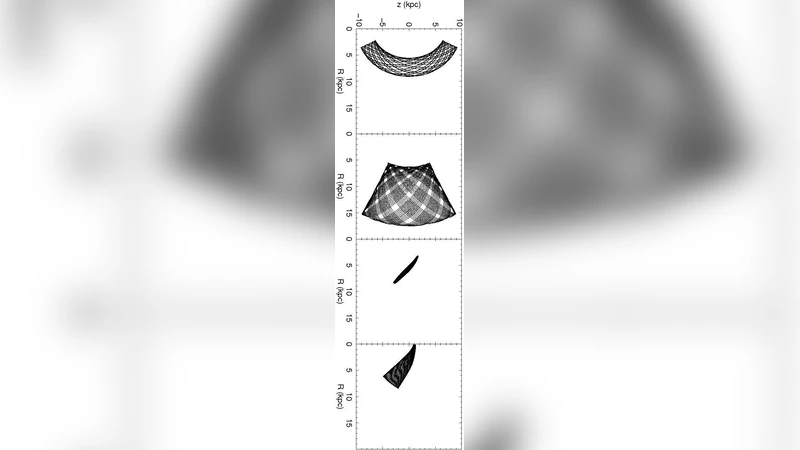
A sample of roughly 1,800 halo subdwarf stars with radial velocities and proper motions is assembled, using the repeated multi-band Sloan Digital Sky Survey photometric measurements in Stripe 82. Our sample of halo subdwarfs is extracted via a reduced proper motion diagram and distances are obtained using photometric parallaxes, thus giving full phase space information. The tilt of the velocity ellipsoid with respect to the spherical polar coordinate system is computed and found to be consistent with zero for two of the three tilt angles, and very small for the third. We prove that if the inner halo is in a steady-state and the triaxial velocity ellipsoid is everywhere aligned in spherical polar coordinates, then the potential must be spherically symmetric. The detectable, but very mild, misalignment with spherical polars is consistent with the perturbative effects of the Galactic disk on a spherical dark halo. Banana orbits are generated at the 1:1 resonance (in horizontal and vertical frequency) by the disk. They populate Galactic potentials at the typical radii of our subdwarf sample, along with the much more dominant short-axis tubes. However, on geometric grounds alone, the tilt cannot vanish for the banana orbits and this leads to a slight, but detectable, misalignment. We argue that the tilt of the stellar halo velocity ellipsoid therefore provides a hitherto largely neglected but important line of argument that the Milky Way’s dark halo, which dominates the potential, must be nearly spherical.
💡 Research Summary
The authors assemble a kinematically complete sample of roughly 1,800 halo subdwarf stars by exploiting the multi‑epoch, multi‑band imaging of the Sloan Digital Sky Survey’s Stripe 82 region. Subdwarfs are identified through a reduced proper‑motion (RPM) diagram that cleanly separates halo members from disk contaminants. Photometric parallaxes provide distances, while SDSS radial velocities combined with proper motions yield full three‑dimensional space motions. With positions and velocities expressed in spherical polar coordinates (r, θ, φ), the velocity dispersion tensor is computed for the entire sample, and the three tilt angles that describe the misalignment of the velocity ellipsoid with respect to the spherical basis are measured. Two of the angles are statistically indistinguishable from zero, and the third is less than one degree, indicating an almost perfect alignment.
The paper then proves a theoretical result: if the inner halo is in a steady‑state and the velocity ellipsoid is everywhere aligned with spherical polar coordinates, the underlying gravitational potential must be spherically symmetric. The proof starts from the collisionless Boltzmann equation in steady state, assumes a triaxial velocity dispersion tensor that is diagonal in spherical coordinates, and shows that the cross‑terms in the Jeans equations vanish only when the potential’s gradient has no angular dependence – i.e., the potential is a function of radius alone. This establishes a direct link between the observed tilt and the shape of the dark‑matter halo.
Nevertheless, the Milky Way is not a perfectly spherical system because of its massive stellar disk. The disk perturbs the otherwise spherical halo, generating a family of resonant “banana” orbits at the 1:1 resonance between the vertical (ν) and radial (κ) frequencies. These orbits are elongated in the meridional plane and cannot be aligned with spherical coordinates by geometry alone; they inevitably introduce a small, systematic tilt in the velocity ellipsoid. The authors support this claim with orbit‑integration experiments that show banana orbits populate the same radial range as the observed subdwarfs and contribute a measurable, though modest, non‑zero tilt. Short‑axis tube orbits, which dominate the halo phase space, remain largely aligned and dilute the effect of the bananas, explaining why the observed misalignment is tiny.
The key insight is that the minute but statistically significant tilt measured in the data is precisely what one would expect from a nearly spherical dark halo perturbed by the Galactic disk. Consequently, the velocity‑ellipsoid tilt provides an independent, dynamical argument that the Milky Way’s dark‑matter halo is close to spherical, complementing constraints from star counts, rotation curves, and stellar stream modeling. The paper concludes by emphasizing that upcoming Gaia data releases, with vastly improved astrometry and larger halo samples, will allow this method to be applied over a broader volume, tightening the limits on halo flattening and probing the interplay between disk and halo dynamics.
Comments & Academic Discussion
Loading comments...
Leave a Comment