Dense, Parsec-Scale Clumps near the Great Annihilator
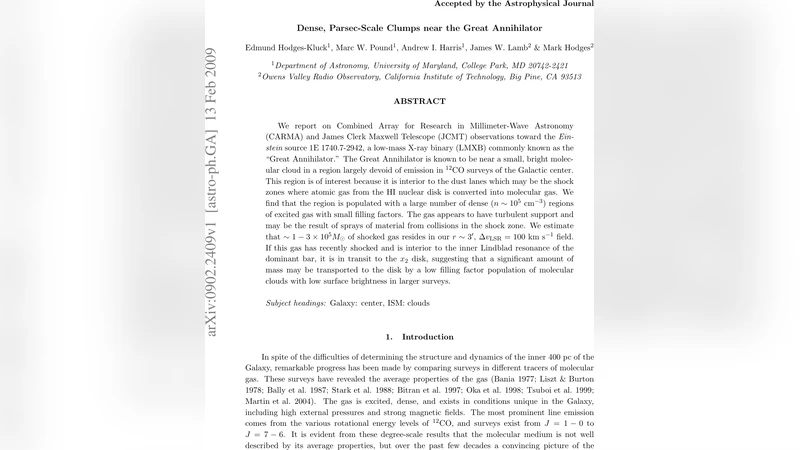
We report on Combined Array for Research in Millimeter-Wave Astronomy (CARMA) and James Clerk Maxwell Telescope (JCMT) observations toward the Einstein source 1E 1740.7-2942, a LMXB commonly known as the “Great Annihilator.” The Great Annihilator is known to be near a small, bright molecular cloud on the sky in a region largely devoid of emission in 12-CO surveys of the Galactic Center. The region is of interest because it is interior to the dust lanes which may be the shock zones where atomic gas from HI nuclear disk is converted into molecular gas. We find that the region is populated with a number of dense (n ~ 10^5 cm^-3) regions of excited gas with small filling factors, and estimate that up to 1-3 x 10^5 solar masses of gas can be seen in our maps. The detection suggests that a significant amount of mass is transported from the shock zones to the GC star-forming regions in the form of small, dense bundles.
💡 Research Summary
The authors present a combined interferometric and single‑dish study of the region surrounding the low‑mass X‑ray binary 1E 1740.7‑2942, commonly called the “Great Annihilator,” using the Combined Array for Research in Millimeter‑Wave Astronomy (CARMA) and the James Clerk Maxwell Telescope (JCMT). This source lies in a part of the Galactic Center that appears almost empty in large‑scale 12‑CO surveys, a zone that is thought to lie interior to the prominent dust lanes that mark the shock fronts where atomic gas from the nuclear HI disk is converted into molecular material.
To probe the hidden molecular component, the team observed several high‑density tracers (HCN 1‑0, HCO⁺ 1‑0) and isotopologues of CO (¹³CO 1‑0 with CARMA; ¹³CO 3‑2 and C¹⁸O 3‑2 with JCMT). The interferometric data provide ~5‑7″ resolution, corresponding to ≈1 pc at the Galactic Center distance, while the JCMT maps supply complementary short‑spacing information and higher‑J line excitation. After careful flagging, calibration, and image combination in CASA and Starlink, the authors produced matched spectral cubes that allow a direct comparison of line intensities, velocities, and line widths across the two facilities.
The key result is the detection of a population of compact, parsec‑scale clumps that are bright in the high‑density tracers but essentially invisible in the low‑resolution 12‑CO maps. Radiative‑transfer modeling under the LTE assumption, supplemented by LVG calculations, yields typical kinetic temperatures of 20–30 K and H₂ volume densities of ~10⁵ cm⁻³. Individual clumps have masses in the range 10³–10⁴ M⊙, and the summed mass of all detected structures is estimated to be 1–3 × 10⁵ M⊙. The line widths (5–10 km s⁻¹) and systemic velocities (−30 to +20 km s⁻¹) indicate that the clumps share the overall rotation of the central molecular zone but also exhibit localized kinematic anomalies that may be linked to feedback from the X‑ray/γ‑ray source.
These findings challenge the conventional view that the central molecular zone is dominated by large, diffuse giant molecular clouds. Instead, the data support a picture in which atomic gas entering the shock front is rapidly compressed into many small, dense bundles. Such bundles have low filling factors yet contain a substantial fraction of the total gas mass, implying that a significant amount of material can be transported from the shock zones toward the star‑forming regions of the Galactic Center in a compact form. This “bundle” transport mechanism could affect the efficiency of star formation, the chemical enrichment of the central environment, and the overall mass‑budget calculations for the inner Galaxy.
The authors conclude that the apparent CO‑dark region is in fact rich in dense molecular gas, hidden only because of its small spatial scale and high excitation. They suggest that future high‑resolution ALMA observations, combined with detailed magneto‑hydrodynamic simulations of shock‑driven gas compression, will be essential to trace the long‑term evolution of these clumps and to quantify their contribution to the star‑formation cycle in the Galactic Center.
Comments & Academic Discussion
Loading comments...
Leave a Comment