Mass Outflow in the Seyfert 1 Galaxy NGC 5548
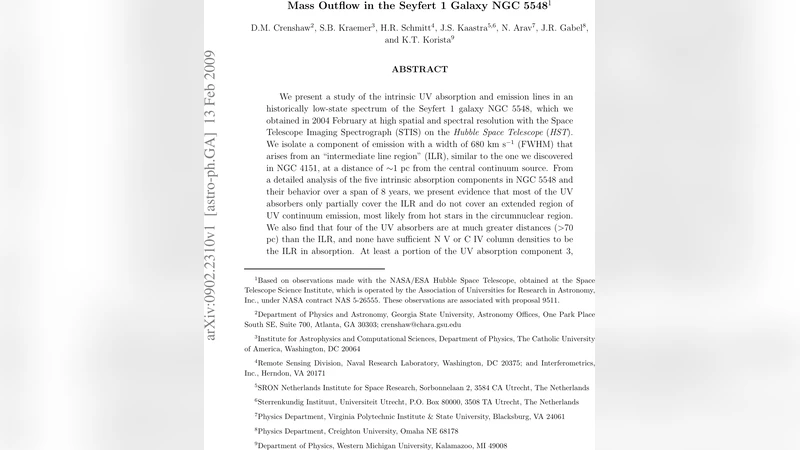
We present a study of the intrinsic UV absorption and emission lines in an historically low-state spectrum of the Seyfert 1 galaxy NGC 5548, which we obtained in 2004 February at high spatial and spectral resolution with the Space Telescope Imaging Spectrograph (STIS) on the Hubble Space Telescope. We isolate a component of emission with a width of 680 km/s (FWHM) that arises from an “intermediate line region” (ILR), similar to the one we discovered in NGC 4151, at a distance of ~1 pc from the central continuum source. From a detailed analysis of the five intrinsic absorption components in NGC 5548 and their behavior over a span of 8 years, we present evidence that most of the UV absorbers only partially cover the ILR and do not cover an extended region of UV continuum emission, most likely from hot stars in the circumnuclear region. We also find that four of the UV absorbers are at much greater distances (>70 pc) than the ILR, and none have sufficient N V or C IV column densities to be the ILR in absorption. At least a portion of the UV absorption component 3, at a radial velocity of -530 km/s, is likely responsible for most of the X-ray absorption, at a distance < 7 pc from the central source. The fact that we see the ILR in absorption in NGC 4151 and not in NGC 5548 suggests that the ILR is located at a relatively large polar angle (~45 degrees) with respect to the narrow-line region outflow axis.
💡 Research Summary
This paper presents a comprehensive study of the intrinsic ultraviolet (UV) absorption and emission lines in the Seyfert 1 galaxy NGC 5548, based on a high‑resolution, high‑spatial‑resolution spectrum obtained with the Space Telescope Imaging Spectrograph (STIS) on the Hubble Space Telescope in February 2004. The authors focus on isolating an “intermediate line region” (ILR) that exhibits a full‑width at half‑maximum (FWHM) of about 680 km s⁻¹, a component previously identified in NGC 4151. By modeling the line profiles, they infer that the ILR is located roughly 1 pc from the central continuum source, occupying a physical regime between the classic broad‑line region (BLR) and the narrow‑line region (NLR).
The spectrum reveals five distinct intrinsic UV absorption components (labeled A–E) spanning a radial velocity range of roughly –530 km s⁻¹ to –1500 km s⁻¹. The authors track the behavior of these components over an eight‑year interval (1996–2004), using archival HST data to assess variability in column densities, covering factors, and ionization states. Their analysis shows that most UV absorbers partially cover the ILR but do not obscure an extended UV continuum source, which they attribute to hot stars in the circumnuclear region. This partial covering implies that the absorbers lie at relatively high polar angles (≈45°) with respect to the axis of the NLR outflow, intersecting the line of sight to the ILR but missing the more spatially extended stellar continuum.
Component 3, with a radial velocity of –530 km s⁻¹, stands out because it possesses the highest N V and C IV column densities among the absorbers. Photoionization modeling indicates that this component is also responsible for the bulk of the X‑ray warm absorber detected in simultaneous Chandra observations. The inferred distance for component 3 is < 7 pc from the central engine, placing it well within the region traditionally associated with the “warm absorber” phenomenon. In contrast, the other four components are located at distances greater than 70 pc, far outside the ILR, and their column densities are insufficient to produce detectable ILR absorption.
The authors compare these findings with the situation in NGC 4151, where the ILR is seen both in emission and absorption. They argue that the difference arises from geometric orientation: in NGC 4151 the ILR lies at a lower polar angle, intersecting the observer’s line of sight and therefore appearing in absorption, whereas in NGC 5548 the ILR is positioned at a larger polar angle, so the line of sight to the continuum source bypasses the ILR, resulting in pure emission.
Methodologically, the paper demonstrates the power of combining high‑resolution UV spectroscopy with multi‑epoch monitoring and X‑ray data to disentangle the complex, multi‑scale structure of AGN outflows. By deriving covering factors, distances, and ionization parameters for each absorber, the study provides a detailed map of the outflow geometry: a compact, high‑ionization component close to the nucleus (component 3) that likely contributes to the X‑ray warm absorber, and more distant, lower‑ionization clouds that affect only the UV spectrum.
Overall, this work advances our understanding of Seyfert galaxy outflows by revealing that the ILR is a distinct, pc‑scale emission region that can be partially obscured by intervening absorbers depending on the system’s orientation. It underscores the importance of considering both emission and absorption diagnostics across multiple wavelengths to fully characterize the mass‑loss processes that regulate the energetics and evolution of active galactic nuclei.
Comments & Academic Discussion
Loading comments...
Leave a Comment