Molecular and Atomic Gas in the Large Magellanic Cloud - I. Conditions for CO Detection
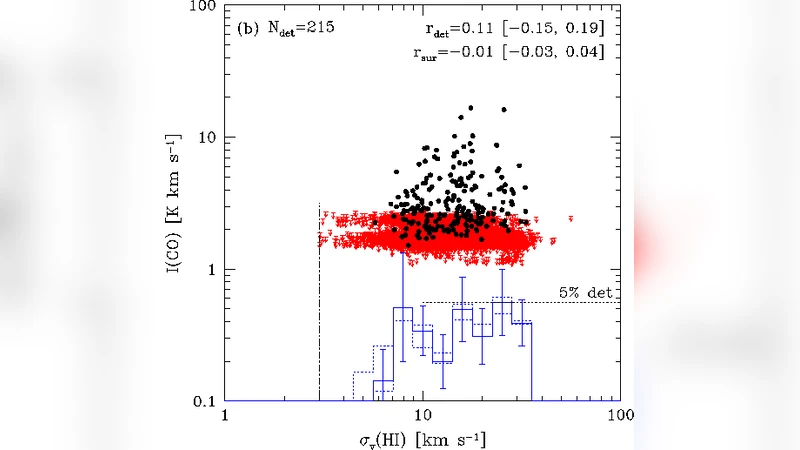
We analyze the conditions for detection of CO(1-0) emission in the Large Magellanic Cloud (LMC), using the recently completed second NANTEN CO survey. In particular, we investigate correlations between CO integrated intensity and HI integrated intensity, peak brightness temperature, and line width at a resolution of 2.6’ (~40 pc). We find that significant HI column density and peak brightness temperature are necessary but not sufficient conditions for CO detection, with many regions of strong HI emission not associated with molecular clouds. The large scatter in CO intensities for a given HI intensity persists even when averaging on scales of >200 pc, indicating that the scatter is not solely due to local conversion of HI into H_2 near GMCs. We focus on two possibilities to account for this scatter: either there exist spatial variations in the I(CO) to N(H_2) conversion factor, or a significant fraction of the atomic gas is not involved in molecular cloud formation. A weak tendency for CO emission to be suppressed for large HI linewidths supports the second hypothesis, insofar as large linewidths may be indicative of warm HI, and calls into question the likelihood of forming molecular clouds from colliding HI flows. We also find that the ratio of molecular to atomic gas shows no significant correlation (or anti-correlation) with the stellar surface density, though a correlation with midplane hydrostatic pressure P_h is found when the data are binned in P_h. The latter correlation largely reflects the increasing likelihood of CO detection at high HI column density.
💡 Research Summary
This paper investigates the environmental conditions that govern the detection of CO (1‑0) emission in the Large Magellanic Cloud (LMC) using the recently completed second‑generation NANTEN CO survey. The authors work at a spatial resolution of 2.6′ (≈ 40 pc) and compare CO integrated intensity (I_CO) with three HI properties measured at the same resolution: total HI column density (I_HI), peak brightness temperature (T_B,HI), and line width (ΔV_HI).
The first major finding is that a high HI column density (∼10^21 cm⁻²) and a high HI peak temperature (∼60 K) are necessary prerequisites for CO detection, but they are not sufficient. Many regions that exceed these thresholds show no CO emission, indicating that additional physical conditions—such as sufficient pressure, shielding, or low kinetic temperature—are required for the conversion of atomic to molecular gas.
Second, for a given I_HI the CO intensity exhibits a scatter of more than an order of magnitude. This large dispersion persists even when the data are averaged over scales larger than 200 pc, demonstrating that the scatter cannot be explained solely by local HI‑to‑H₂ conversion near individual giant molecular clouds (GMCs). The authors propose two possible explanations: (1) spatial variations in the CO‑to‑H₂ conversion factor (X_CO), or (2) a substantial fraction of the atomic gas is not participating in molecular cloud formation, perhaps remaining in a warm, diffuse phase.
Third, a weak anti‑correlation is observed between CO detection and HI line width. Broad HI lines, which likely trace warm or highly turbulent atomic gas, appear to suppress CO emission. This result challenges models in which colliding HI flows efficiently produce cold, dense clouds, suggesting that large‑scale turbulence or heating may inhibit molecular cloud formation in parts of the LMC.
The authors also explore the relationship between CO detection and the underlying stellar environment. No significant correlation (or anti‑correlation) is found between CO intensity and stellar surface density (Σ★). However, when the data are binned by mid‑plane hydrostatic pressure (P_h), a trend emerges: higher P_h bins show an increased likelihood of CO detection. This pressure dependence is largely driven by the fact that high‑pressure regions also have high HI column densities, reinforcing the idea that a high atomic column is a primary driver for CO visibility.
In summary, the study concludes that CO detection in the LMC requires (i) a sufficiently high HI column and peak temperature, (ii) relatively narrow HI line widths (indicative of cooler atomic gas), and (iii) likely favorable local pressure conditions. The persistent scatter in I_CO at fixed I_HI points to either spatially varying X_CO or the presence of CO‑dark molecular gas that is not traced by CO emission. The findings caution against using CO alone as a universal tracer of H₂ in low‑metallicity, irregular galaxies and underscore the need for complementary tracers such as
Comments & Academic Discussion
Loading comments...
Leave a Comment