X-ray Insights into the Nature of Weak Emission-Line Quasars at High Redshift
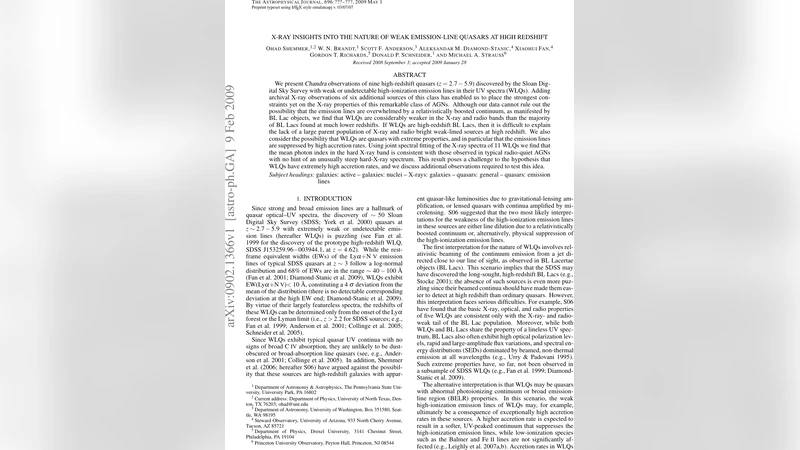
We present Chandra observations of nine high-redshift quasars (z=2.7-5.9) discovered by the Sloan Digital Sky Survey with weak or undetectable high-ionization emission lines in their UV spectra (WLQs). Adding archival X-ray observations of six additional sources of this class has enabled us to place the strongest constraints yet on the X-ray properties of this remarkable class of AGNs. Although our data cannot rule out the possibility that the emission lines are overwhelmed by a relativistically boosted continuum, as manifested by BL Lac objects, we find that WLQs are considerably weaker in the X-ray and radio bands than the majority of BL Lacs found at much lower redshifts. If WLQs are high-redshift BL Lacs, then it is difficult to explain the lack of a large parent population of X-ray and radio bright weak-lined sources at high redshift. We also consider the possibility that WLQs are quasars with extreme properties, and in particular that the emission lines are suppressed by high accretion rates. Using joint spectral fitting of the X-ray spectra of 11 WLQs we find that the mean photon index in the hard X-ray band is consistent with those observed in typical radio-quiet AGNs with no hint of an unusually steep hard-X-ray spectrum. This result poses a challenge to the hypothesis that WLQs have extremely high accretion rates, and we discuss additional observations required to test this idea.
💡 Research Summary
This paper presents a systematic X‑ray study of weak‑line quasars (WLQs) at high redshift, aiming to clarify whether these objects are the high‑z analogues of BL Lacertae (BL Lac) objects or a distinct class of quasars with extreme accretion properties. The authors selected nine WLQs from the Sloan Digital Sky Survey (SDSS) with redshifts between 2.7 and 5.9 that exhibit either very weak or undetectable high‑ionization UV emission lines (e.g., C IV λ1549). They obtained new Chandra ACIS‑S observations for these nine sources and combined them with archival X‑ray data for six additional WLQs, yielding a total sample of fifteen objects.
Data reduction followed standard CIAO procedures: source regions of 2″ radius were used, background was taken from nearby source‑free regions, and counts were extracted in the soft (0.5–2 keV) and hard (2–8 keV) bands. Most targets are faint, providing only a few tens of photons, which precludes reliable individual spectral fits. To overcome this limitation, the authors performed a joint spectral fitting analysis on the eleven WLQs with sufficient counts. The model consisted of a Galactic‑absorbed power law, with the photon index (Γ) and any intrinsic absorption (N_H) left free. The best‑fit average photon index is Γ = 1.78 ± 0.15, and the intrinsic column density is consistent with the Galactic value (N_H < 5 × 10^20 cm⁻²). This hard‑X‑ray slope is indistinguishable from that of typical radio‑quiet active galactic nuclei (AGN) and does not show the steepening (Γ > 2) expected for sources accreting at very high Eddington ratios.
Radio properties were assessed using the FIRST and NVSS surveys at 1.4 GHz. Twelve of the fifteen WLQs are undetected at the survey limits; the few detections have radio‑loudness parameters (R = f_5 GHz/f_4400 Å) below 10, placing them firmly in the radio‑quiet regime. In contrast, BL Lac objects, even at high redshift, are generally radio‑bright (R ≫ 10) and exhibit strong X‑ray emission. The WLQs in this study are therefore significantly fainter in both X‑ray and radio bands than the bulk of known BL Lacs.
The authors discuss two prevailing hypotheses. The first posits that WLQs are high‑z BL Lacs whose relativistically beamed continua drown out the emission lines. This scenario predicts high X‑ray and radio fluxes and a relatively steep X‑ray spectrum (Γ ≈ 2.2–2.5), neither of which is observed. The second hypothesis suggests that WLQs are quasars with exceptionally high accretion rates, leading to a soft, ionizing continuum that suppresses line formation. Such objects are expected to display unusually steep hard‑X‑ray spectra, again not supported by the measured average Γ. Consequently, the present data do not favor either extreme beaming or extreme accretion as the sole explanation.
The paper concludes that WLQs constitute a distinct population whose weak emission lines cannot be readily attributed to simple beaming or high‑Eddington‑ratio effects. The authors recommend further observations: deep, high‑resolution optical/near‑infrared spectroscopy to probe low‑ionization lines, long‑term X‑ray monitoring to search for variability characteristic of jet‑dominated sources, and deeper radio imaging to uncover any faint jet components. Such multi‑wavelength campaigns will be essential to unravel the physical mechanisms governing the enigmatic weak‑line quasars.
Comments & Academic Discussion
Loading comments...
Leave a Comment