X-Ray Insights Into the Physics of Mini-BAL Quasar Outflows
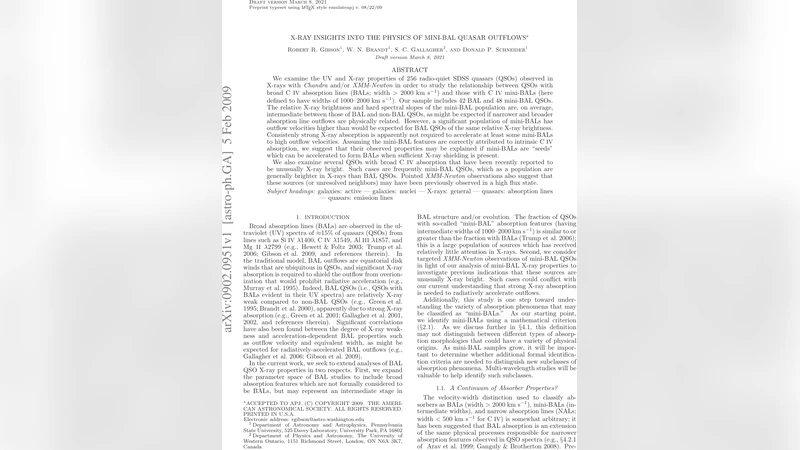
We examine the UV and X-ray properties of 256 radio-quiet SDSS quasars (QSOs) observed in X-rays with Chandra and/or XMM-Newton in order to study the relationship between QSOs with broad CIV absorption lines (BALs; width >2000 km/s) and those with CIV mini-BALs (here defined to have widths of 1000–2000 km/s). Our sample includes 42 BAL and 48 mini-BAL QSOs. The relative X-ray brightness and hard spectral slopes of the mini-BAL population are, on average, intermediate between those of BAL and non-BAL QSOs, as might be expected if narrower and broader absorption line outflows are physically related. However, a significant population of mini-BALs has outflow velocities higher than would be expected for BAL QSOs of the same relative X-ray brightness. Consistenly strong X-ray absorption is apparently not required to accelerate at least some mini-BALs to high outflow velocities. Assuming the mini-BAL features are correctly attributed to intrinsic CIV absorption, we suggest that their observed properties may be explained if mini-BALs are “seeds” which can be accelerated to form BALs when sufficient X-ray shielding is present. We also examine several QSOs with broad CIV absorption that have been recently reported to be unusually X-ray bright. Such cases are frequently mini-BAL QSOs, which as a population are generally brighter in X-rays than BAL QSOs. Pointed XMM-Newton observations also suggest that these sources (or unresolved neighbors) may have been previously observed in a high flux state.
💡 Research Summary
The authors present a systematic investigation of the ultraviolet (UV) and X‑ray properties of a well‑defined sample of 256 radio‑quiet quasars (QSOs) drawn from the Sloan Digital Sky Survey (SDSS) and observed with the Chandra and XMM‑Newton observatories. The primary goal is to explore the physical relationship between quasars that exhibit broad C IV absorption lines (BALs, defined as having full‑width at half‑maximum > 2000 km s⁻¹) and those that show narrower “mini‑BAL” features (widths between 1000 and 2000 km s⁻¹). The sample contains 42 BAL QSOs, 48 mini‑BAL QSOs, and the remaining objects are classified as non‑BAL.
X‑ray spectral analysis was performed in the 0.5–8 keV band. For each source the authors derived the X‑ray flux density at 2 keV, the UV flux density at 2500 Å, and calculated the standard α_ox index, which quantifies the relative X‑ray to UV brightness. The deviation from the expected α_ox for a given UV luminosity, Δα_ox, serves as a proxy for X‑ray absorption. BAL quasars display a median Δα_ox ≈ –0.5, indicating strong X‑ray weakness, while mini‑BALs have a median Δα_ox ≈ –0.2, placing them intermediate between BALs and non‑BALs, which show Δα_ox ≈ 0. The photon index (Γ) of the X‑ray power‑law continuum also follows a trend: BALs are hardest (Γ ≈ 1.5), mini‑BALs are moderately hard (Γ ≈ 1.8), and non‑BALs are softest (Γ ≈ 2.0).
A key finding is that a substantial subset of mini‑BAL quasars reaches very high outflow velocities (v_max > 15 000 km s⁻¹) despite having Δα_ox values close to zero, i.e., without the strong X‑ray shielding that is traditionally invoked to protect the outflowing gas from over‑ionization. This challenges the canonical picture in which a thick X‑ray absorbing “shield” is a prerequisite for accelerating high‑velocity winds. The authors propose that mini‑BALs represent an early “seed” stage of outflow development: when sufficient shielding material accumulates, these seeds can evolve into full‑blown BALs. This scenario dovetails with radiation‑pressure driven wind models that incorporate a radiatively compressed shielding layer.
The paper also revisits several quasars previously reported as unusually X‑ray bright despite showing broad C IV absorption. Upon re‑examination, many of these objects are re‑classified as mini‑BALs, which as a class are on average brighter in X‑rays than BALs. The authors note that pointed XMM‑Newton observations sometimes capture these sources in a high‑flux state or include unresolved neighboring sources, suggesting that variability or source confusion may have contributed to the apparent X‑ray brightness.
Statistical tests (Kolmogorov‑Smirnov and Spearman rank correlation) confirm that Δα_ox and v_max are strongly anti‑correlated for BAL quasars (ρ ≈ –0.6, p < 0.01), whereas the correlation is weak and statistically insignificant for mini‑BALs (ρ ≈ –0.2, p ≈ 0.15). This reinforces the idea that while BALs and mini‑BALs share a common outflow mechanism, the degree of X‑ray shielding modulates both the observed X‑ray weakness and the maximum attainable velocity.
In conclusion, the study provides compelling evidence that mini‑BALs occupy an intermediate physical regime between non‑BAL quasars and classic BAL quasars. Their X‑ray properties suggest that strong shielding is not universally required for achieving high outflow speeds, and that mini‑BALs may evolve into BALs when environmental conditions (e.g., increased column density of shielding gas) become favorable. The authors advocate for future high‑resolution X‑ray spectroscopy (e.g., with XRISM and Athena) and long‑term monitoring campaigns to map the ionization state, column density, and variability of the shielding gas, thereby refining our understanding of quasar wind launching, acceleration, and their role in galaxy‑scale feedback.
Comments & Academic Discussion
Loading comments...
Leave a Comment