Disk-Braking in Young Stars: Probing Rotation in Chamaeleon I and Taurus-Auriga
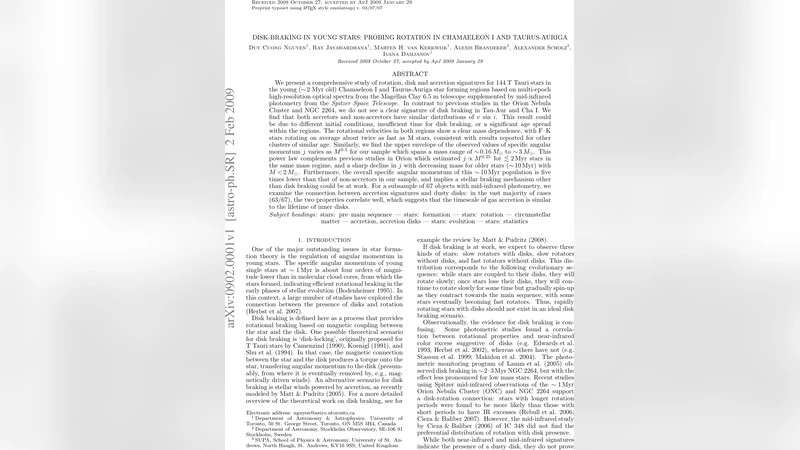
We present a comprehensive study of rotation, disk and accretion signatures for 144 T Tauri stars in the young (~2 Myr old) Chamaeleon I and Taurus-Auriga star forming regions based on multi-epoch high-resolution optical spectra from the Magellan Clay 6.5 m telescope supplemented by mid-infared photometry from the Spitzer Space Telescope. In contrast to previous studies in the Orion Nebula Cluster and NGC 2264, we do not see a clear signature of disk braking in Tau-Aur and Cha I. We find that both accretors and non-accretors have similar distributions of v sin i. The rotational velocities in both regions show a clear mass dependence, with F–K stars rotating on average about twice as fast as M stars, consistent with results reported for other clusters of similar age. Similarly, we find the upper envelope of the observed values of specific angular momentum j varies as M^0.5 for our sample which spans a mass range of ~0.16 to ~3 M_sun. This power law complements previous studies in Orion which estimated j is proportional to M^0.25 for < ~2 Myr stars in the same mass regime, and a sharp decline in j with decreasing mass for older stars (~10 Myr) with M < 2 M_sun. For a subsample of 67 objects with mid-IR photometry, we examine the connection between accretion signatures and dusty disks: in the vast majority of cases (63/67), the two properties correlate well, which suggests that the timescale of gas accretion is similar to the lifetime of inner disks.
💡 Research Summary
This paper presents a systematic investigation of stellar rotation, circumstellar disks, and accretion signatures for 144 T Tauri stars in the ~2 Myr‑old Chamaeleon I and Taurus‑Auriga star‑forming regions. High‑resolution optical spectra were obtained over multiple epochs with the Magellan Clay 6.5 m telescope, providing precise projected rotational velocities (v sin i) and accretion diagnostics (Hα 10 % width, Ca II 8542 Å). Mid‑infrared photometry from the Spitzer Space Telescope (IRAC 3.6–8.0 µm) was used to identify infrared excesses indicative of dusty inner disks.
The authors find a clear mass dependence of rotation: F–K type stars (≈0.8–3 M☉) rotate on average about twice as fast as M‑type stars (≈0.2–0.8 M☉). This mirrors results from other ~2 Myr clusters. Specific angular momentum (j) follows a power‑law j ∝ M^0.5 across the sampled mass range (0.16–3 M☉), a steeper dependence than the j ∝ M^0.25 reported for Orion’s similarly young stars, and markedly different from the sharp decline of j with decreasing mass observed in older (≈10 Myr) populations.
Contrary to earlier studies of the Orion Nebula Cluster and NGC 2264, the present work does not detect a statistically significant “disk‑braking” signature in either region. Accretors and non‑accretors share indistinguishable v sin i distributions, indicating that the presence of a disk does not, at this age and in these environments, produce a measurable slowdown of stellar rotation.
For the subset of 67 objects with reliable Spitzer photometry, 63 (≈94 %) show a one‑to‑one correspondence between accretion indicators and infrared excess. This strong correlation implies that the timescales for gas accretion and inner‑disk dust dissipation are essentially the same, supporting models in which gas and dust are removed concurrently from the inner disk.
The authors discuss the implications of these findings for angular‑momentum evolution. The lack of observable disk‑braking suggests that magnetic star‑disk coupling may be less efficient, or that the coupling timescale is shorter than the age of the sample, allowing stars to retain much of their initial angular momentum. The observed j–mass scaling provides a benchmark for theoretical models of pre‑main‑sequence angular‑momentum loss, indicating that mass‑dependent processes (e.g., stellar winds, magnetic field strength) likely play a dominant role.
Overall, the study combines multi‑epoch high‑resolution spectroscopy with space‑based infrared photometry to deliver a comprehensive picture of rotation, accretion, and disk evolution in two nearby, low‑density star‑forming regions. The results highlight environmental diversity in disk‑braking efficiency and reinforce the close link between gas accretion and inner‑disk lifetimes, offering valuable constraints for future models of early stellar angular‑momentum regulation.
Comments & Academic Discussion
Loading comments...
Leave a Comment