Local Turbulence Simulations for the Multiphase ISM
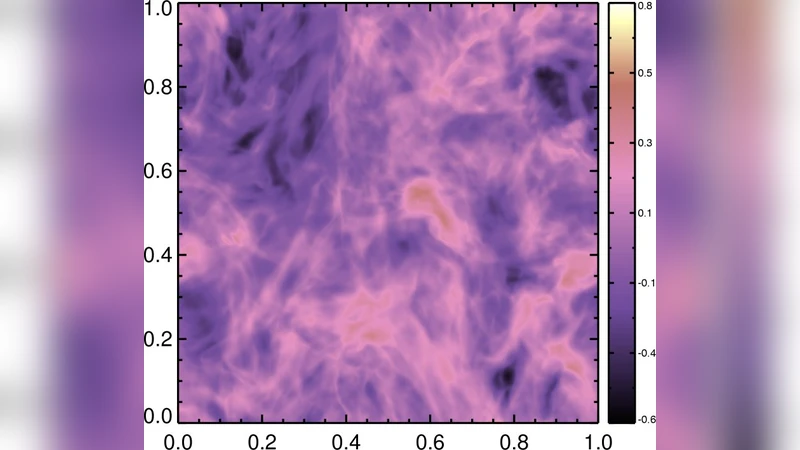
In this paper we show results of numerical simulations for the turbulence in the interstellar medium. These results were obtained using a Riemann solver-free numerical scheme for high-Mach number hyperbolic equations. Here we especially concentrate on the physical properties of the ISM. That is, we do not present turbulence simulations trimmed to be applicable to the interstellar medium. The simulations are rather based on physical estimates for the relevant parameters of the interstellar gas. Applying our code to simulate the turbulent plasma motion within a typical interstellar molecular cloud, we investigate the influence of different equations of state (isothermal and adiabatic) on the statistical properties of the resulting turbulent structures. We find slightly different density power spectra and dispersion maps, while both cases yield qualitatively similar dissipative structures, and exhibit a departure from the classical Kolmogorov case towards a scaling described by the She-Leveque model. Solving the full energy equation with realistic heating/cooling terms appropriate for the diffuse interstellar gas, we are able to reproduce a realistic two-phase distribution of cold and warm plasma. When extracting maps of polarised intensity from our simulation data, we find encouraging similarity to actual observations. Finally, we compare the actual magnetic field strength of our simulations to its value inferred from the rotation measure. We find these to be systematically different by a factor of about 1.5, thus highlighting the often underestimated influence of varying line-of-sight particle densities on the magnetic field strength derived from observed rotation measures.
💡 Research Summary
The paper presents a series of high‑resolution three‑dimensional magnetohydrodynamic (MHD) simulations aimed at reproducing the physical properties of turbulence in the multiphase interstellar medium (ISM). The authors employ a Riemann‑solver‑free scheme specifically designed for high‑Mach‑number hyperbolic equations, which allows them to capture strong shocks and steep pressure gradients without the artificial viscosity that often contaminates conventional shock‑capturing methods. The computational domain is a periodic box resolved with at least 512³ cells, representing a typical molecular cloud with an average density of ~100 cm⁻³. Turbulent motions are driven at large scales to achieve rms Mach numbers between 5 and 10, mimicking the supersonic conditions observed in star‑forming regions.
Two distinct equations of state (EOS) are examined: an isothermal EOS (constant temperature ≈10 K) and an adiabatic EOS (γ ≈ 5/3, temperature ≈30 K). Both runs generate supersonic, compressible turbulence, but the statistical diagnostics reveal subtle differences. The density power spectra follow power‑law slopes of roughly k⁻¹·⁶ for the isothermal case and k⁻¹·⁷ for the adiabatic case, slightly steeper than the classic Kolmogorov k⁻⁵⁄³ expectation. Higher‑order velocity structure functions deviate from Kolmogorov scaling and are well described by the She‑Leveque intermittency model, indicating that thin current sheets and intense shear layers dominate dissipation.
A third set of simulations solves the full energy equation with realistic heating and cooling terms appropriate for diffuse interstellar gas. The cooling function incorporates metal‑line cooling and photoelectric heating following Wolfire et al. (2003). This treatment yields a thermally bistable medium: a cold phase (T ≲ 100 K, n ≳ 10³ cm⁻³) coexists with a warm phase (T ≈ 8000 K, n ≈ 0.5 cm⁻³). The resulting pressure–density diagram reproduces the classic two‑phase equilibrium curve, and the spatial distribution of the phases matches observed filamentary structures in HI and CO surveys.
To connect the simulations with observations, synthetic maps of linear polarisation intensity and rotation measure (RM) are generated from the simulated magnetic field and electron density distributions. The polarisation maps display fragmented, filamentary patterns that closely resemble those seen in real sub‑millimetre polarimetric surveys of molecular clouds. When the magnetic field strength is inferred from the synthetic RM using the standard line‑of‑sight (LOS) formula B‖ ≈ RM/(0.81 ∫ nₑ dl), the derived values are systematically lower than the actual mean field imposed in the simulation (≈5 µG) by a factor of about 1.5. This discrepancy arises because LOS variations in electron density weight the RM signal, leading to an underestimation of the true field strength if a uniform density is assumed.
The authors conclude that (1) the Riemann‑solver‑free scheme is robust for high‑Mach‑number ISM turbulence; (2) both isothermal and adiabatic turbulence exhibit She‑Leveque‑type intermittency, highlighting the role of sheet‑like dissipative structures; (3) incorporating realistic heating and cooling naturally produces the observed two‑phase ISM without ad‑hoc prescriptions; and (4) synthetic observables demonstrate that magnetic field estimates from RM can be biased by up to 50 % due to density fluctuations along the LOS. These findings provide a quantitative bridge between numerical models of turbulent, multiphase ISM and the interpretation of modern polarimetric and RM observations, and they point to the necessity of accounting for density inhomogeneities when deriving magnetic field strengths from Faraday rotation data.
Comments & Academic Discussion
Loading comments...
Leave a Comment