The magnetic field toward the young planetary nebula K~3-35
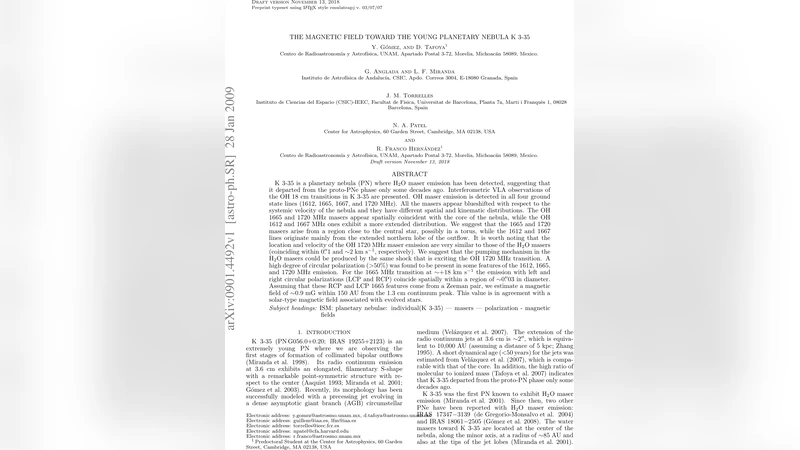
K 3-35 is a planetary nebula (PN) where H2O maser emission has been detected, suggesting that it departed from the proto-PNe phase only some decades ago. Interferometric VLA observations of the OH 18 cm transitions in K~3-35 are presented.OH maser emission is detected in all four ground state lines (1612, 1665, 1667, and 1720 MHz). All the masers appear blueshifted with respect to the systemic velocity of the nebula and they have different spatial and kinematic distributions.The OH 1665 and 1720 MHz masers appear spatially coincident with the core of the nebula, while the OH 1612 and 1667 MHz ones exhibit a more extended distribution. We suggest that the 1665 and 1720 masers arise from a region close to the central star, possibly in a torus, while the 1612 and 1667 lines originate mainly from the extended northern lobe of the outflow. It is worth noting that the location and velocity of the OH 1720 MHz maser emission are very similar to those of the H2O masers (coinciding within 0.1" and ~2 km/s, respectively). We suggest that the pumping mechanism in the H2O masers could be produced by the same shock that is exciting the OH 1720 MHz transition. A high degree of circular polarization (>50%) was found to be present in some features of the 1612, 1665, and 1720 MHz emission.For the 1665 MHz transition at ~ +18 km/s the emission with left and right circular polarizations (LCP and RCP) coincide spatially within a region of ~0.03" in diameter.Assuming that these RCP and LCP 1665 features come from a Zeeman pair, we estimate a magnetic field of ~0.9 mG within 150 AU from the 1.3 cm continuum peak. This value is in agreement with a solar-type magnetic field associated with evolved stars.
💡 Research Summary
The planetary nebula K 3‑35 is an exceptionally young object, as evidenced by the presence of water (H₂O) maser emission that indicates the transition from the proto‑planetary nebula phase occurred only a few decades ago. In this work the authors present Very Large Array (VLA) interferometric observations of all four ground‑state hydroxyl (OH) transitions at 18 cm (1612, 1665, 1667, and 1720 MHz). OH maser emission is detected in every line, and all features are blueshifted relative to the systemic velocity of the nebula (≈ +23 km s⁻¹), suggesting that the masers arise from material on the near side of the expanding envelope.
Spatially, the 1665 MHz and 1720 MHz masers are confined to the central region, coincident within ~0.1″ (≈ 150 AU) of the 1.3 cm continuum peak, whereas the 1612 MHz and 1667 MHz masers are distributed over a more extended area, primarily along the northern lobe of the outflow. This dichotomy points to distinct physical environments: the central masers likely originate in a dense torus or disk close to the central star, while the outer masers trace shocked gas in the bipolar outflow.
A striking result is the near‑identical position and velocity of the OH 1720 MHz maser with respect to the H₂O masers. The two species coincide within 0.1″ and differ by only ~2 km s⁻¹, implying that they are pumped by the same shock front. The 1720 MHz transition is known to be collisionally excited in C‑type shocks, and the simultaneous presence of H₂O masers—also shock‑excited—provides strong observational support for a common shock‑pumping mechanism in K 3‑35.
Polarization analysis reveals a high degree of circular polarization (> 50 %) in several features of the 1612, 1665, and 1720 MHz lines. In particular, the 1665 MHz component near +18 km s⁻¹ shows left‑ and right‑circularly polarized (LCP and RCP) emission that overlap within a region of ~0.03″. Interpreting this pair as a Zeeman split allows an estimate of the line‑of‑sight magnetic field strength. Using the standard Zeeman coefficient for the 1665 MHz transition, the authors derive B‖ ≈ 0.9 mG at a projected distance of ~150 AU from the continuum peak.
This magnetic field strength is consistent with a solar‑type (B ∝ r⁻²) decline expected for evolved stars, and it demonstrates that a measurable magnetic field persists into the early planetary nebula phase. The presence of such a field can influence the shaping of the nebula, potentially contributing to the formation of the observed torus and bipolar outflows.
The authors conclude that K 3‑35 offers a rare laboratory for studying the interplay of shocks, maser excitation, and magnetic fields during the rapid transition from the proto‑planetary nebula to the planetary nebula stage. They suggest that future high‑resolution observations with facilities such as ALMA and VLBI, combined with time‑monitoring of the maser spots, will be essential to map the magnetic field geometry, trace the shock propagation, and refine models of early PN evolution.
Comments & Academic Discussion
Loading comments...
Leave a Comment