Detailed Analysis of Filamentary Structure in the Weibel Instability
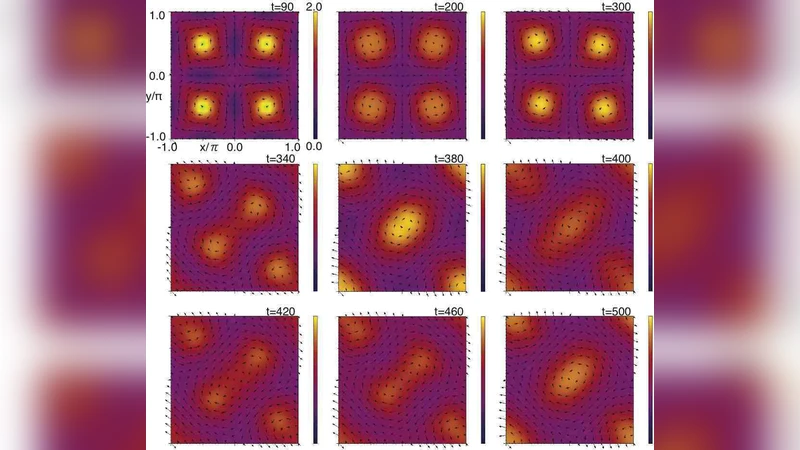
We present results of a 2D3V kinetic Vlasov simulation of the Weibel instability. The kinetic Vlasov simulation allows us to investigate the velocity distribution of dilute plasmas, in which the effect of collisions between particles is negligible, and has the advantage that the accuracy of the calculated velocity distribution does not depend on the density of plasmas at each point in the physical space. We succeed in reproducing some features of the Weibel instability shown by other simulations, for example, the exponentially growing phase, the saturation of the magnetic field strength, the formation of filamentary structure, and the coalescence of the filaments. Especially, we concentrate on the behavior of the filaments after the saturation of the magnetic field strength and find that there is a kind of quasi-equilibrium states before the coalescence occurs. Furthermore, it is found that an analytical solution for stationary states of the 2D3V Vlasov-Maxwell system can reproduce some dominant features of the quasi-equilibrium, e.g, the configuration of the magnetic field and the velocity distribution at each point. The analytical expression could give a plausible model for the transition layer of a collisionless shock where a strong magnetic field generated by the Weibel instability provides an effective dissipation process instead of collisions between particles.
💡 Research Summary
This paper presents a comprehensive kinetic study of the Weibel instability using a two‑dimensional, three‑velocity (2D3V) Vlasov‑Maxwell simulation. The authors chose the Vlasov approach because it directly evolves the continuous distribution functions of electrons and ions, eliminating the statistical noise and density‑dependent accuracy issues that often affect particle‑in‑cell (PIC) methods. The simulation domain is a periodic x‑y plane discretized into a uniform grid; at each spatial node the full three‑dimensional velocity space is resolved for both species. An initially isotropic plasma is perturbed by imposing a modest temperature anisotropy (T⊥ > T∥) in the electron population, which serves as the seed for the Weibel instability. No initial currents or electric fields are present, and the ion‑to‑electron mass ratio is set close to the physical value.
The time evolution naturally separates into three distinct phases. In the first, linear phase, the magnetic field grows exponentially with a rate that matches the analytical prediction γ ≈ (ΔT/T) ωp, confirming that the kinetic treatment correctly captures the instability’s dispersion relation. During the second phase, the magnetic field reaches saturation. At this point, current sheets develop, and the magnetic field becomes concentrated into narrow filamentary structures. The electron and ion velocity distributions inside the filaments become more isotropic, whereas the surrounding plasma retains a significant anisotropy. This redistribution of momentum is accompanied by a pronounced spatial modulation of the current density. In the third phase, neighboring filaments attract each other and merge (coalescence), leading to a progressive increase in the characteristic scale of the magnetic field.
A key observation is the emergence of a quasi‑equilibrium state immediately after saturation but before full coalescence. In this regime, the filament interiors exhibit relatively steady velocity distributions, while the overall filament lattice remains dynamically evolving. To interpret this state, the authors derived an analytical stationary solution of the 2D3V Vlasov‑Maxwell system. The solution consists of thin current sheets whose magnetic field can be expressed as Bz(x,y) = B0 sin(kx) cos(ky). The associated distribution functions are Maxwellian in the bulk with a small spatially periodic perturbation that encodes the temperature anisotropy: fe ≈ f0e exp