A Substantial Dust Disk Surrounding an Actively Accreting First-Ascent Giant Star
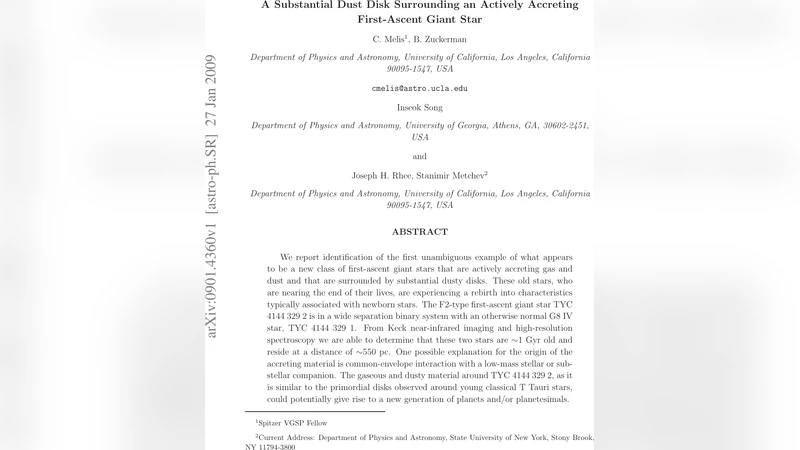
We report identification of the first unambiguous example of what appears to be a new class of first-ascent giant stars that are actively accreting gas and dust and that are surrounded by substantial dusty disks. These old stars, who are nearing the end of their lives, are experiencing a rebirth into characteristics typically associated with newborn stars. The F2-type first-ascent giant star TYC 4144 329 2 is in a wide separation binary system with an otherwise normal G8 IV star, TYC 4144 329 1. From Keck near-infrared imaging and high-resolution spectroscopy we are able to determine that these two stars are $\sim$1 Gyr old and reside at a distance of $\sim$550 pc. One possible explanation for the origin of the accreting material is common-envelope interaction with a low-mass stellar or sub-stellar companion. The gaseous and dusty material around TYC 4144 329 2, as it is similar to the primordial disks observed around young classical T Tauri stars, could potentially give rise to a new generation of planets and/or planetesimals.
💡 Research Summary
The authors present the first unequivocal detection of a first‑ascent giant star that is actively accreting gas and dust while being surrounded by a substantial dusty disk. The object, TYC 4144‑329 2, is an F2‑type giant with an estimated age of ~1 Gyr and lies at a distance of ~550 pc. It forms a wide binary with a normal G8 IV companion, TYC 4144‑329 1, and both stars share consistent radial velocities and photometric properties, confirming their physical association.
High‑resolution spectroscopy obtained with Keck reveals strong emission and absorption in Hα, Ca II K, and Na I D lines, indicating ongoing mass accretion at rates comparable to those observed in classical T Tauri stars. Near‑infrared imaging shows a thick, optically opaque circumstellar disk extending to at least ~10 AU, with an infrared excess corresponding to dust temperatures of 300–500 K and a minimum dust mass of several Earth masses. The disk’s spectral energy distribution and dust composition (silicate and carbonaceous grains of tens of microns) closely resemble primordial protoplanetary disks around young stars.
To explain the origin of this material, the authors propose a common‑envelope interaction with a low‑mass stellar or sub‑stellar companion (e.g., a brown dwarf or massive planet). As the primary star expanded during its ascent of the red‑giant branch, the companion would have been engulfed, leading to envelope ejection and the formation of a circumbinary disk. This scenario accounts for both the presence of fresh gas and dust and the observed accretion signatures.
The discovery challenges the conventional view that evolved giants have lost their disks and are no longer sites of planet formation. Instead, the system provides a rare laboratory where a “reborn” giant hosts a disk capable of forming a new generation of planets or planetesimals. The authors emphasize the need for long‑term monitoring, high‑resolution millimeter interferometry (e.g., ALMA), and detailed hydrodynamic modeling to determine the disk’s structure, longevity, and potential for planet formation. This work opens a new avenue in stellar evolution research, linking late‑stage stellar interactions with renewed circumstellar activity and possible secondary planet formation.
Comments & Academic Discussion
Loading comments...
Leave a Comment