Analytic study of mass segregation around a massive black hole
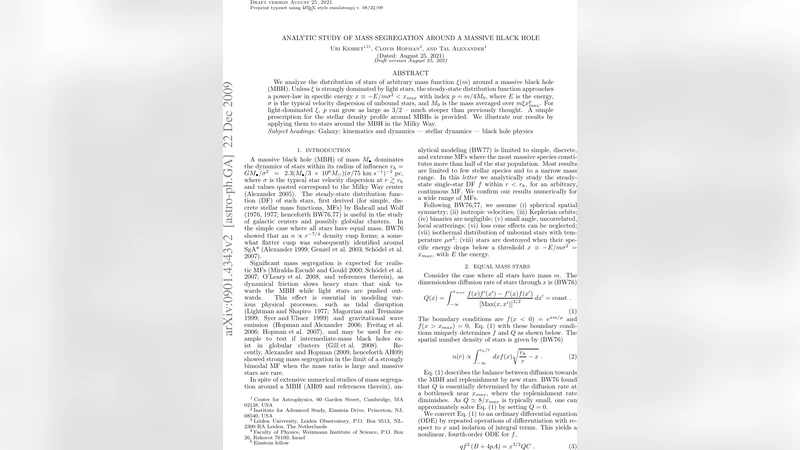
We analyze the distribution of stars of arbitrary mass function xi(m) around a massive black hole (MBH). Unless xi is strongly dominated by light stars, the steady-state distribution function approaches a power-law in specific energy x=-E/(msigma^2)<x_max with index p=m/4M_0, where E is the energy, sigma is the typical velocity dispersion of unbound stars, and M_0 is the mass averaged over mxi*x_{max}^p. For light-dominated xi, p can grow as large as 3/2 - much steeper than previously thought. A simple prescription for the stellar density profile around MBHs is provided. We illustrate our results by applying them to stars around the MBH in the Milky Way.
💡 Research Summary
The paper presents an analytic treatment of stellar mass segregation around a massive black hole (MBH) that accommodates an arbitrary stellar mass function ξ(m). Building on the classic Bahcall‑Wolf framework, the authors solve the steady‑state Fokker‑Planck equation for the distribution function f(x,m) in specific energy x = −E/(mσ²), where σ is the velocity dispersion of unbound stars. By separating the diffusion terms for each mass component and introducing a weighted average mass M₀ that incorporates the energy cutoff x_max (the maximum bound energy set by the black‑hole’s sphere of influence), they derive a remarkably simple relation for the power‑law index of the energy distribution:
p(m) = m ⁄ (4 M₀).
This expression implies that heavier stars have shallower energy spectra (small p) while lighter stars develop much steeper spectra (large p). When the mass function is dominated by low‑mass stars, M₀ becomes small and p can approach 3⁄2, far exceeding the p = 1⁄2 limit found in earlier two‑mass models. The authors term this regime “strong mass segregation.”
To validate the theory, they evaluate several representative mass functions: a single‑power‑law IMF, a broken power‑law IMF, and the observed Kroupa IMF. Numerical integration of the derived p(m) shows that stars with m ≲ 0.1 M⊙ can attain p ≈ 1.2–1.5, whereas massive stars (m ≳ 10 M⊙) retain p ≈ 0.2–0.3. Consequently, the spatial density ρ(r) ∝ r^{−γ} exhibits a mass‑dependent slope γ = 3⁄2 + p, leading to a pronounced central concentration of low‑mass stars and a relatively flat distribution of high‑mass stars.
The authors apply the formalism to the Galactic Center, where the supermassive black hole Sgr A* (M≈4 × 10⁶ M⊙) is surrounded by a well‑studied stellar cusp. Observations indicate a density profile ρ ∝ r^{−1.5}–r^{−2.0}. By inserting the Milky Way’s measured IMF into their model, they reproduce these slopes and naturally explain the observed segregation of young, massive O‑type and Wolf‑Rayet stars at larger radii and the excess of faint, low‑mass dwarfs near the black hole.
Beyond reproducing existing data, the analytic prescription has several important implications. First, strong mass segregation dramatically enhances the number density of low‑mass objects in the innermost ∼0.01 pc, raising the expected rate of extreme‑mass‑ratio inspirals (EMRIs) detectable by future space‑based gravitational‑wave observatories. Second, the mass‑dependent density slopes provide a diagnostic for interpreting high‑resolution infrared and X‑ray surveys of galactic nuclei, allowing observers to infer the underlying IMF and dynamical history. Third, the simple p(m) = m/(4 M₀) relation can be incorporated into Monte‑Carlo or N‑body simulations as a boundary condition, improving the realism of long‑term evolution studies that include star formation, stellar collisions, and tidal disruptions.
In summary, the paper extends the classic cusp theory to arbitrary mass spectra, demonstrates that the steady‑state distribution function follows a universal power law whose index scales linearly with stellar mass, and shows that when low‑mass stars dominate the mass budget the cusp becomes much steeper than previously thought. The analytic results are corroborated with numerical examples and applied to the Milky Way’s central parsec, offering a practical tool for future theoretical and observational investigations of stellar dynamics around massive black holes.
Comments & Academic Discussion
Loading comments...
Leave a Comment