Recovering Stellar Population Properties and Redshifts from Broad-Band Photometry of Simulated Galaxies: Lessons for SED Modeling
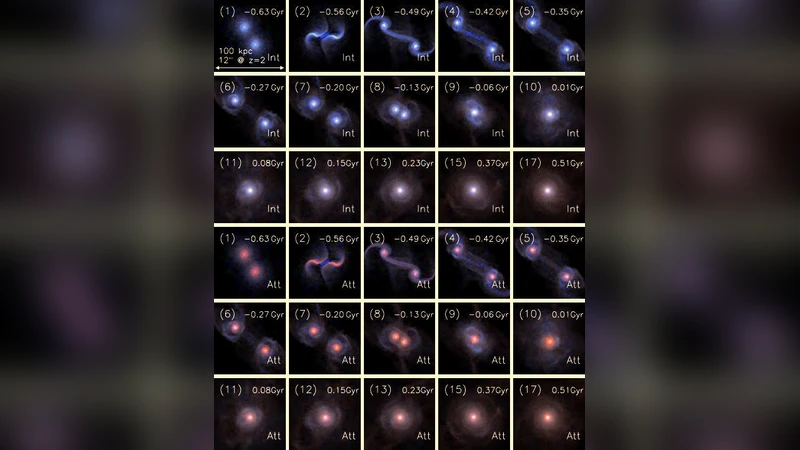
We present a detailed analysis of our ability to determine stellar masses, ages, reddening and extinction values, and star formation rates of high-redshift galaxies by modeling broad-band SEDs with stellar population synthesis. In order to do so, we computed synthetic optical-to-NIR SEDs for model galaxies taken from hydrodynamical merger simulations placed at redshifts 1.5 < z < 3. Viewed under different angles and during different evolutionary phases, the simulations represent a wide variety of galaxy types (disks, mergers, spheroids). We show that simulated galaxies span a wide range in SEDs and color, comparable to these of observed galaxies. In all star-forming phases, dust attenuation has a large effect on colors, SEDs, and fluxes. The broad-band SEDs were then fed to a standard SED modeling procedure and resulting stellar population parameters were compared to their true values. Disk galaxies generally show a decent median correspondence between the true and estimated mass and age, but suffer from large uncertainties. During the merger itself, we find larger offsets (e.g., log M_recovered - log M_true = -0.13^{+0.10}_{-0.14}). E(B-V) values are generally recovered well, but the estimated total visual absorption Av is consistently too low, increasingly so for larger optical depths. Since the largest optical depths occur during the phases of most intense star formation, it is for the highest SFRs that we find the largest underestimates. The masses, ages, E(B-V), Av, and SFR of merger remnants (spheroids) are very well reproduced. We discuss possible biases in SED modeling results caused by mismatch between the true and template star formation history, dust distribution, metallicity variations and AGN contribution.
💡 Research Summary
This paper investigates how accurately the fundamental physical properties of high‑redshift galaxies—stellar mass, stellar age, dust reddening (E(B‑V)), visual extinction (A_V), and current star‑formation rate (SFR)—can be recovered from broadband spectral‑energy‑distribution (SED) fitting. The authors employ a suite of hydrodynamical simulations that produce realistic galaxy models spanning disks, major mergers, and post‑merger spheroids. Each simulated galaxy is placed at redshifts 1.5 < z < 3, observed from multiple viewing angles, and sampled with synthetic photometry that mimics the filter sets of HST/ACS, WFC3, and Spitzer/IRAC, including realistic noise and detection limits.
The synthetic photometric catalogs are then fed into a standard SED‑fitting pipeline that uses widely adopted stellar‑population synthesis models (e.g., BC03) and assumes a limited set of star‑formation histories (SFHs): single‑burst, exponentially declining, and a two‑component composite. Free parameters are stellar mass, age, E(B‑V), A_V, and instantaneous SFR; a Bayesian approach yields best‑fit values and credible intervals.
Key findings are as follows. For disk‑dominated galaxies, the median recovered masses and ages agree with the true simulation values, but the scatter is substantial (≈ ±0.2 dex in mass, ±0.3 Gyr in age). Dust reddening E(B‑V) is generally well recovered, yet visual extinction A_V is systematically underestimated when the true optical depth τ_V exceeds unity, with typical deficits of ~0.3 mag. During the merger phase, biases become more pronounced: stellar masses are on average 0.13 dex lower than the true values, and the uncertainty widens (±0.12 dex). High‑τ_V systems (τ_V > 2) suffer from A_V underestimates of ≥ 0.5 mag and SFR underestimates of ~0.2 dex. The authors attribute these offsets to the concentration of dust in clumpy clouds, which produces an attenuation curve that deviates from the smooth Calzetti law assumed in the templates. Post‑merger spheroids (the remnant ellipticals) show the best agreement across all parameters; mass offsets are < 0.02 dex, age errors < 0.1 Gyr, and dust quantities are accurately retrieved. This improvement reflects the quiescent star‑formation activity and more uniform dust‑metallicity distribution in the remnants, making the simple template assumptions more appropriate.
The paper also examines the impact of active galactic nuclei (AGN) that become luminous during the coalescence phase. When an AGN contributes significantly to the UV–NIR flux, the SED fitting, which assumes purely stellar emission, misattributes part of the light to younger stellar populations, leading to modest mass underestimates (≈ 0.1 dex) and further suppression of the inferred A_V.
Four principal sources of systematic bias are identified: (1) mismatch between the true, often bursty, SFH and the smooth exponential or single‑burst templates; (2) the simplified, uniform dust screen model versus the complex, clumpy dust geometry in the simulations; (3) neglect of metallicity evolution, as the templates usually adopt a fixed Z while the simulated galaxies experience rapid enrichment; and (4) omission of AGN emission in the fitting process.
From an observational standpoint, the authors suggest several mitigations. Adding far‑infrared or sub‑millimeter data (e.g., from ALMA) can constrain the total dust luminosity and break the degeneracy that leads to A_V underestimates in high‑τ_V systems. Mid‑infrared photometry (e.g., JWST/MIRI) can help separate AGN contributions from stellar light. Employing more flexible SFH libraries—such as two‑component models that combine an old exponential with a recent burst—or allowing for variable attenuation curves (e.g., power‑law or mixed screen + birth‑cloud models) reduces mass and age biases. Incorporating metallicity as a free parameter or using a grid of metallicities also improves the fidelity of the recovered stellar ages.
In summary, broadband SED fitting remains a powerful tool for extracting galaxy physical parameters at z ≈ 2, but the method is vulnerable to systematic errors when galaxies experience intense star formation, high dust optical depths, or host luminous AGN. The study underscores the importance of realistic template construction and the value of multi‑wavelength data to alleviate these biases, guiding future surveys that aim to characterize the mass assembly and star‑formation histories of the early universe.
Comments & Academic Discussion
Loading comments...
Leave a Comment