On the triple origin of blue stragglers
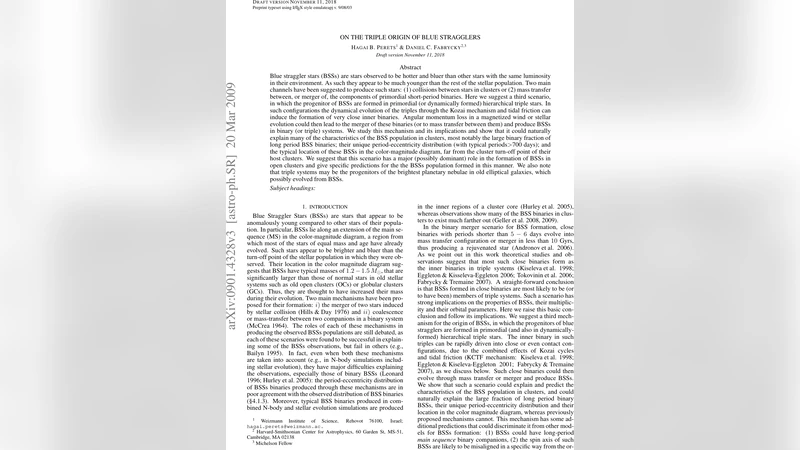
Blue straggler stars (BSSs) are stars observed to be hotter and bluer than other stars with the same luminosity in their environment. As such they appear to be much younger than the rest of the stellar population. Two main channels have been suggested to produce such stars: (1) collisions between stars in clusters or (2) mass transfer between, or merger of, the components of primordial short-period binaries. Here we suggest a third scenario, in which the progenitor of BSSs are formed in primordial (or dynamically formed) hierarchical triple stars. In such configurations the dynamical evolution of the triples through the Kozai mechanism and tidal friction can induce the formation of very close inner binaries. Angular momentum loss in a magnetized wind or stellar evolution could then lead to the merger of these binaries (or to mass transfer between them) and produce BSSs in binary (or triple) systems. We study this mechanism and its implications and show that it could naturally explain many of the characteristics of the BSS population in clusters, most notably the large binary fraction of long period BSS binaries; their unique period-eccentricity distribution (with typical periods > 700 days); and the typical location of these BSSs in the color-magnitude diagram, far from the cluster turn-off point of their host clusters. We suggest that this scenario has a major (possibly dominant) role in the formation of BSSs in open clusters and give specific predictions for the the BSSs population formed in this manner. We also note that triple systems may be the progenitors of the brightest planetary nebulae in old elliptical galaxies, which possibly evolved from BSSs.
💡 Research Summary
The paper tackles the long‑standing puzzle of blue straggler stars (BSSs), which appear hotter and more luminous than the main‑sequence turn‑off in their host stellar populations, giving the impression of being younger than the bulk of the cluster. Two classic formation channels have dominated the discussion: (1) direct stellar collisions in dense environments, and (2) mass transfer or merger within primordial short‑period binaries. The authors propose a third, dynamical pathway that operates in hierarchical triple systems. In such triples, the outer companion induces Kozai‑Lidov oscillations in the inner binary when the mutual inclination lies roughly between 40° and 140°. These oscillations periodically pump the inner binary’s eccentricity to very high values, causing the two inner stars to pass each other at extremely close pericenter distances. Tidal friction then dissipates orbital energy, shrinking the inner orbit on timescales of 10⁶–10⁸ yr. Once the binary becomes sufficiently tight (periods of a few days or less), additional angular‑momentum loss through magnetised stellar winds, or evolutionary expansion of one component, can drive the pair to merge or to commence stable mass transfer. The outcome is a rejuvenated, more massive star – a blue straggler – that remains bound to the distant tertiary, producing a wide (hundreds to thousands of days) BSS binary or, in some cases, a residual triple.
Using analytic estimates combined with N‑body simulations of realistic cluster populations, the authors demonstrate that (i) primordial triples constitute roughly 10 % of all stellar systems, (ii) a sizable fraction of these triples satisfy the inclination and orbital‑parameter criteria for efficient Kozai‑tidal evolution, and (iii) the resulting BSS binaries naturally reproduce three key observational signatures: a high binary fraction (≈70 % of BSSs are in binaries), a period distribution peaked at >700 days, and relatively low eccentricities for those long periods. These features are difficult to reconcile with pure binary‑mass‑transfer models, which predict much shorter periods, and also differ from the outcomes of direct collisions, which tend to produce single BSSs or very tight binaries.
The authors argue that the triple‑induced channel should dominate BSS production in low‑density environments such as open clusters, where stellar collisions are rare. In dense globular clusters, collisions may still be the primary mechanism, but the triple pathway can contribute a non‑negligible fraction, especially in the cluster outskirts where dynamical encounters are less frequent. The paper also outlines several testable predictions: (a) many BSSs should have a distant third companion detectable via long‑term radial‑velocity monitoring or high‑resolution imaging; (b) the mutual inclination distribution of BSS triples should retain a memory of the Kozai‑Lidov excitation, potentially observable through astrometric measurements; (c) BSSs formed via this route are expected to occupy positions on the colour‑magnitude diagram significantly above the turn‑off, consistent with the observed “blue plume” in many clusters.
Finally, the authors speculate that BSSs formed in triples may later evolve into the brightest planetary nebulae observed in old elliptical galaxies, providing a link between stellar dynamics, blue‑straggler formation, and late‑stage stellar evolution on galactic scales.
In summary, the study introduces a robust dynamical mechanism—Kozai‑induced tidal shrinkage in hierarchical triples—that can account for many observed properties of blue stragglers, especially the high binary fraction and long‑period, low‑eccentricity orbits seen in open clusters. The work offers clear observational diagnostics to validate the scenario and suggests that triple systems could play a dominant role in shaping the blue‑straggler populations across diverse stellar environments.
Comments & Academic Discussion
Loading comments...
Leave a Comment