Different types of ultraluminous X-ray sources in NGC 4631
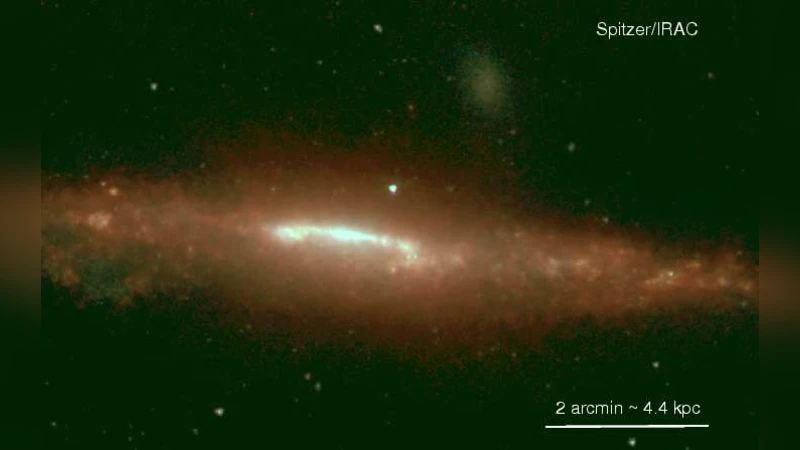
We have re-examined the most luminous X-ray sources in the starburst galaxy NGC 4631, using XMM-Newton, Chandra and ROSAT data. The most interesting source is a highly variable supersoft ULX. We suggest that its bolometric luminosity ~ a few 10^{39} erg/s in the high/supersoft state: this is an order of magnitude lower than estimated in previous studies, thus reducing the need for extreme or exotic scenarios. Moreover, we find that this source was in a non-canonical low/soft (kT ~ 0.1-0.3 keV) state during the Chandra observation. By comparing the high and low state, we argue that the spectral properties may not be consistent with the expected behaviour of an accreting intermediate-mass black hole. We suggest that recurrent super-Eddington outbursts with photospheric expansion from a massive white dwarf (M_{wd} >~ 1.3 M_{sun}), powered by non-steady nuclear burning, may be a viable possibility, in alternative to the previously proposed scenario of a super-Eddington outflow from an accreting stellar-mass black hole. The long-term average accretion rate required for nuclear burning to power such white-dwarf outbursts in this source and perhaps in other supersoft ULXs is ~ 5-10 x 10^{-6} M_{sun}/yr: this is comparable to the thermal-timescale mass transfer rate invoked to explain the most luminous hard-spectrum ULXs (powered by black hole accretion). The other four most luminous X-ray sources in NGC 4631 (three of which can be classified as ULXs) appear to be typical accreting black holes, in four different spectral states: high/soft, convex-spectrum, power-law with soft excess, and simple power-law. None of them requires masses >~ 50 M_{sun}.
💡 Research Summary
The authors re‑examined the five brightest X‑ray sources in the starburst galaxy NGC 4631 using archival XMM‑Newton, Chandra, and ROSAT observations. The most intriguing object, a supersoft ultraluminous X‑ray source (ULX), was found to have a bolometric luminosity of only a few × 10^39 erg s⁻¹ in its high/supersoft state—an order of magnitude lower than earlier estimates. This revision eliminates the need for an extreme intermediate‑mass black hole (IMBH) or exotic super‑Eddington outflows. During a Chandra observation the source was in a low/soft state with a blackbody temperature of 0.1–0.3 keV, and the temperature–luminosity relation does not follow the L ∝ T⁴ trend expected for a standard accretion disk around an IMBH.
Instead, the authors propose that the source is a massive white dwarf (M ≳ 1.3 M⊙) undergoing recurrent, non‑steady nuclear burning. Super‑Eddington outbursts would cause photospheric expansion, producing the observed supersoft emission. To sustain such burning, a long‑term mass‑transfer rate of ~5–10 × 10⁻⁶ M⊙ yr⁻¹ is required, comparable to the thermal‑timescale mass transfer invoked for the most luminous hard‑spectrum ULXs powered by stellar‑mass black holes. This suggests a possible evolutionary link between supersoft ULXs and their hard‑spectrum counterparts.
The remaining four luminous sources (three classified as ULXs) each display a distinct spectral state: a classic high/soft disk‑dominated spectrum, a convex‑shaped spectrum indicative of a hot inner flow, a power‑law with a soft excess, and a simple power‑law. All can be modeled with accreting black holes of ≤ 30 M⊙, and none require masses approaching 50 M⊙ or higher.
Overall, the paper argues that the supersoft ULX in NGC 4631 is better explained by a massive white dwarf undergoing episodic nuclear‑burning outbursts rather than by an IMBH, while the other ULXs conform to standard stellar‑mass black hole accretion states. The work highlights the diversity of ULX phenomenology and underscores the importance of accurate luminosity measurements and multi‑epoch spectral analysis in distinguishing between competing physical models.