Submillimeter Array Observations of the Molecular Outflow in High-mass Star-forming Region G240.31+0.07
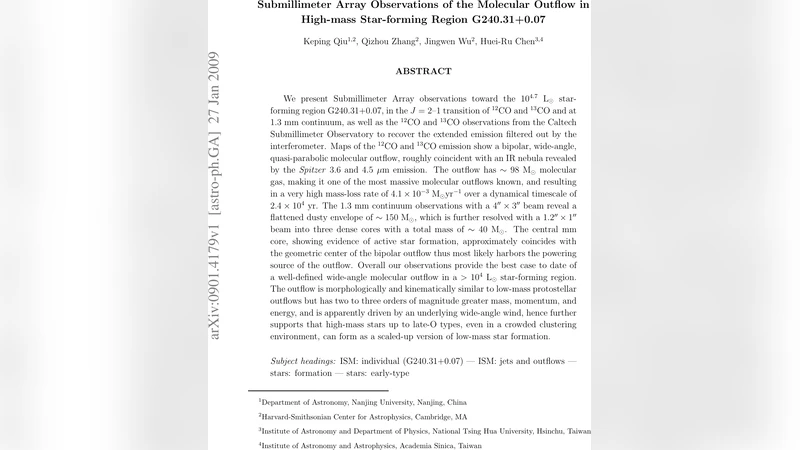
We present Submillimeter Array observations toward the 10^{4.7} Lsun star-forming region G240.31+0.07, in the J=2-1 transition of 12CO and 13CO and at 1.3 mm continuum, as well as the 12CO and 13CO observations from the Caltech Submillimeter Observatory to recover the extended emission filtered out by the interferometer. Maps of the 12CO and 13CO emission show a bipolar, wide-angle, quasi-parabolic molecular outflow, roughly coincident with an IR nebula revealed by the Spitzer 3.6 and 4.5 micron emission. The outflow has ~98 Msun molecular gas, making it one of the most massive molecular outflows known, and resulting in a very high mass-loss rate of 4.1 by 10^{-3} Msun yr^{-1} over a dynamical timescale of 2.4 by 10^4 yr. The 1.3 mm continuum observations with a 4" by 3" beam reveal a flattened dusty envelope of ~150 Msun, which is further resolved with a 1.2" by 1" beam into three dense cores with a total mass of ~40 Msun. The central mm core, showing evidence of active star formation, approximately coincides with the geometric center of the bipolar outflow thus most likely harbors the powering source of the outflow. Overall our observations provide the best case to date of a well-defined wide-angle molecular outflow in a >10^4 Lsun star-forming region. The outflow is morphologically and kinematically similar to low-mass protostellar outflows but has two to three orders of magnitude greater mass, momentum, and energy, and is apparently driven by an underlying wide-angle wind, hence further supports that high-mass stars up to late-O types, even in a crowded clustering environment, can form as a scaled-up version of low-mass star formation.
💡 Research Summary
The authors present a comprehensive study of the high‑mass star‑forming region G240.31+0.07, whose bolometric luminosity is ≈10⁴·⁷ L☉, using the Submillimeter Array (SMA) and complementary single‑dish data from the Caltech Submillimeter Observatory (CSO). The SMA observations target the J = 2–1 transitions of ¹²CO and ¹³CO as well as the 1.3 mm dust continuum, while the CSO data recover the extended, low‑spatial‑frequency emission filtered out by the interferometer. By merging the two data sets the authors obtain fully sampled maps of the molecular gas distribution and kinematics over a field of several arcminutes.
The CO maps reveal a well‑defined, bipolar, wide‑angle outflow with a quasi‑parabolic morphology that closely follows the infrared nebula seen in Spitzer 3.6 µm and 4.5 µm images. The outflow contains an enormous amount of molecular material, ≈98 M☉, making it one of the most massive outflows ever detected. Its dynamical age, estimated from the flow length and characteristic velocity, is ≈2.4 × 10⁴ yr, which implies a mass‑loss rate of 4.1 × 10⁻³ M☉ yr⁻¹. The momentum and kinetic energy of the flow exceed those of typical low‑mass protostellar outflows by two to three orders of magnitude, yet the overall shape and velocity structure (a continuous range from low‑velocity ambient gas to high‑velocity jet‑like components) are strikingly similar to those seen in low‑mass systems.
The 1.3 mm continuum image at 4″ × 3″ resolution shows a flattened dusty envelope of ≈150 M☉ surrounding the outflow source. When the data are imaged at the highest available resolution (≈1″), the envelope resolves into three compact cores with a combined mass of ≈40 M☉. The central core, which exhibits strong 24 µm emission, free‑free radio continuum, and molecular line signatures of active accretion, lies at the geometric centre of the bipolar outflow and is therefore identified as the most likely driving source. The two peripheral cores are less massive and may represent additional sites of future star formation within the same cluster.
A key result of the paper is the demonstration that the outflow is most plausibly driven by a wide‑angle wind rather than a highly collimated jet. The quasi‑parabolic morphology, the broad velocity distribution, and the alignment with the infrared reflection nebula all point to a wind that sweeps up ambient material over a large solid angle. This mechanism, long established for low‑mass protostars, appears to operate unchanged in a region forming late‑O type stars (≈10⁴ L☉) despite the crowded, clustered environment.
The authors discuss the implications for massive star formation theories. Their observations support the “scaled‑up” scenario in which massive stars form via disk‑mediated accretion and launch outflows that are essentially scaled versions of those from low‑mass protostars. The enormous outflow mass, momentum, and energy are simply the result of the higher accretion rates required to build a massive star. The study also highlights the importance of combining interferometric and single‑dish data to capture both compact and extended emission, a methodological point that will be crucial for future high‑resolution ALMA investigations of massive star‑forming cores.
In summary, this work provides the most compelling case to date of a well‑collimated, wide‑angle molecular outflow in a >10⁴ L☉ star‑forming region. It bridges the gap between low‑ and high‑mass star formation, showing that the same physical processes—disk accretion, wide‑angle winds, and feedback‑driven outflows—can operate across a wide range of stellar masses, thereby reinforcing the view that massive stars can form as scaled‑up analogues of their low‑mass counterparts.
Comments & Academic Discussion
Loading comments...
Leave a Comment