Host galaxies, clustering, Eddington ratios, and evolution of radio, X-ray, and infrared-selected AGNs
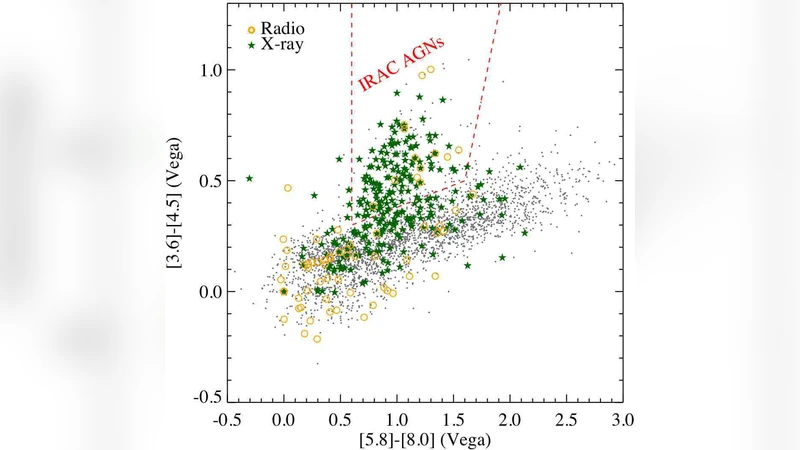
We explore the connection between different classes of active galactic nuclei (AGNs) and the evolution of their host galaxies, by deriving host galaxy properties, clustering, and Eddington ratios of AGNs selected in the radio, X-ray, and infrared. We study a sample of 585 AGNs at 0.25 < z < 0.8 using redshifts from the AGN and Galaxy Evolution Survey (AGES) and data in the radio (WSRT 1.4 GHz), X-rays (Chandra XBootes), and mid-IR (IRAC Shallow Survey). The radio, X-ray, and IR AGN samples show modest overlap, indicating that to the flux limits of the survey, they represent largely distinct classes of AGNs. We derive host galaxy colors and luminosities, as well as Eddington ratios (lambda), for obscured or optically faint AGNs. We also measure the two-point cross-correlation between AGNs and galaxies on scales of 0.3-10 h^-1 Mpc, and derive typical dark matter halo masses. We find that: (1) radio AGNs are mainly found in luminous red galaxies, are strongly clustered (with M_halo ~ 3x10^13 h^-1 M_sun), and have very low lambda <~ 10^-3; (2) X-ray-selected AGNs are preferentially found in galaxies in the “green valley” of color-magnitude space and are clustered similarly to typical AGES galaxies (M_halo ~ 10^13 h^-1 M_sun), with 10^-3 <~ lambda <~ 1; (3) IR AGNs reside in slightly bluer, less luminous galaxies than X-ray AGNs, are weakly clustered (M_halo <~ 10^12 h^-1 M_sun), and have lambda > 10^-2. We interpret these results in terms of a simple model of AGN and galaxy evolution, whereby a “quasar” phase and the growth of the stellar bulge occurs when a galaxy’s dark matter halo reaches a critical mass between ~10^12 and 10^13 M_sun. Subsequently, star formation ceases and AGN accretion shifts from radiatively efficient (optical- and IR- bright) to radiatively inefficient (optically-faint, radio-bright) modes.
💡 Research Summary
This paper investigates how active galactic nuclei (AGNs) selected at radio, X‑ray, and mid‑infrared wavelengths relate to the evolution of their host galaxies. Using the AGN and Galaxy Evolution Survey (AGES) for precise spectroscopic redshifts, the authors assemble a sample of 585 AGNs in the redshift range 0.25 < z < 0.8. The radio sample comes from the WSRT 1.4 GHz survey, the X‑ray sample from Chandra XBootes, and the infrared sample from the IRAC Shallow Survey. Because the three selection methods have modest overlap, each probes a largely distinct AGN population at the flux limits of the surveys.
The authors first derive host‑galaxy properties. Optical photometry provides absolute r‑band magnitudes and rest‑frame (U–V) colors. Radio AGNs are overwhelmingly found in luminous red galaxies—typically massive early‑type systems with colors placing them on the red sequence. X‑ray AGNs preferentially occupy the “green valley,” the transitional region between blue star‑forming and red quiescent galaxies. Infrared AGNs reside in slightly bluer, less luminous hosts, suggesting they are associated with lower‑mass, possibly disk‑dominated systems.
To quantify environment, the two‑point cross‑correlation between each AGN subsample and the full AGES galaxy catalog is measured on scales of 0.3–10 h⁻¹ Mpc. By fitting a Halo Occupation Distribution model to the correlation functions, the typical dark‑matter halo mass (M_halo) for each class is inferred. Radio AGNs are the most strongly clustered, with M_halo ≈ 3 × 10¹³ h⁻¹ M_⊙, indicating residence in massive group or cluster halos. X‑ray AGNs have M_halo ≈ 10¹³ h⁻¹ M_⊙, comparable to the average AGES galaxy, while infrared AGNs are only weakly clustered, with halo masses ≲ 10¹² h⁻¹ M_⊙.
Eddington ratios (λ = L_bol/L_Edd) are estimated for obscured or optically faint AGNs using bolometric corrections from the X‑ray or infrared luminosities and black‑hole mass proxies derived from host‑galaxy stellar masses. Radio AGNs exhibit very low λ ≲ 10⁻³, consistent with radiatively inefficient, jet‑dominated “radio‑mode” accretion. X‑ray AGNs span 10⁻³ ≲ λ ≲ 1, characteristic of radiatively efficient “quasar‑mode” accretion. Infrared AGNs have λ > 10⁻², indicating relatively high accretion efficiency despite residing in low‑mass halos.
The authors interpret these findings within a simple evolutionary framework. When a dark‑matter halo reaches a critical mass of roughly 10¹²–10¹³ M_⊙, rapid cooling of gas fuels both a burst of star formation and a luminous, radiatively efficient quasar phase, during which the stellar bulge and central black hole grow together. As the halo continues to grow, gas supply dwindles, star formation quenches, and accretion switches to a low‑efficiency, jet‑dominated mode. This transition produces the observed sequence: infrared‑selected, high‑λ AGNs in low‑mass halos (early growth), X‑ray‑selected, moderate‑λ AGNs in intermediate‑mass halos (green‑valley transition), and radio‑selected, low‑λ AGNs in massive halos (post‑quenching, radio‑mode).
The study demonstrates that multi‑wavelength AGN selection effectively isolates different stages of black‑hole growth and host‑galaxy evolution, and that halo mass plays a pivotal role in governing the mode of AGN feedback. The authors suggest that deeper surveys and cosmological simulations will be essential to refine the halo‑mass threshold and to explore how environmental processes shape the co‑evolution of galaxies and their central black holes.
Comments & Academic Discussion
Loading comments...
Leave a Comment