Spontaneous Initiation of Detonations in White Dwarf Environments: Determination of Critical Sizes
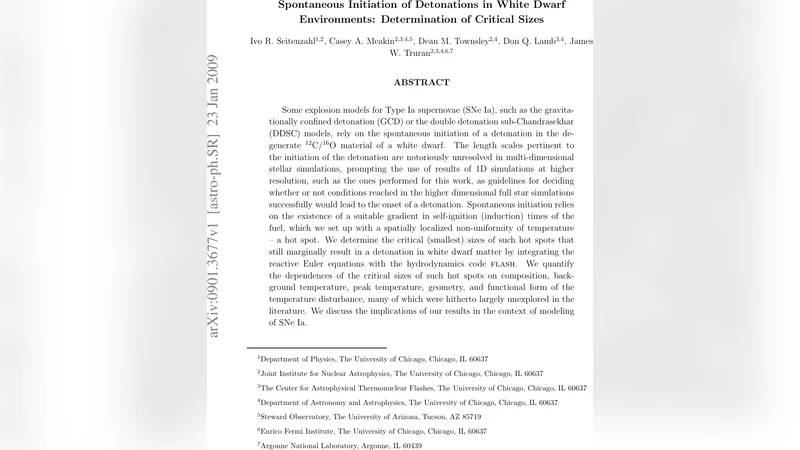
Some explosion models for Type Ia supernovae (SN Ia), such as the gravitationally confined detonation (GCD) or the double detonation sub-Chandrasekhar (DDSC) models, rely on the spontaneous initiation of a detonation in the degenerate C/O material of a white dwarf. The length scales pertinent to the initiation of the detonation are notoriously unresolved in multi-dimensional stellar simulations, prompting the use of results of 1D simulations at higher resolution, such as the ones performed for this work, as guidelines for deciding whether or not conditions reached in the higher dimensional full star simulations successfully would lead to the onset of a detonation. Spontaneous initiation relies on the existence of a suitable gradient in self-ignition (induction) times of the fuel, which we set up with a spatially localized non-uniformity of temperature – a hot spot. We determine the critical (smallest) sizes of such hot spots that still marginally result in a detonation in white dwarf matter by integrating the reactive Euler equations with the hydrodynamics code FLASH. We quantify the dependences of the critical sizes of such hot spots on composition, background temperature, peak temperature, geometry, and functional form of the temperature disturbance, many of which were hitherto largely unexplored in the literature. We discuss the implications of our results in the context of modeling of SNe Ia.
💡 Research Summary
This paper addresses a critical gap in Type Ia supernova modeling: the unresolved length scales at which a spontaneous detonation can be triggered in the degenerate carbon‑oxygen (C/O) material of a white dwarf (WD). In scenarios such as the gravitationally confined detonation (GCD) and double‑detonation sub‑Chandrasekhar (DDSC) models, a detonation must arise from a localized temperature excess—a “hot spot”—that creates a gradient in the fuel’s induction (self‑ignition) time. Because multidimensional stellar simulations cannot resolve the centimeter‑to‑meter scales required for such gradients, the authors perform a series of high‑resolution one‑dimensional (1‑D) simulations using the FLASH hydrodynamics code to determine the smallest hot‑spot sizes that still marginally produce a detonation.
Methodology
The reactive Euler equations are solved with a 13‑species nuclear network (including ⁴He, ¹²C, ¹⁶O, etc.) at a representative WD density of ρ ≈ 10⁹ g cm⁻³. Hot spots are introduced as spatially localized temperature perturbations superimposed on a uniform background. The authors explore three functional forms for the temperature profile: linear decline, Gaussian, and power‑law tails. Peak temperatures (Tₚₑₐₖ) range from 2 × 10⁹ K to 5 × 10⁹ K, while background temperatures (T_bg) span 1 × 10⁸ K to 5 × 10⁸ K. Compositional variations include pure carbon, pure oxygen, and mixed C/O ratios (e.g., 70/30, 50/50, 30/70). Geometry is treated in 1‑D planar, cylindrical, and spherical configurations to assess curvature effects. For each parameter set, a bisection search determines the critical radius R_crit at which a detonation just succeeds.
Key Results
- Composition Dependence – Higher carbon fractions lower the critical radius because carbon burns more rapidly. For Tₚₑₐₖ = 4 × 10⁹ K and T_bg = 3 × 10⁸ K, a C/O = 70/30 mixture requires R_crit ≈ 1.2 cm, whereas a 30/70 mixture needs ≈ 1.8 cm.
- Background Temperature – Raising T_bg from 10⁸ K to 5 × 10⁸ K reduces R_crit by roughly an order of magnitude (from tens of centimeters to a few centimeters). This reflects the exponential sensitivity of induction time to temperature.
- Peak Temperature & Gradient Shape – When Tₚₑₐₖ ≥ 4 × 10⁹ K, the detonation outcome becomes relatively insensitive to the exact shape of the temperature gradient; a detonation almost always follows. At lower Tₚₑₐₖ ≈ 2 × 10⁹ K, Gaussian profiles succeed with about 20 % smaller R_crit than linear ones because the Gaussian concentrates heat more tightly at the center.
- Geometrical Effects – Spherical hot spots require ≈ 1.5 × larger radii than planar ones due to curvature‑induced dilution of the shock front. Cylindrical geometry yields intermediate values.
- Empirical Scaling – The authors find an approximate scaling law R_crit ∝ (ρ · τ_ind)¹ᐟ², where τ_ind is the induction time evaluated at the hot‑spot center. This matches the classic Zeldovich gradient mechanism while providing a quantitative calibration for WD conditions.
Implications for Supernova Modeling
The tabulated critical radii give modelers a practical sub‑grid criterion: if a multidimensional simulation produces a temperature excess larger than the listed R_crit for the local composition and background temperature, a detonation can be assumed to ignite without explicitly resolving the micro‑scale physics. In GCD scenarios, surface‑impact‑generated bubbles typically exceed a few centimeters; the paper shows that for carbon‑rich material and moderate background temperatures, such bubbles are sufficient to trigger a detonation. In DDSC models, the helium‑shell detonation drives a shock into the C/O core; the resulting compression can raise local temperatures to 2–3 × 10⁹ K over scales of a few centimeters, again meeting the criteria identified here.
Limitations and Future Work
The study is confined to 1‑D geometry, thus neglecting turbulence, shear, and multi‑dimensional wave interactions that could either aid or hinder detonation initiation. The nuclear network is limited to 13 species, omitting minor isotopes (e.g., Ne, Mg) that might affect induction times at high densities. The authors recommend extending the analysis to full 3‑D high‑resolution runs and incorporating more comprehensive reaction networks to refine the critical‑size boundaries.
Conclusion
By systematically varying composition, background and peak temperatures, geometry, and temperature‑profile shape, the authors have mapped the parameter space governing spontaneous detonation in white‑dwarf matter. Their results furnish a robust, physics‑based guideline for when a hot spot in a WD will successfully transition to a detonation, thereby bridging the resolution gap that currently hampers realistic SN Ia simulations. This work represents a significant step toward more reliable predictions of the conditions under which Type Ia supernovae ignite.
Comments & Academic Discussion
Loading comments...
Leave a Comment