CNO abundances of HdC and RCB stars: a view of the nucleosynthesis in a white dwarf merger
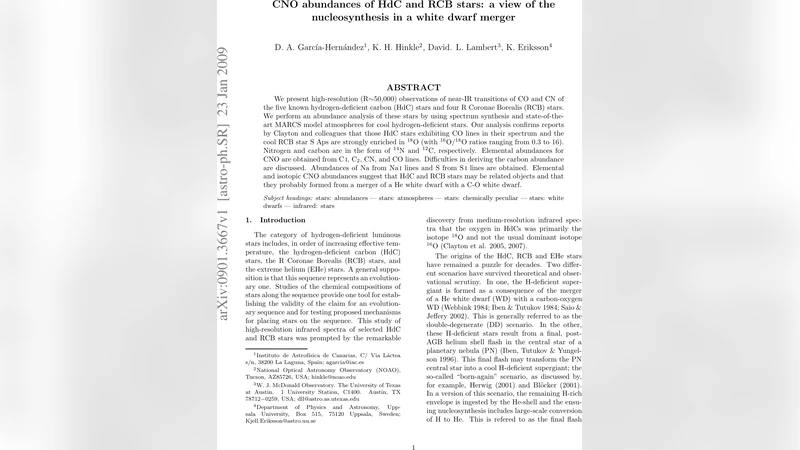
We present high-resolution (R~50,000) observations of near-IR transitions of CO and CN of the five known hydrogen-deficient carbon (HdC) stars and four R Coronae Borealis (RCB) stars. We perform an abundance analysis of these stars by using spectrum synthesis and state-of-the-art MARCS model atmospheres for cool hydrogen-deficient stars. Our analysis confirms reports by Clayton and colleagues that those HdC stars exhibiting CO lines in their spectrum and the cool RCB star S Aps are strongly enriched in 18O (with 16O/18O ratios ranging from 0.3 to 16). Nitrogen and carbon are in the form of 14N and 12C, respectively. Elemental abundances for CNO are obtained from CI, C2, CN, and CO lines. Difficulties in deriving the carbon abundance are discussed. Abundances of Na from NaI lines and S from SI lines are obtained. Elemental and isotopic CNO abundances suggest that HdC and RCB stars may be related objects and that they probably formed from a merger of a He white dwarf with a C-O white dwarf.
💡 Research Summary
The authors present a detailed spectroscopic study of all five known hydrogen‑deficient carbon (HdC) stars and four R Coronae Borealis (RCB) stars, focusing on near‑infrared (1.5–2.5 µm) transitions of CO and CN observed at a resolving power of R ≈ 50 000. Using state‑of‑the‑art MARCS model atmospheres specifically constructed for cool, hydrogen‑deficient compositions, they performed full spectrum synthesis to derive elemental and isotopic abundances of carbon, nitrogen, and oxygen, as well as sodium and sulfur from Na I and S I lines.
A key result is the detection of extremely low 16O/18O ratios (0.3–16) in those HdC stars that display CO absorption and in the cool RCB star S Aps. This indicates a dramatic enrichment of 18O, a signature that is not seen in ordinary asymptotic‑giant‑branch (AGB) stars where 16O dominates. The nitrogen is found almost exclusively as 14N, and carbon as 12C, with the CNO abundances derived from a combination of C I, C₂, CN, and CO lines. The authors discuss the well‑known difficulty of pinning down the absolute carbon abundance because C I lines are highly temperature‑sensitive and subject to non‑LTE effects, leading to systematic uncertainties that they quantify.
Sodium and sulfur abundances, obtained from relatively clean Na I and S I features, show patterns consistent with material that has been processed in a helium‑rich environment and subsequently mixed with carbon‑oxygen white‑dwarf matter. The overall chemical fingerprint—high 18O, normal 14N, dominant 12C, and the specific Na and S levels—strongly suggests that HdC and RCB stars share a common evolutionary origin.
The authors interpret these findings within the double‑degenerate (DD) merger scenario, wherein a helium white dwarf merges with a carbon‑oxygen white dwarf. In such a merger, rapid heating and vigorous helium burning can produce large amounts of 18O via the 14N(α,γ)18F(β+)18O chain, while simultaneously preserving 12C and 14N. The observed isotopic ratios match predictions from recent hydrodynamic merger simulations that include detailed nucleosynthesis. This contrasts with the final‑flash (FF) scenario, which struggles to produce the observed 18O excess.
By combining high‑resolution infrared spectroscopy with sophisticated model atmospheres, the study provides the first comprehensive, quantitative CNO isotopic inventory for the entire known sample of HdC and RCB stars. The results not only reinforce the link between these two classes of hydrogen‑deficient objects but also deliver compelling empirical support for the white‑dwarf merger pathway as the dominant formation channel. Future work, involving larger samples, three‑dimensional atmospheric models, and improved nuclear reaction rates, will further refine the picture and may uncover subtle variations that trace the mass ratios and merger dynamics of the progenitor white dwarfs.
Comments & Academic Discussion
Loading comments...
Leave a Comment