Empirical Abundance Scaling Laws and Implications for the Gamma-Process in Core-Collapse Supernovae
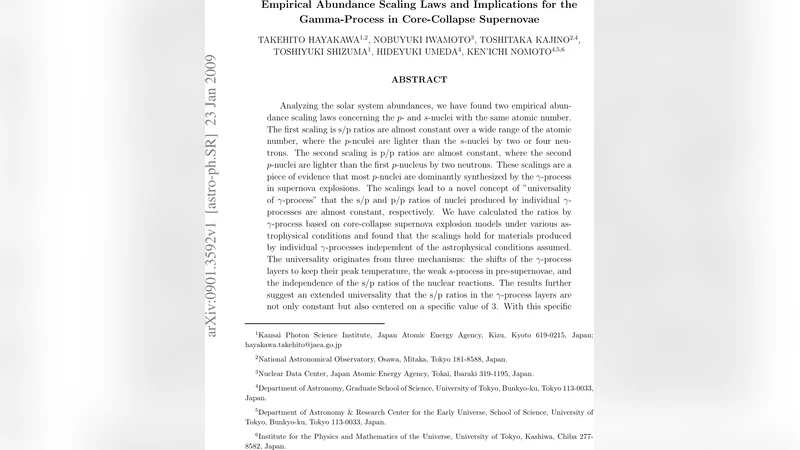
Analyzing the solar system abundances, we have found two empirical abundance scaling laws concerning the p- and s-nuclei with the same atomic number. The first scaling is s/p ratios are almost constant over a wide range of the atomic number, where the p-nculei are lighter than the s-nuclei by two or four neutrons. The second scaling is p/p ratios are almost constant, where the second $p$-nuclei are lighter than the first p-nucleus by two neutrons. These scalings are a piece of evidence that most p-nuclei are dominantly synthesized by the gamma-process in supernova explosions. The scalings lead to a novel concept of “universality of gamma-process” that the s/p and p/p ratios of nuclei produced by individual gamma-processes are almost constant, respectively. We have calculated the ratios by gamma-process based on core-collapse supernova explosion models under various astrophysical conditions and found that the scalings hold for materials produced by individual gamma-processes independent of the astrophysical conditions assumed. The universality originates from three mechanisms: the shifts of the gamma-process layers to keep their peak temperature, the weak s-process in pre-supernovae, and the independence of the s/p ratios of the nuclear reactions. The results further suggest an extended universality that the s/p ratios in the gamma-process layers are not only constant but also centered on a specific value of 3. With this specific value and the first scaling, we estimate that the ratios of $s$-process abundance contributions from the AGB stars to the massive stars are almost 6.7 for the $s$-nuclei of A > 90. We find that large enhancements of s/p ratios for Ce, Er, and W are a piece of evidence that the weak s-process actually occurred before SNe.
💡 Research Summary
The paper presents a comprehensive analysis of solar‑system isotopic abundances, revealing two striking empirical scaling relations between p‑process and s‑process nuclei that share the same atomic number. The first relation shows that the abundance ratio of s‑ to p‑nuclei (s/p) remains nearly constant across a wide range of Z when the p‑nucleus is lighter than its s‑partner by two or four neutrons. The observed s/p values cluster around a mean of about 3 with a modest scatter. The second relation demonstrates that, within a given element, the ratio of the two p‑nuclei (p/p) – where the second p‑nucleus is lighter by two neutrons – is also essentially constant, typically between 0.5 and 0.7.
These regularities constitute strong evidence that the bulk of p‑nuclei are produced by the γ‑process (photodisintegration) occurring in core‑collapse supernovae (CCSNe). In the γ‑process, pre‑existing s‑seed nuclei are exposed to intense γ‑radiation at peak temperatures of roughly 2–3 GK, leading to successive (γ,n), (γ,p), and (γ,α) reactions that strip neutrons and shift the composition toward proton‑rich isotopes.
To test the robustness of the scaling laws, the authors performed a suite of nucleosynthesis calculations using a variety of CCSN explosion models. They varied key astrophysical parameters such as explosion energy, mass cut, and the strength of the weak s‑process that operates during the pre‑supernova evolution of massive stars. For each model they extracted the final abundances of the relevant p‑ and s‑isotopes and computed the s/p and p/p ratios. Remarkably, all models reproduced the observed constancy of both ratios, indicating that the scaling is insensitive to the detailed explosion conditions. Moreover, the s/p ratios consistently converged toward the specific value of 3, a phenomenon the authors term “extended universality.”
The paper identifies three physical mechanisms that underpin this universality. First, the γ‑process layers shift in mass coordinate to maintain the same peak temperature regardless of the explosion energetics, ensuring that the photodisintegration flow proceeds under nearly identical thermodynamic conditions. Second, the weak s‑process in massive star progenitors pre‑enriches the stellar interior with a relatively uniform distribution of s‑seed nuclei; consequently, the initial composition entering the γ‑process is largely the same across different progenitors. Third, the network of γ‑induced reactions exhibits a self‑regulating behavior: although individual reaction rates are temperature dependent, the overall flow adjusts so that the final s/p and p/p ratios remain stable.
A noteworthy observational implication arises from the pronounced enhancements of s/p ratios for Ce, Er, and W. These anomalies are interpreted as direct signatures that the weak s‑process operated efficiently before the supernova explosion, boosting the s‑seed abundances for these particular elements. By combining the first scaling law with the extended universality, the authors estimate the relative contributions of AGB stars and massive stars to the solar s‑process inventory for nuclei with A > 90. Their calculation yields a ratio of roughly 6.7 : 1 in favor of AGB stars, providing a quantitative constraint on galactic chemical evolution models.
In summary, the study delivers three major contributions: (1) it empirically validates the dominance of the γ‑process in p‑nucleus production through robust, model‑independent abundance scaling laws; (2) it introduces the concept of γ‑process universality, showing that the s/p and p/p ratios are virtually invariant across a wide span of supernova conditions; and (3) it leverages these findings to infer the magnitude of the weak s‑process in massive stars and to refine the relative s‑process contributions from low‑mass (AGB) versus high‑mass stellar sources.
The authors suggest several avenues for future work. High‑precision measurements of key (γ,n), (γ,p), and (γ,α) reaction rates, especially for isotopes near the p‑process path, would reduce nuclear physics uncertainties. Multi‑dimensional CCSN simulations could test whether the temperature‑maintaining shift of γ‑process layers persists in realistic, turbulent environments. Finally, extending the analysis to meteoritic and stellar spectroscopic data would further assess the universality of the scaling relations across different galactic epochs. Together, these efforts promise to deepen our understanding of how the heaviest proton‑rich nuclei are forged in the cosmos.
Comments & Academic Discussion
Loading comments...
Leave a Comment