Cool Gas in the Magellanic Stream
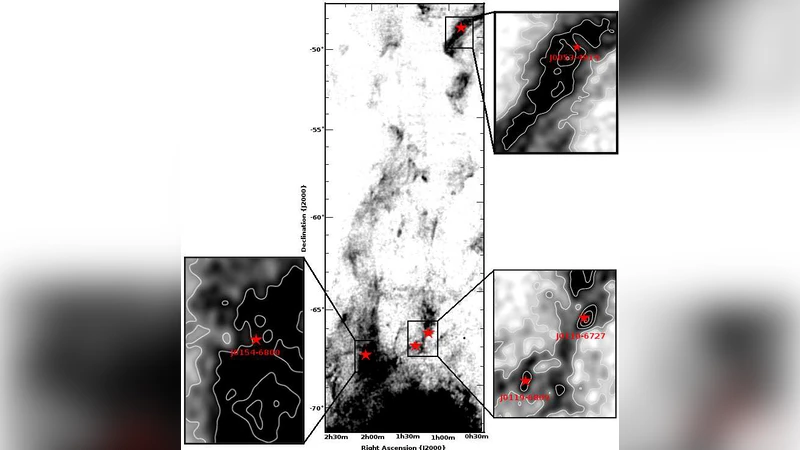
We present the first direct detection of cold atomic gas in the Magellanic Stream, through 21 cm line absorption toward a background radio source, J0119 - 6809, using the Australia Telescope Compact Array. Two absorption components were identified at heliocentric velocities 218.6 km/s and 227.0 km/s, with optical depths of tau ~ 0.02. The corresponding H I emission region has a column density in excess of 2 x 10^20 cm^{-2}. The inferred spin temperature of the emitting gas is ~70 K. We failed to find cool gas in observations of three other radio continuum sources. Although we have definitively detected cool gas in the Stream, its spin temperature is higher than similar components in the LMC, SMC and Bridge, and its contribution to the total H I density is probably lower. No corresponding 12CO(J = 1 -> 0) or dust appears to be associated with the cool gas, suggesting that the cloud is not forming stars.
💡 Research Summary
The authors report the first direct detection of cold atomic hydrogen within the Magellanic Stream using 21 cm absorption toward the background radio source J0119‑6809 observed with the Australia Telescope Compact Array (ATCA). Two narrow absorption components are identified at heliocentric velocities of 218.6 km s⁻¹ and 227.0 km s⁻¹, each exhibiting an optical depth of τ ≈ 0.02 and a line width of roughly 3–4 km s⁻¹. The corresponding H I emission at the same sight‑line shows a column density exceeding 2 × 10²⁰ cm⁻² and a line width of about 5 km s⁻¹, indicating the presence of a cold, relatively dense gas parcel. By combining the absorption depth with the emission column density, the spin temperature of the gas is derived to be ≈ 70 K—significantly higher than the 30–50 K typical of cold H I components in the Large and Small Magellanic Clouds and the Magellanic Bridge. This elevated temperature likely reflects the Stream’s lower metallicity, weaker ambient UV radiation field, and reduced pressure, which together modify the thermal balance of the cold phase.
The authors also searched for molecular gas and dust associated with the cold component by observing the 12CO (J = 1 → 0) line and examining far‑infrared dust emission; neither was detected, implying that the cold H I has not yet transitioned to a molecular state and that star formation is not currently occurring in this region. Follow‑up ATCA observations of three additional background continuum sources failed to reveal any absorption, suggesting that cold H I is confined to localized high‑density clumps rather than being widespread throughout the Stream.
These results have several implications. First, they confirm that the Magellanic Stream is a multi‑phase medium, containing both warm, diffuse H I and isolated pockets of colder, denser gas. Second, the relatively high spin temperature and the lack of CO or dust indicate that, while cold gas exists, the physical conditions are not yet conducive to efficient cooling and molecule formation, limiting the Stream’s ability to form stars. Third, the contribution of the cold component to the total H I mass of the Stream appears modest, consistent with previous indirect estimates.
The paper concludes by emphasizing the need for deeper, higher‑sensitivity observations—such as those possible with ASKAP, MeerKAT, or the upcoming SKA—to map the distribution of cold gas across the Stream, to search for faint molecular emission, and to assess whether any regions might evolve toward star formation under different environmental conditions.
Comments & Academic Discussion
Loading comments...
Leave a Comment