Mapping crustal heating with the cooling lightcurves of quasi-persistent transients
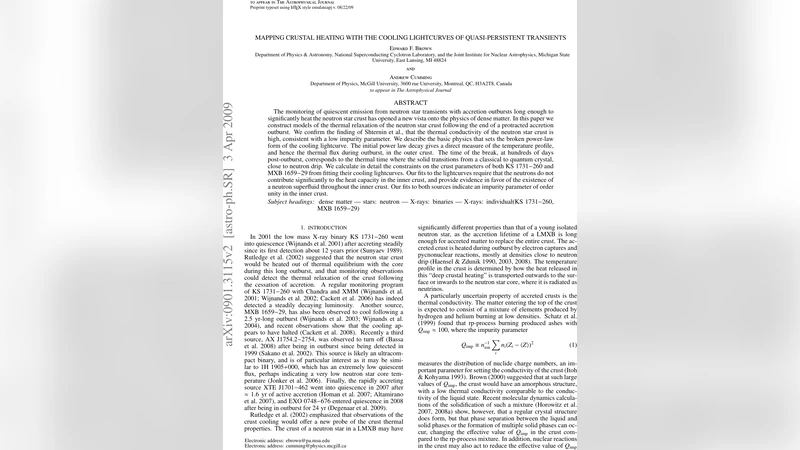
The monitoring of quiescent emission from neutron star transients with accretion outbursts long enough to significantly heat the neutron star crust has opened a new vista onto the physics of dense matter. In this paper we construct models of the thermal relaxation of the neutron star crust following the end of a protracted accretion outburst. We confirm the finding of Shternin et al., that the thermal conductivity of the neutron star crust is high, consistent with a low impurity parameter. We describe the basic physics that sets the broken power-law form of the cooling lightcurve. The initial power law decay gives a direct measure of the temperature profile, and hence the thermal flux during outburst, in the outer crust. The time of the break, at hundreds of days post-outburst, corresponds to the thermal time where the solid transitions from a classical to quantum crystal, close to neutron drip. We calculate in detail the constraints on the crust parameters of both KS 1731-260 and MXB 1659-29 from fitting their cooling lightcurves. Our fits to the lightcurves require that the neutrons do not contribute significantly to the heat capacity in the inner crust, and provide evidence in favor of the existence of a neutron superfluid throughout the inner crust. Our fits to both sources indicate an impurity parameter of order unity in the inner crust.
💡 Research Summary
The paper presents a comprehensive study of the thermal relaxation of neutron‑star crusts after the cessation of long‑duration accretion outbursts, a class of events often termed “quasi‑persistent transients.” By constructing time‑dependent heat‑transport models that incorporate realistic microphysics—electron thermal conductivity, ion‑lattice impurity scattering (parameterized by Q_imp), nuclear heating during outburst, and the specific heat of free neutrons—the authors reproduce the characteristic broken power‑law shape observed in the X‑ray cooling lightcurves of two well‑studied sources, KS 1731‑260 and MXB 1659‑29.
The analysis begins with a physical description of the crust. In the outer layers (densities 10^9–10^11 g cm⁻³) the temperature profile established during the outburst determines the initial steep decline of the lightcurve. The slope of this early power‑law directly measures the outward heat flux that the accreted material deposited, providing a diagnostic of the average heating rate during the years‑long accretion phase. As the cooling wave propagates inward, the thermal diffusion time grows with depth, and after a few hundred days the lightcurve exhibits a “break.” The authors identify this break with the depth at which the ion lattice transitions from a classical to a quantum crystal, a region that lies close to the neutron‑drip density (≈4×10^11 g cm⁻³). At this transition the heat capacity of the lattice changes, and, crucially, the contribution of free neutrons to the specific heat becomes decisive.
A key result of the fitting procedure is that the observed rapid post‑break cooling can only be reproduced if the free neutrons are in a superfluid state throughout the inner crust. Superfluidity suppresses the neutron specific heat by orders of magnitude, allowing the crust to lose heat on the observed timescales. If the neutrons were normal (non‑superfluid), the inner‑crust heat capacity would be too large, and the model lightcurve would decay far more slowly than the data. Thus the cooling observations provide indirect but compelling evidence for a pervasive neutron superfluid in the inner crust.
The impurity parameter, which quantifies the degree of compositional disorder in the ion lattice, emerges from the fits as Q_imp≈1 (within a factor of two) for both sources. Such a low value implies a highly ordered crystal with minimal scattering of electrons, consistent with a high electron thermal conductivity (κ≈10^20 erg cm⁻¹ s⁻¹ K⁻¹). This high conductivity is essential for reproducing the relatively short thermal diffusion times inferred from the data and confirms earlier findings by Shternin et al. that neutron‑star crusts are “clean” rather than amorphous.
By simultaneously fitting the cooling curves of KS 1731‑260 (which experienced a ~12‑year outburst) and MXB 1659‑29 (≈2‑year outburst), the authors demonstrate that a single set of crustal parameters can describe both systems despite their different outburst histories. The outer‑crust temperature gradient derived from the fits corresponds to an average heating flux of order 10^21 erg cm⁻² s⁻¹ during outburst, a value compatible with theoretical estimates of deep‑crustal heating from nuclear reactions such as electron captures and pycnonuclear fusion.
In summary, the paper establishes that (1) the neutron‑star crust possesses a high electron thermal conductivity and a low impurity content, (2) the inner crust must contain a neutron superfluid to account for the observed rapid cooling after the break, and (3) the break in the cooling lightcurve is a robust diagnostic of the depth where the lattice becomes quantum mechanical, i.e., near neutron drip. These conclusions provide stringent constraints on the equation of state of dense matter, the nature of nuclear pasta phases, and the microphysical inputs required for modeling thermal evolution of accreting neutron stars. The methodology demonstrated here—using long‑term X‑ray monitoring to map crustal heating and cooling—opens a powerful observational window onto the physics of matter at supra‑nuclear densities.
Comments & Academic Discussion
Loading comments...
Leave a Comment