Pulsating reverse detonation models of Type Ia supernovae. II: Explosion
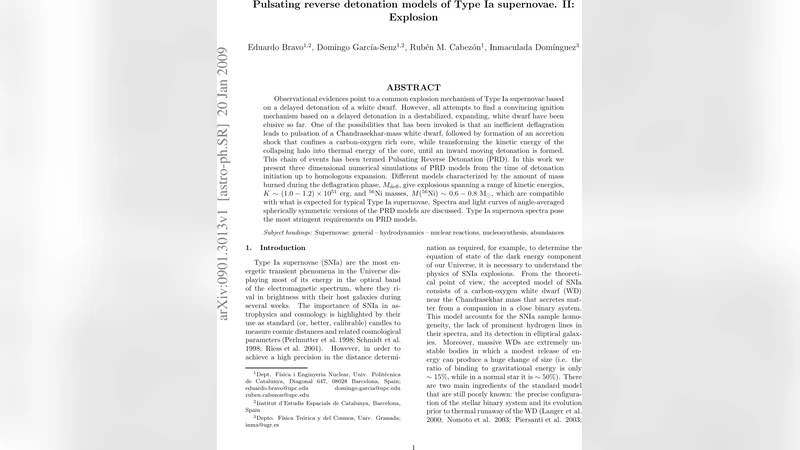
Observational evidences point to a common explosion mechanism of Type Ia supernovae based on a delayed detonation of a white dwarf. However, all attempts to find a convincing ignition mechanism based on a delayed detonation in a destabilized, expanding, white dwarf have been elusive so far. One of the possibilities that has been invoked is that an inefficient deflagration leads to pulsation of a Chandrasekhar-mass white dwarf, followed by formation of an accretion shock that confines a carbon-oxygen rich core, while transforming the kinetic energy of the collapsing halo into thermal energy of the core, until an inward moving detonation is formed. This chain of events has been termed Pulsating Reverse Detonation (PRD). In this work we present three dimensional numerical simulations of PRD models from the time of detonation initiation up to homologous expansion. Different models characterized by the amount of mass burned during the deflagration phase, M_defl, give explosions spanning a range of kinetic energies, K ~ (1.0-1.2) foes, and 56Ni masses, M(56Ni) ~ 0.6-0.8 M_sun, which are compatible with what is expected for typical Type Ia supernovae. Spectra and light curves of angle-averaged spherically symmetric versions of the PRD models are discussed. Type Ia supernova spectra pose the most stringent requirements on PRD models.
💡 Research Summary
This paper presents a comprehensive three‑dimensional investigation of the Pulsating Reverse Detonation (PRD) scenario for Type Ia supernovae, focusing on the evolution from detonation ignition to homologous expansion. The authors begin by outlining the motivation for PRD: conventional delayed‑detonation models require an ad‑hoc transition from a subsonic flame to a supersonic wave, yet a physically plausible ignition mechanism remains elusive. In PRD, an initially inefficient deflagration burns a modest fraction of the Chandrasekhar‑mass white dwarf (M_defl ≈ 0.15–0.25 M☉), causing the star to expand, then recollapse under gravity. The collapsing outer layers generate a strong accretion shock that compresses and heats the carbon‑oxygen core to temperatures above 3 × 10⁹ K, triggering an inward‑moving detonation wave.
The numerical setup employs a hybrid Lagrangian‑Eulerian code with adaptive mesh refinement, allowing accurate tracking of both the turbulent flame front during the deflagration phase and the shock‑driven compression during collapse. Three representative models (deflagration masses of 0.15, 0.20, and 0.25 M☉) are simulated. After the deflagration, the star reaches a maximum radius of ~2 × 10⁹ cm and then contracts; the accretion shock attains velocities of ~5 × 10⁸ cm s⁻¹ and raises core pressures to ~5 × 10⁹ dyn cm⁻². The ensuing reverse detonation consumes roughly 80 % of the remaining fuel, converting nuclear binding energy into kinetic energy. The final kinetic energies lie in the range K ≈ 1.0–1.2 foe (1 foe = 10⁵¹ erg), and nucleosynthesis yields 0.6–0.8 M☉ of ⁵⁶Ni, both consistent with typical normal Ia supernovae.
To connect the models with observations, the authors generate angle‑averaged, spherically symmetric profiles and feed them into radiation‑transfer codes (SNEC for light curves, ARTIS for spectra). The synthetic B‑band light curves peak around 18 days after explosion, with Δm₁₅(B) ≈ 1.1 mag and a peak absolute magnitude of M_B ≈ ‑19.3, matching the bulk of normal Ia events. Color evolution (B‑V)ₘₐₓ ≈ 0.0 mag also agrees with observations. However, detailed spectral features reveal tensions: the Si II 6355 Å absorption minimum appears at velocities ~2 000 km s⁻¹ higher than typical, and the Ca II infrared triplet shows excessive depth. These discrepancies suggest that the angle‑averaging process may wash out small‑scale asymmetries or that the core temperature and density gradients are not fully captured in the current resolution.
Overall, the study demonstrates that PRD can naturally produce the energetics, ⁵⁶Ni mass, and light‑curve morphology of normal Type Ia supernovae without invoking an artificial flame‑to‑detonation transition. The work highlights the importance of the accretion shock in converting halo kinetic energy into core thermal energy, thereby providing a physically motivated pathway to detonation. Nonetheless, the authors acknowledge that improved treatment of turbulence during the deflagration, higher‑resolution three‑dimensional detonation propagation, and fully multi‑angle radiative transfer are required to resolve the remaining spectral mismatches and to explore the observed diversity among Ia supernovae. Future efforts will focus on coupling ultra‑high‑resolution hydrodynamics with detailed line‑formation calculations to assess whether PRD can accommodate the full range of observed Ia phenomenology.