Discovery of the Most-Distant Double-Peaked Emitter at z=1.369
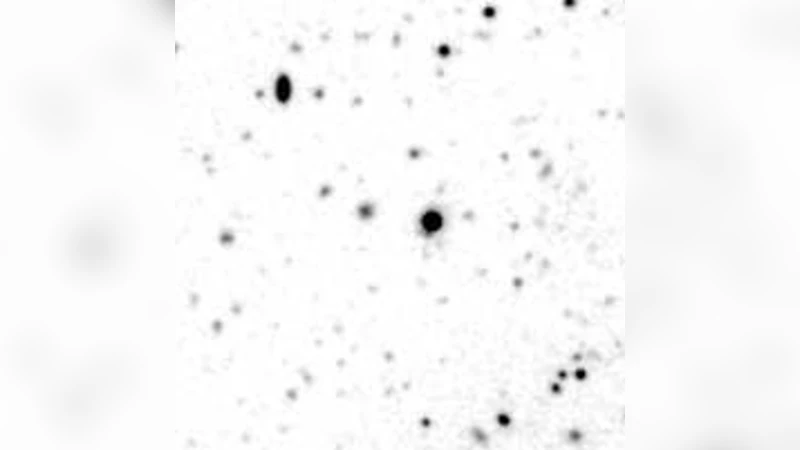
We report the discovery of the most-distant double-peaked emitter, CXOECDFS J033115.0-275518, at z=1.369. A Keck/DEIMOS spectrum shows a clearly double-peaked broad Mg II $\lambda2799$ emission line, with FWHM 11000 km/s for the line complex. The line profile can be well fit by an elliptical relativistic Keplerian disk model. This is one of a handful of double-peaked emitters known to be a luminous quasar, with excellent multiwavelength coverage and a high-quality X-ray spectrum. CXOECDFS J033115.0-275518 is a radio-loud quasar with two radio lobes (FR II morphology) and a radio loudness of f_{5 GHz}/f_{4400 \AA}~429. The X-ray spectrum can be modeled by a power law with photon index 1.72 and no intrinsic absorption; the rest-frame 0.5-8.0 keV luminosity is $5.0\times10^{44}$ erg/s. The spectral energy distribution (SED) of CXOECDFS J033115.0-275518 has a shape typical for radio-loud quasars and double-peaked emitters at lower redshift. The local viscous energy released from the line-emitting region of the accretion disk is probably insufficient to power the observed line flux, and external illumination of the disk appears to be required. The presence of a big blue bump in the SED along with the unexceptional X-ray spectrum suggest that the illumination cannot arise from a radiatively inefficient accretion flow.
💡 Research Summary
The authors present the discovery and multi‑wavelength characterization of CXOECDFS J033115.0‑275518, the most distant double‑peaked emitter (DPE) known to date at a redshift of z = 1.369. Optical spectroscopy obtained with Keck/DEIMOS reveals a broad Mg II λ2799 emission line with a full width at half maximum of ≈ 11 000 km s⁻¹ and a clear double‑peaked profile. By fitting the line shape with an elliptical relativistic Keplerian disk model, they infer a line‑forming region extending from roughly 200 to 2000 gravitational radii (R_g), an eccentricity of ~0.3, and an inclination of ~30°. These parameters are consistent with those derived for lower‑redshift DPEs, indicating that a relativistic accretion disk can produce the same kinematic signatures even in the early universe.
Radio observations from the VLA show a classic FR II morphology with two well‑separated lobes. The source’s radio‑to‑optical flux ratio, R ≈ 429 (f_5 GHz/f_4400 Å), classifies it as a radio‑loud quasar. The X‑ray spectrum, obtained with Chandra, is well described by an unabsorbed power law with photon index Γ = 1.72 ± 0.08 and a rest‑frame 0.5–8 keV luminosity of 5 × 10⁴⁴ erg s⁻¹, typical of radio‑loud quasars and showing no evidence for intrinsic absorption.
The broadband spectral energy distribution (SED) displays the characteristic “big blue bump” in the UV–optical regime, indicating a radiatively efficient accretion disk (η ≈ 0.1). The overall SED shape matches that of other radio‑loud quasars and lower‑z DPEs, with only modest excess in the infrared likely attributable to host‑galaxy dust emission.
A key part of the analysis concerns the energy budget of the Mg II line. Using a standard α‑disk prescription (α = 0.1), the viscous power released in the line‑emitting annulus (200–2000 R_g) is estimated to be L_visc ≈ 10⁴³ erg s⁻¹, an order of magnitude lower than the observed line luminosity L_line ≈ 10⁴⁴ erg s⁻¹. Consequently, the authors argue that local viscous dissipation cannot alone power the line; external illumination of the disk is required. They explore possible illumination sources: a radiatively inefficient accretion flow (RIAF) is ruled out because the presence of a prominent big blue bump and a normal X‑ray spectrum imply a standard, efficient disk rather than a hot, low‑efficiency flow. Instead, they favor illumination by high‑energy photons associated with the powerful radio jet, consistent with the FR II morphology and high radio loudness. Jet‑disk interactions could supply the necessary hard X‑ray/UV photons that strike the outer disk, enhancing line emission.
The paper situates this object within the broader context of DPE research. While most known DPEs are low‑luminosity Seyfert galaxies, a handful of luminous quasars exhibit double‑peaked lines, and CXOECDFS J033115.0‑275518 adds a crucial high‑redshift data point. Its combination of a relativistic disk, strong jet, efficient accretion, and double‑peaked Mg II emission suggests that the DPE phenomenon can persist in the early universe and may be linked to the presence of powerful jets. The authors propose that future high‑resolution infrared (JWST) and sub‑millimeter (ALMA) observations could directly resolve the disk‑jet interface and test the illumination scenario.
In conclusion, the study provides compelling evidence that CXOECDFS J033115.0‑275518 is a radio‑loud quasar with a relativistic accretion disk producing a double‑peaked Mg II line, that external illumination—most plausibly from the jet—is required to power the line emission, and that such systems exist at cosmological distances, offering valuable insight into black‑hole growth, disk physics, and jet feedback in the early universe.
Comments & Academic Discussion
Loading comments...
Leave a Comment