The Cepheid Period-Luminosity Relation (The Leavitt Law) at Mid-Infrared Wavelengths: IV. Cepheids in IC 1613
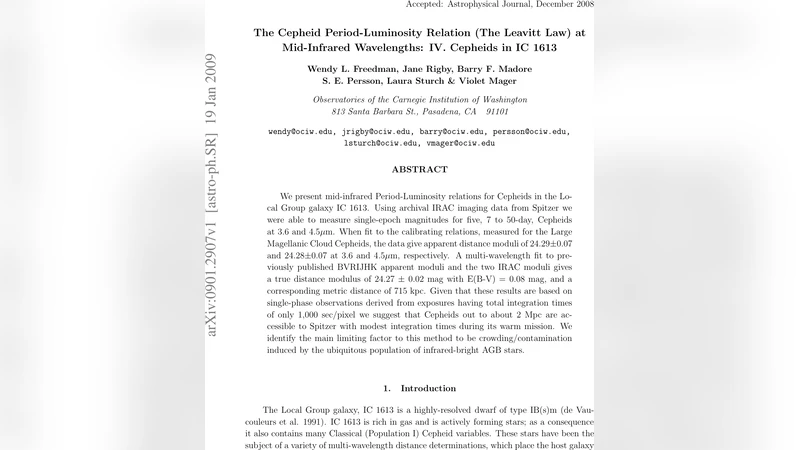
We present mid-infrared Period-Luminosity relations for Cepheids in the Local Group galaxy IC1613. Using archival IRAC imaging data from Spitzer we were able to measure single-epoch magnitudes for five, 7 to 50-day, Cepheids at 3.6 and 4.5 microns. When fit to the calibrating relations, measured for the Large Magellanic Cloud Cepheids, the data give apparent distance moduli of 24.29 +/- 0.07 and 24.28 +/- 0.07 at 3.6 and 4.5 microns, respectively. A multi-wavelength fit to previously published BVRIJHK apparent moduli and the two IRAC moduli gives a true distance modulus of 24.27 +/- 0.02 mag with E(B-V) = 0.08 mag, and a corresponding metric distance of 715 kpc. Given that these results are based on single-phase observations derived from exposures having total integration times of only 1,000 sec/pixel we suggest that Cepheids out to about 2 Mpc are accessible to Spitzer with modest integration times during its warm mission. We identify the main limiting factor to this method to be crowding/contamination induced by the ubiquitous population of infrared-bright AGB stars.
💡 Research Summary
The paper presents the first mid‑infrared (MIR) period‑luminosity (PL) relations for Cepheid variables in the Local Group dwarf galaxy IC 1613, using archival Spitzer/IRAC imaging at 3.6 µm and 4.5 µm. Five fundamental‑mode Cepheids with periods ranging from 7 to 50 days were identified, and single‑epoch photometry was extracted from relatively shallow exposures (≈1 000 s per pixel). The authors adopted the well‑calibrated LMC MIR PL relations as a reference, fitting the IC 1613 Cepheids to these relations without any additional zero‑point adjustment. This yielded apparent distance moduli of 24.29 ± 0.07 mag at 3.6 µm and 24.28 ± 0.07 mag at 4.5 µm.
To convert these apparent moduli into a true distance, the authors performed a multi‑wavelength fit that combined the new MIR moduli with previously published optical (BVRI) and near‑infrared (JHK) distance estimates for IC 1613. The simultaneous fit solved for both the true distance modulus and the line‑of‑sight reddening, resulting in (m‑M)0 = 24.27 ± 0.02 mag and E(B‑V) = 0.08 mag. The corresponding metric distance is 715 kpc, in excellent agreement with earlier determinations based on independent methods (e.g., tip of the red giant branch, RR Lyrae).
A key methodological point is that the MIR PL relation is remarkably insensitive to the phase of observation. Even with single‑epoch data, the scatter about the LMC PL relation is comparable to that obtained from multi‑epoch optical light curves, confirming that the amplitude of Cepheid variability diminishes dramatically at 3–5 µm. Consequently, the authors argue that modest integration times (≈1 000 s per pixel) are sufficient to obtain reliable distances to galaxies out to ~2 Mpc during Spitzer’s warm mission, when only the 3.6 µm and 4.5 µm channels remain operational.
The study also identifies the principal limitation of this approach: crowding and contamination from infrared‑bright asymptotic giant branch (AGB) stars. In the dense stellar fields of IC 1613, AGB stars can blend with Cepheids, biasing PSF photometry and inflating measured fluxes. The authors suggest that for more distant targets, higher‑resolution facilities (e.g., JWST/NIRCam) or advanced de‑blending algorithms (e.g., machine‑learning based source separation) will be required to mitigate this effect.
An additional scientific implication concerns the metallicity dependence of the MIR PL relation. IC 1613 is slightly more metal‑poor than the LMC, yet the Cepheids follow the same PL zero‑point within the quoted uncertainties. This supports the prevailing view that MIR Cepheid PL relations are largely metallicity‑independent, making them powerful tools for constructing a universal distance ladder.
Future work proposed by the authors includes (1) quantifying the residual phase‑induced scatter by simulating single‑epoch observations using full LMC light curves, (2) applying sophisticated PSF modeling and neural‑network de‑blending to reduce AGB contamination, and (3) extending the MIR Cepheid distance technique to other low‑metallicity Local Group galaxies such as WLM and NGC 6822. Successful implementation of these steps would sharpen the Cepheid‑based distance scale, thereby providing an independent, high‑precision anchor for the Hubble constant (H₀) determination.
Comments & Academic Discussion
Loading comments...
Leave a Comment