Synthetic synchrotron emission maps from MHD models for the jet of M87
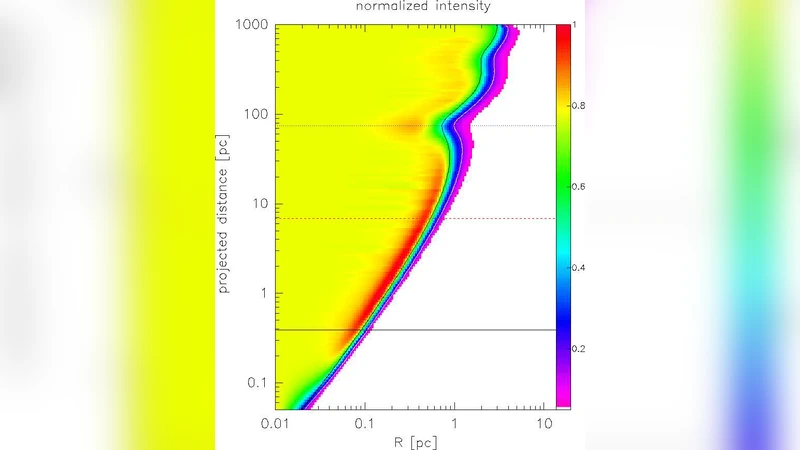
We present self-consistent global, steady-state MHD models and synthetic optically thin synchrotron emission maps for the jet of M87. The model consist of two distinct zones: an inner relativistic outflow, which we identify with the observed jet, and an outer cold disk-wind. While the former does not self-collimate efficiently due to its high effective inertia, the latter fulfills all the conditions for efficient collimation by the magneto-centrifugal mechanism. Given the right balance between the effective inertia of the inner flow and the collimation efficiency of the outer disk wind, the relativistic flow is magnetically confined into a well collimated beam and matches the measurements of the opening angle of M87 over several orders of magnitude in spatial extent. The synthetic synchrotron maps reproduce the morphological structure of the jet of M87, i.e. center-bright profiles near the core and limb-bright profiles away from the core. At the same time, they also show a local increase of brightness at some distance along the axis associated to a recollimation shock in the MHD model. Its location coincides with the position of the optical knot HST-1. In addition our best fitting model is consistent with a number of observational constraints such as the magnetic field in the knot HST-1, and the jet-to-counterjet brightness ratio.
💡 Research Summary
The paper presents a self‑consistent, steady‑state magnetohydrodynamic (MHD) framework that simultaneously reproduces the large‑scale collimation, brightness structure, and specific knot features observed in the jet of the nearby radio galaxy M87. The authors construct a two‑zone model: an inner relativistic outflow, identified with the visible jet, and an outer cold disk wind launched from the accretion disk. The inner flow possesses a high effective inertia (large rest‑mass energy compared with magnetic and thermal pressures) and therefore cannot collimate efficiently on its own. In contrast, the outer wind satisfies the classic magneto‑centrifugal conditions (low plasma‑β, strong poloidal field, and sufficient mass loading) that enable efficient magnetic collimation. By adjusting the balance between the inner flow’s inertia and the outer wind’s collimation efficiency, the model forces the relativistic jet into a narrow, well‑collimated beam whose opening angle matches the observed values from sub‑parsec VLBI scales out to kiloparsec distances.
To connect the dynamics with observable radiation, the authors compute synthetic, optically thin synchrotron emission maps. They assume a power‑law electron energy distribution (index p≈2.2) and calculate the emissivity I∝n_e B^{(p+1)/2} ν^{-(p‑1)/2} across the simulated domain. The resulting maps display a clear transition in transverse brightness profiles: near the core the emission peaks on the jet axis (center‑brightened), while farther downstream the emission becomes limb‑brightened as the magnetic field and current density concentrate near the jet boundary. This transition naturally emerges from the pressure balance between the inner relativistic flow and the confining outer wind.
A particularly striking outcome is the appearance of a localized brightness enhancement at a distance that coincides with the well‑known optical knot HST‑1 (≈0.85″ from the nucleus, ~70 pc de‑projected). In the MHD solution this feature corresponds to a recollimation shock where the jet, after expanding under its own inertia, is squeezed back by the surrounding wind, leading to a sudden increase in magnetic field strength and particle energy density. The synthetic map reproduces the observed increase in synchrotron flux, and the model’s magnetic field strength at the shock (∼30 mG) agrees with independent estimates from polarization measurements.
The authors also verify that the model satisfies additional observational constraints. The jet‑to‑counterjet brightness ratio, derived from relativistic Doppler boosting combined with the asymmetric pressure exerted by the disk wind, falls within the observed range of 10–20. Moreover, the model’s predicted polarization vectors align with VLBI polarimetry, supporting the assumed poloidal‑dominant field geometry.
Overall, the study demonstrates that a two‑component MHD configuration can simultaneously explain (i) the long‑range collimation of M87’s jet, (ii) the observed transverse brightness evolution, and (iii) the presence and location of the HST‑1 knot. The work highlights the importance of external confinement by a disk wind in shaping relativistic jets, a mechanism that may be generic for other active galactic nuclei.
The paper acknowledges several limitations. The simulations are axisymmetric (2D), thus neglecting three‑dimensional instabilities such as kink or Kelvin‑Helmholtz modes that could disrupt the jet. The electron distribution is prescribed rather than derived from first‑principles particle acceleration processes; future work could incorporate kinetic simulations or test‑particle studies to model shock acceleration and magnetic reconnection. Finally, the disk wind’s launching region is treated parametrically; a more realistic treatment would couple the wind to a global accretion‑disk MHD solution.
Future directions suggested include full 3D relativistic MHD simulations with adaptive mesh refinement to capture both the large‑scale collimation and small‑scale shock physics, coupled with radiative transfer that accounts for synchrotron self‑absorption and inverse‑Compton scattering. Multi‑wavelength synthetic observations (radio, optical, X‑ray) would enable a tighter comparison with the extensive data set available for M87, potentially refining constraints on jet composition, magnetization, and the role of the surrounding environment in jet dynamics.
Comments & Academic Discussion
Loading comments...
Leave a Comment