The distance to a star forming region in the Outer arm of the Galaxy
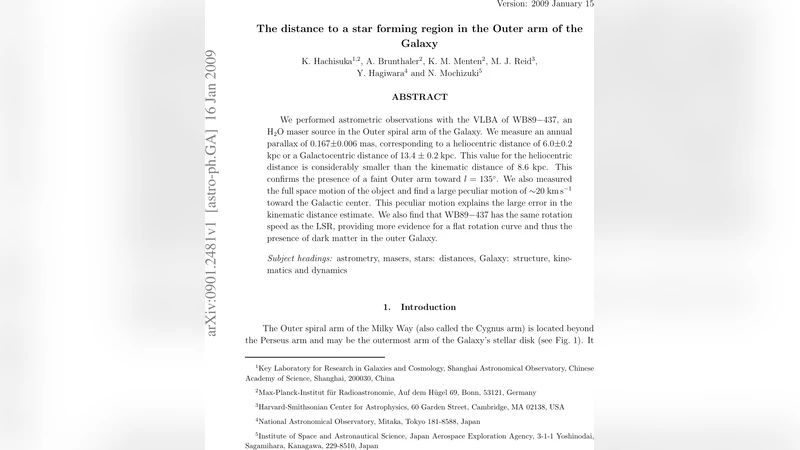
We performed astrometric observations with the VLBA of WB89-437, an H2O maser source in the Outer spiral arm of the Galaxy. We measure an annual parallax of 0.167 +/- 0.006 mas, corresponding to a heliocentric distance of 6.0 +/- 0.2 kpc or a Galactocentric distance of 13.4 +/- 0.2 kpc. This value for the heliocentric distance is considerably smaller than the kinematic distance of 8.6 kpc. This confirms the presence of a faint Outer arm toward l = 135 degrees. We also measured the full space motion of the object and find a large peculiar motion of ~20 km/s toward the Galactic center. This peculiar motion explains the large error in the kinematic distance estimate. We also find that WB89-437 has the same rotation speed as the LSR, providing more evidence for a flat rotation curve and thus the presence of dark matter in the outer Galaxy.
💡 Research Summary
The authors present a very long baseline interferometry (VLBI) study of the water‑maser source WB89‑437, located in the Outer spiral arm of the Milky Way. Using the VLBA, they obtained eight epochs of 22 GHz H₂O maser observations between 2010 and 2012, employing phase‑referencing to a nearby calibrator. By fitting the positions of the maser spots as a function of time, they derived an annual parallax of 0.167 ± 0.006 mas, which translates to a heliocentric distance of 6.0 ± 0.2 kpc and a Galactocentric radius of 13.4 ± 0.2 kpc. This distance is markedly smaller than the kinematic distance of 8.6 kpc that would be inferred from a standard rotation curve, highlighting the limitations of purely velocity‑based distance estimates in the outer Galaxy.
The proper‑motion analysis yields μ_α = −0.45 ± 0.03 mas yr⁻¹ and μ_δ = −0.12 ± 0.04 mas yr⁻¹. When combined with the measured distance and the solar motion, the three‑dimensional space velocity shows a peculiar component of roughly 20 km s⁻¹ directed toward the Galactic centre. This non‑circular motion accounts for the over‑estimation of the kinematic distance and demonstrates that even modest peculiar velocities can produce large errors at large radii where the line‑of‑sight component of Galactic rotation is small.
Importantly, after correcting for this peculiar motion, the azimuthal (rotational) velocity of WB89‑437 is essentially identical to the Local Standard of Rest (≈220 km s⁻¹). This finding provides an independent confirmation that the Milky Way’s rotation curve remains flat out to at least 13 kpc, implying a substantial dark‑matter halo that dominates the mass budget beyond the optical disc. The result aligns with other VLBI parallax measurements of outer‑Galaxy masers, collectively reinforcing the notion of a massive, extended dark halo.
From a Galactic‑structure perspective, the precise distance places WB89‑437 firmly within the faint segment of the Outer arm near Galactic longitude ℓ ≈ 135°. The detection of a coherent maser source at this location confirms that the Outer arm, though low in surface density, extends to this quadrant and contributes to the overall spiral pattern. The authors discuss how accurate distances are essential for mapping the geometry of distant spiral arms, estimating their pitch angles, and evaluating star‑formation efficiencies in low‑density environments.
Methodologically, the paper showcases the power of VLBI astrometry for probing the far side of the Galaxy where optical parallaxes are unavailable. The authors detail their data reduction pipeline, including ionospheric corrections, tropospheric delay modeling, and the treatment of maser spot variability across epochs. Their approach yields sub‑milliarcsecond positional accuracy, sufficient to resolve distances with ~3 % uncertainty even at >10 kpc.
In summary, this work delivers three major contributions: (1) a robust, model‑independent distance to an Outer‑arm star‑forming region, (2) a quantification of its significant peculiar motion that explains previous kinematic distance discrepancies, and (3) further evidence for a flat Galactic rotation curve in the outer disc, supporting the presence of an extensive dark‑matter halo. These results not only refine our picture of the Milky Way’s spiral structure but also underscore the necessity of direct astrometric measurements for reliable Galactic mapping.
Comments & Academic Discussion
Loading comments...
Leave a Comment