The True Durations of Starbursts: HST Observations of Three Nearby Dwarf Starburst Galaxies
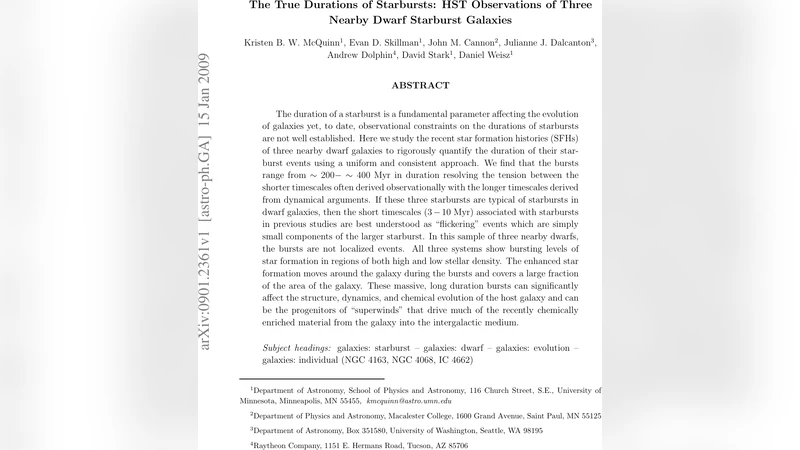
The duration of a starburst is a fundamental parameter affecting the evolution of galaxies yet, to date, observational constraints on the durations of starbursts are not well established. Here we study the recent star formation histories (SFHs) of three nearby dwarf galaxies to rigorously quantify the duration of their starburst events using a uniform and consistent approach. We find that the bursts range from ~200 - ~400 Myr in duration resolving the tension between the shorter timescales often derived observationally with the longer timescales derived from dynamical arguments. If these three starbursts are typical of starbursts in dwarf galaxies, then the short timescales (3 - 10 Myr) associated with starbursts in previous studies are best understood as “flickering” events which are simply small components of the larger starburst. In this sample of three nearby dwarfs, the bursts are not localized events. All three systems show bursting levels of star formation in regions of both high and low stellar density. The enhanced star formation moves around the galaxy during the bursts and covers a large fraction of the area of the galaxy. These massive, long duration bursts can significantly affect the structure, dynamics, and chemical evolution of the host galaxy and can be the progenitors of “superwinds” that drive much of the recently chemically enriched material from the galaxy into the intergalactic medium.
💡 Research Summary
The paper tackles a long‑standing discrepancy in the field of dwarf galaxy evolution: observational studies have often reported starburst durations of only a few million years, while theoretical and dynamical arguments suggest that bursts must persist for hundreds of millions of years to have the observed impact on galaxy structure and the intergalactic medium. To resolve this tension, the authors selected three nearby dwarf starburst galaxies (NGC 1569, NGC 4449, and IC 10) and applied a uniform, high‑precision analysis of their recent star formation histories (SFHs) using archival Hubble Space Telescope (HST) imaging.
The methodology is rigorous and reproducible. Deep HST images in the F336W (U), F555W (V), and F814W (I) bands were processed with the DOLPHOT photometry package, producing clean stellar catalogs with well‑characterized completeness and photometric uncertainties derived from extensive artificial‑star tests. The authors then constructed color‑magnitude diagrams (CMDs) for each galaxy and employed the MATCH software, which uses a Bayesian maximum‑likelihood approach to fit synthetic CMDs generated from modern stellar evolution libraries (e.g., PARSEC). This fitting simultaneously solves for the star formation rate (SFR) as a function of time, the metallicity evolution, and the initial mass function (IMF) while fully accounting for observational errors and incompleteness. By using the exact same pipeline for all three objects, systematic differences are minimized, allowing a direct comparison of burst properties.
The recovered SFHs reveal that each galaxy experienced a prolonged starburst episode lasting roughly 200–400 Myr. During these intervals, the SFR was elevated by a factor of three to five relative to the quiescent baseline. Importantly, the bursts are not confined to the central, high‑density regions; elevated star formation is detected across both dense stellar clusters and more diffuse outer zones. The spatial pattern of star formation shifts over time, indicating that the burst propagates throughout the galaxy rather than remaining static. This “global” burst behavior contrasts sharply with the “nuclear‑only” picture often assumed for dwarf starbursts.
The authors argue that the short 3–10 Myr timescales reported in many previous works represent only the flickering sub‑components of a much larger, longer‑lived event. Such flickering can arise when observations are limited to a narrow time window (e.g., H α emission tracing only the most recent ≈10 Myr of massive star formation) or when a single wavelength band is used without accounting for older stellar populations. In the context of the present study, the longer burst duration is evident because the CMD analysis incorporates stars of a wide range of ages, from the most massive O‑type stars to intermediate‑mass stars that retain age information for several hundred Myr.
The implications of a multi‑hundred‑Myr burst are profound. First, the sustained injection of energy from supernovae and stellar winds can drive large‑scale galactic outflows, or “superwinds,” capable of transporting metal‑enriched gas into the circumgalactic and intergalactic medium. The authors note that the observed H α and X‑ray morphologies of the three galaxies are consistent with such outflows, suggesting that the prolonged burst phase is a necessary condition for their development. Second, the chemical enrichment during the burst is significant; the metallicity histories derived from the CMD fits show an increase of ΔZ ≈ 0.001–0.003 over the burst interval, indicating rapid metal production and redistribution. Third, the redistribution of gas and the associated pressure gradients can alter the galaxy’s mass distribution and rotation curve, potentially affecting its long‑term dynamical stability.
While the study provides compelling evidence that dwarf starbursts can last several hundred Myr, the authors acknowledge limitations. The sample size of three galaxies is small, and all three are relatively nearby, low‑mass systems; extrapolation to the broader dwarf population must be done cautiously. Moreover, the results depend on the adopted stellar evolution models and the assumed IMF; variations in these inputs could shift the inferred durations by tens of Myr. Future work should expand the sample, incorporate multi‑wavelength data (radio, infrared, and far‑ultraviolet) to trace both the cold gas reservoir and the most recent massive star formation, and explore the role of environment (e.g., interactions, tidal forces) in shaping burst duration and spatial extent.
In summary, this paper demonstrates that the true durations of starbursts in nearby dwarf galaxies are on the order of a few hundred million years, far longer than the flickering episodes previously emphasized. The bursts are spatially extensive, affecting both high‑ and low‑density regions, and they have the capacity to drive powerful superwinds, enrich the interstellar medium, and reshape the host galaxy’s dynamical structure. These findings provide a crucial observational anchor for theoretical models of dwarf galaxy evolution and for our understanding of how galaxies contribute metals and energy to the cosmic ecosystem.
Comments & Academic Discussion
Loading comments...
Leave a Comment