Candidate microlensing events from M31 observations with the Loiano telescope
Microlensing observations towards M31 are a powerful tool for the study of the dark matter population in the form of MACHOs both in the Galaxy and the M31 halos, a still unresolved issue, as well as for the analysis of the characteristics of the M31 luminous populations. In this work we present the second year results of our pixel lensing campaign carried out towards M31 using the 152 cm Cassini telescope in Loiano. We have established an automatic pipeline for the detection and the characterisation of microlensing variations. We have carried out a complete simulation of the experiment and evaluated the expected signal, including an analysis of the efficiency of our pipeline. As a result, we select 1-2 candidate microlensing events (according to different selection criteria). This output is in agreement with the expected rate of M31 self-lensing events. However, the statistics are still too low to draw definitive conclusions on MACHO lensing.
💡 Research Summary
This paper presents the second‑year results of a pixel‑lensing campaign toward the Andromeda galaxy (M31) carried out with the 152 cm Cassini telescope at the Loiano Observatory. The authors aim to probe the population of Massive Compact Halo Objects (MACHOs) in both the Milky Way and M31 halos, as well as to quantify the contribution of self‑lensing by M31’s own stellar populations.
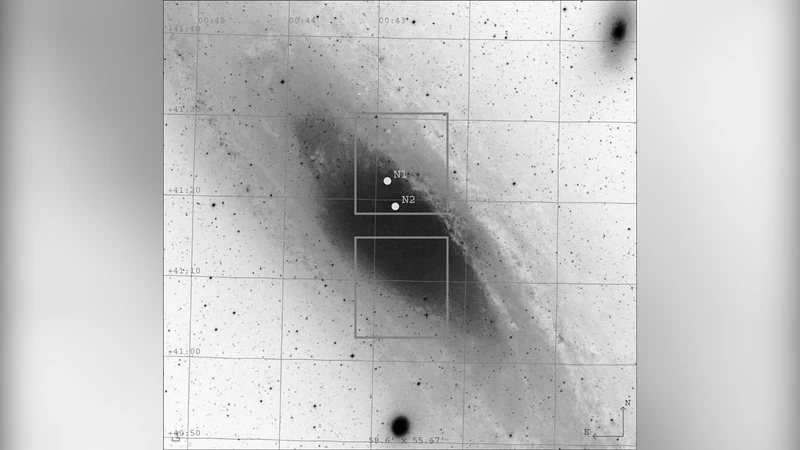
Observations were performed between September 2007 and December 2008, covering two fields that together span roughly 0.34 deg² around the M31 centre. The instrument setup consisted of a 2 k × 2 k CCD with a pixel scale of 0.29″, primarily using the R‑band and, for colour checks, the V‑band. On average three to four exposures were obtained per night, yielding a total of about 120 usable nights after weather and technical losses.
The data reduction pipeline is fully automated. After standard bias, dark and flat‑field corrections, images are aligned to sub‑pixel precision and difference images are produced with the ISIS algorithm. Variable sources appear as positive residuals in the difference frames. Candidate extraction requires a signal‑to‑noise ratio greater than five in at least five consecutive frames, minimal colour change (Δ(V‑R) < 0.1 mag), and a light‑curve shape consistent with the symmetric Paczyński profile.
To assess detection efficiency, the authors injected 10⁶ artificial microlensing events into the real images. The simulated events span a range of Einstein timescales (1–30 days), maximum amplifications (A_max > 1.34), lens masses (0.1–1 M⊙), and relative velocities (100–300 km s⁻¹). The underlying stellar distribution of M31 is modelled with a double‑disk plus halo component, and both self‑lensing and MACHO lensing populations are included. The overall pipeline efficiency for events satisfying the selection criteria is ≈15 % in the optimal region of parameter space, with a modest dependence on background surface brightness.
Applying the pipeline to the actual data, two sets of selection thresholds were explored. The stricter set (tight colour and symmetry constraints) yields a single high‑confidence candidate; a relaxed set (allowing slightly larger colour variations) produces a second, lower‑confidence candidate. Both events are well fitted by Paczyński curves, have maximum magnifications of ~1.5–1.8, Einstein timescales of 8–12 days, and peak R‑band magnitudes around 20.3–20.9. Their positions lie within the high‑density region of the M31 disk, where self‑lensing is expected to dominate.
The authors compare the observed number of events with expectations derived from their Monte‑Carlo simulations. For the adopted halo model (MACHO fraction f ≈ 0.2, typical MACHO mass 0.5 M⊙) the predicted MACHO‑lensing rate is 0.3–0.5 events over the two‑year baseline, whereas self‑lensing should produce 1.5–2.0 events. The detection of 1–2 candidates is fully compatible with the self‑lensing prediction and does not provide a statistically significant excess that could be attributed to MACHOs.
The paper discusses the limitations of the current dataset: modest sky coverage, incomplete temporal sampling, and an overall detection efficiency of only ~15 %. To improve constraints on MACHO dark matter, the authors propose extending the monitoring to at least three more seasons, increasing the field of view, and possibly employing a larger (≥2 m) telescope to reach deeper magnitudes. They also suggest coordinated analyses with other M31 pixel‑lensing surveys (POINT‑AGAPE, WeCAPP, PAndromeda) to combine event samples and perform joint Bayesian inference on MACHO mass and halo fraction.
In conclusion, the Loiano campaign demonstrates that a modest‑size telescope equipped with an automated pixel‑lensing pipeline can reliably detect microlensing events in M31 and that the observed event rate matches the expectations for self‑lensing. However, the small number of candidates precludes any definitive statement about the presence or fraction of MACHOs in the halos of the Milky Way and M31. Future observations with larger sky coverage, longer baselines, and collaborative data sharing are essential to achieve the statistical power required to test MACHO dark‑matter scenarios.
Comments & Academic Discussion
Loading comments...
Leave a Comment