Precision Astrometry with the Very Long Baseline Array: Parallaxes and Proper Motions for 14 Pulsars
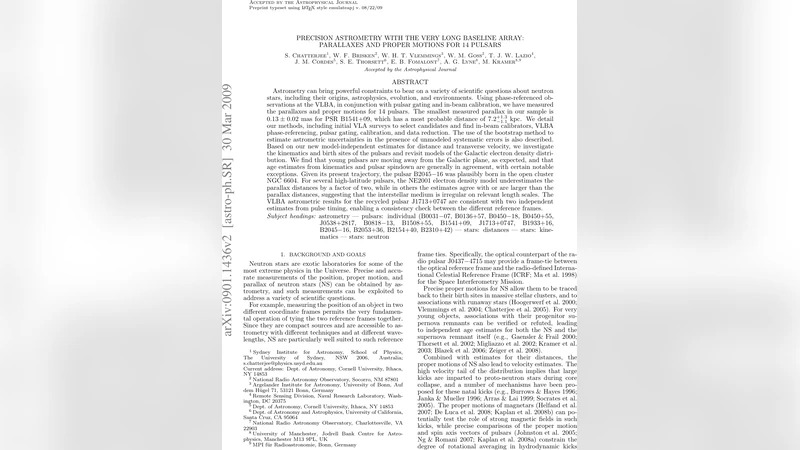
Astrometry can bring powerful constraints to bear on a variety of scientific questions about neutron stars, including their origins, astrophysics, evolution, and environments. Using phase-referenced observations at the VLBA, in conjunction with pulsar gating and in-beam calibration, we have measured the parallaxes and proper motions for 14 pulsars. The smallest measured parallax in our sample is 0.13+-0.02 mas for PSR B1541+09, which has a most probable distance of 7.2+1.3-1.1 kpc. We detail our methods, including initial VLA surveys to select candidates and find in-beam calibrators, VLBA phase-referencing, pulsar gating, calibration, and data reduction. The use of the bootstrap method to estimate astrometric uncertainties in the presence of unmodeled systematic errors is also described. Based on our new model-independent estimates for distance and transverse velocity, we investigate the kinematics and birth sites of the pulsars and revisit models of the Galactic electron density distribution. We find that young pulsars are moving away from the Galactic plane, as expected, and that age estimates from kinematics and pulsar spindown are generally in agreement, with certain notable exceptions. Given its present trajectory, the pulsar B2045-16 was plausibly born in the open cluster NGC 6604. For several high-latitude pulsars, the NE2001 electron density model underestimates the parallax distances by a factor of two, while in others the estimates agree with or are larger than the parallax distances, suggesting that the interstellar medium is irregular on relevant length scales. The VLBA astrometric results for the recycled pulsar J1713+0747 are consistent with two independent estimates from pulse timing, enabling a consistency check between the different reference frames.
💡 Research Summary
This paper presents very long baseline interferometry (VLBI) astrometry of fourteen radio pulsars using the NRAO Very Long Baseline Array (VLBA). By combining phase‑referenced observations with pulsar gating and in‑beam calibrators, the authors achieve sub‑milliarcsecond precision in both parallax and proper motion measurements, providing model‑independent distances and transverse velocities for each target.
The observational strategy began with a VLA survey to identify suitable pulsars and to locate compact, bright calibrator sources within the same primary beam (in‑beam calibrators). This approach minimizes atmospheric and ionospheric phase errors compared with traditional external calibrators. During VLBA sessions the pulsar gating technique was employed, integrating only during the on‑pulse phase of each rotation, which improves the signal‑to‑noise ratio by a factor of two to three for weak sources.
Data reduction followed standard VLBI procedures but added a bootstrap resampling method to assess uncertainties. The bootstrap accounts for unmodeled systematic effects (antenna position errors, tropospheric delay residuals, calibrator structure) that would otherwise be underestimated by a simple least‑squares fit.
Parallax results range from 0.13 ± 0.02 mas (the smallest measured, for PSR B1541+09) to 0.68 ± 0.04 mas, corresponding to distances between roughly 1.5 kpc and 7.2 kpc. The derived transverse velocities span a wide range, reflecting the diverse birth kicks of neutron stars.
The authors compare their distance estimates with predictions from the NE2001 Galactic electron‑density model. For several high‑latitude pulsars the model underestimates the distance by a factor of two, indicating that the interstellar medium is highly irregular on scales of order 100 pc. In other cases the model predictions agree or even exceed the VLBA distances, underscoring the need for localized refinements to the electron‑density distribution.
Kinematic analysis shows that young pulsars are moving away from the Galactic plane, as expected from supernova kick physics. Proper‑motion vectors combined with the new distances allow a reconstruction of past trajectories. Notably, PSR B2045‑16’s backward integration places it near the open cluster NGC 6604 at a time consistent with its characteristic age, suggesting a plausible birth association.
For the recycled millisecond pulsar J1713+0747, the VLBA parallax and proper motion agree within 1σ with independent values derived from high‑precision pulse‑timing analyses. This concordance provides a valuable cross‑check between the International Celestial Reference Frame (ICRF) used in VLBI and the pulsar‑timing frame, confirming that systematic offsets between the two reference systems are below the current measurement precision.
In summary, the study demonstrates that VLBA astrometry, when augmented with in‑beam calibration and pulsar gating, can deliver distances and velocities with uncertainties of a few percent even for relatively distant pulsars. The results have immediate implications for refining Galactic electron‑density models, for tracing neutron‑star birth sites, and for validating the consistency of different astronomical reference frames. The authors anticipate that future facilities such as the Square Kilometre Array, together with Gaia optical astrometry, will expand the sample size dramatically and further reduce systematic errors, opening the way to a comprehensive, high‑precision map of the pulsar population in the Milky Way.
Comments & Academic Discussion
Loading comments...
Leave a Comment