Physical Conditions in the Narrow-Line Region of Markarian 3. II. Photoionization Modeling Results
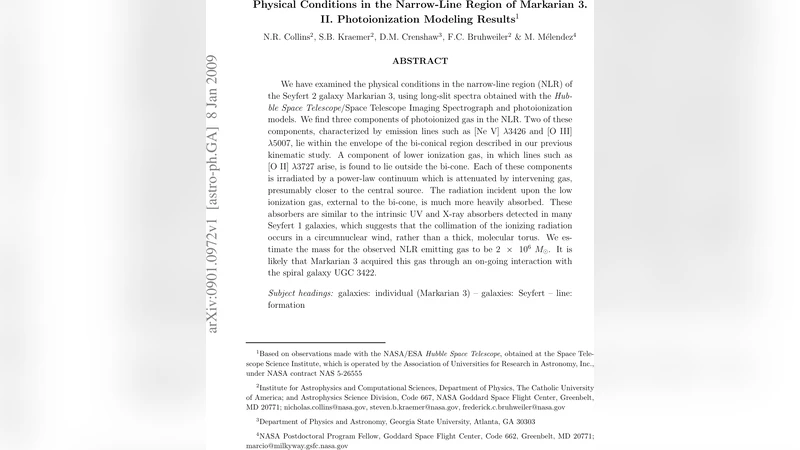
We have examined the physical conditions in the narrow-line region (NLR) of the Seyfert 2 galaxy Markarian 3, using long-slit spectra obtained with the Hubble Space Telescope/Space Telescope Imaging Spectrograph and photoionization models. We find three components of photoionized gas in the NLR. Two of these components, characterized by emission lines such as [NeV] 3426 and [OIII] 5007, lie within the envelope of the bi-conical region described in our previous kinematic study. A component of lower ionization gas, in which lines such as [OII] 3727 arise, is found to lie outside the bi-cone. Each of these components is irradiated by a power-law continuum which is attenuated by intervening gas, presumably closer to the central source. The radiation incident upon the low ionization gas, external to the bi-cone, is much more heavily absorbed. These absorbers are similar to the intrinsic UV and X-ray absorbers detected in many Seyfert 1 galaxies, which suggests that the collimation of the ionizing radiation occurs in a circumnuclear wind, rather than a thick, molecular torus. We estimate the mass for the observed NLR emitting gas to be 2 million solar-masses. It is likely that Markarian 3 acquired this gas through an on-going interaction with the spiral galaxy UGC 3422.
💡 Research Summary
This paper presents a comprehensive investigation of the narrow‑line region (NLR) in the Seyfert 2 galaxy Markarian 3, combining high‑resolution long‑slit spectra from the Hubble Space Telescope’s Space Telescope Imaging Spectrograph (STIS) with detailed photo‑ionization modeling. The authors identify three distinct ionized gas components. Two high‑ionization components, traced by strong
Comments & Academic Discussion
Loading comments...
Leave a Comment