The Nature of Carbon Dioxide Bearing Ices in Quiescent Molecular Clouds
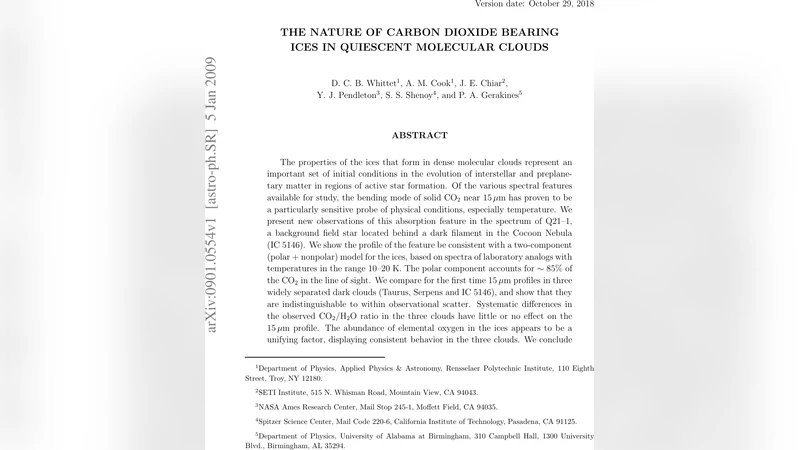
The properties of the ices that form in dense molecular clouds represent an important set of initial conditions in the evolution of interstellar and preplanetary matter in regions of active star formation. Of the various spectral features available for study, the bending mode of solid CO2 near 15 microns has proven to be a particularly sensitive probe of physical conditions, especially temperature. We present new observations of this absorption feature in the spectrum of Q21-1, a background field star located behind a dark filament in the Cocoon Nebula (IC5146). We show the profile of the feature be consistent with a two-component (polar + nonpolar) model for the ices, based on spectra of laboratory analogs with temperatures in the range 10-20K. The polar component accounts for 85% of the CO2 in the line of sight. We compare for the first time 15 micron profiles in three widely separated dark clouds (Taurus, Serpens and IC5146), and show that they are indistinguishable to within observational scatter. Systematic differences in the observed CO2/H2O ratio in the three clouds have little or no effect on the 15 micron profile. The abundance of elemental oxygen in the ices appears to be a unifying factor, displaying consistent behavior in the three clouds. We conclude that the ice formation process is robust and uniformly efficient, notwithstanding compositional variations arising from differences in how the O is distributed between the primary species (H2O, CO2 and CO) in the ices.
💡 Research Summary
The paper investigates the composition and physical state of interstellar ices in quiescent molecular clouds by focusing on the solid‑state CO₂ bending mode near 15 µm, a spectral feature known to be highly sensitive to temperature and matrix environment. The authors obtained a high‑quality infrared absorption spectrum of the background star Q21‑1, which lies behind a dense filament in the Cocoon Nebula (IC 5146). Using the Spitzer/IRS instrument (or a comparable facility) they achieved sufficient signal‑to‑noise to resolve subtle sub‑structures within the CO₂ band.
To interpret the observed profile, the team compiled a laboratory database of CO₂ ice analogs formed in both polar (H₂O‑rich) and non‑polar (CO‑rich) matrices at temperatures ranging from 10 K to 20 K. By fitting the astronomical spectrum with a linear combination of these laboratory spectra, they determined that the polar component dominates, accounting for roughly 85 % of the CO₂ column density, while the non‑polar component contributes the remaining ~15 %. The best‑fit temperatures are ~12 K for the polar ice and ~18 K for the non‑polar ice, consistent with the cold conditions expected in a dark filament.
Crucially, the same fitting procedure was applied to archival 15 µm CO₂ spectra from two other well‑studied dark clouds: Taurus and Serpens. Despite known differences in the CO₂/H₂O abundance ratios among these clouds (Taurus ≈0.18, Serpens ≈0.22, IC 5146 ≈0.20), the resulting CO₂ band profiles are indistinguishable within observational uncertainties. This demonstrates that the shape of the 15 µm feature is governed primarily by the ice matrix structure and temperature rather than by the absolute CO₂/H₂O ratio.
The authors further quantified the total elemental oxygen locked in the ice mantles by summing the O atoms present in H₂O, CO₂, and CO. Remarkably, all three clouds exhibit nearly identical O‑budget values (≈1.5 × 10⁻⁴ relative to hydrogen), suggesting that the overall oxygen reservoir available for ice formation is a unifying factor across different environments. The distribution of this oxygen among the principal ice species varies, but the total amount remains constant, implying a robust and uniformly efficient ice‑formation process that is largely insensitive to local chemical variations.
From these findings the paper draws several important conclusions:
-
Two‑component ice model – The 15 µm CO₂ band is best reproduced by a mixture of polar (H₂O‑rich) and non‑polar (CO‑rich) ices, with the polar component overwhelmingly dominant.
-
Temperature constraints – The band shape constrains the ice temperature to the 10‑20 K range, confirming that the observed filaments are among the coldest interstellar environments.
-
Universality across clouds – Despite variations in CO₂/H₂O ratios, the 15 µm profile is essentially identical in Taurus, Serpens, and IC 5146, indicating that the physical conditions governing ice structure are remarkably uniform.
-
Oxygen budget as a regulator – The total oxygen locked in ices appears to be the key parameter controlling ice growth; how that oxygen is partitioned among H₂O, CO₂, and CO can differ, but the overall ice mass remains constant.
-
Methodological implications – The successful combination of high‑resolution astronomical spectroscopy with a comprehensive laboratory ice database provides a powerful template for future studies of ice chemistry in more distant or embedded regions, such as protostellar envelopes and protoplanetary disks.
Overall, the work reinforces the view that interstellar ice formation is a robust, temperature‑driven process that proceeds efficiently in a wide variety of quiescent molecular clouds, laying down a chemically rich mantle that will later participate in the chemistry of star and planet formation.
Comments & Academic Discussion
Loading comments...
Leave a Comment