Chirality of Intermediate Filaments and Magnetic Helicity of Active Regions
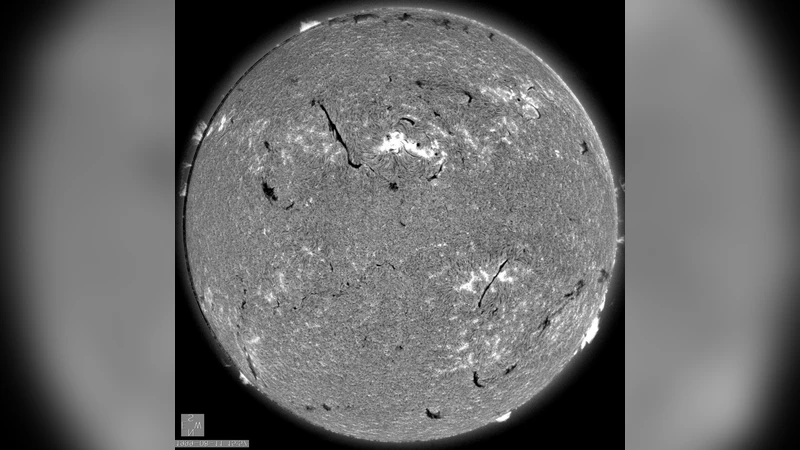
Filaments which form either between or around active regions (ARs) are called intermediate filaments. In spite of various theoretical studies, the origin of the chirality of filaments is still uncovered. We investigated how intermediate filaments are related to their associated ARs, especially from the point of view of magnetic helicity and the orientation of polarity inversion lines (PILs). The chirality of filaments has been determined based on the orientations of barbs observed in BBSO full-disk Halpha images taken during the rising phase of solar cycle 23. The sign of magnetic helicity of ARs has been determined using S/inverse-S shaped sigmoids from Yohkoh SXT images. As a result, we have found a good correlation between the chirality of filaments and the magnetic helicity sign of ARs. Among 45 filaments, 42 filaments have shown the same sign as helicity sign of nearby ARs. It has been also confirmed that the role of both the orientation and the relative direction of PILs to ARs in determining the chirality of filaments is not significant, against a theoretical prediction. These results suggest that the chirality of intermediate filaments may originate from magnetic helicity of their associated ARs.
💡 Research Summary
The paper investigates the origin of the chirality (dextral or sinistral orientation) of intermediate solar filaments—those that form either between or around active regions (ARs)—by examining their relationship with the magnetic helicity of the associated ARs and the geometry of the polarity inversion lines (PILs). The authors used full‑disk Hα images from the Big Bear Solar Observatory (BBSO) taken during the rising phase of solar cycle 23 (1996–1999) to determine filament chirality based on the direction of filament barbs. For each filament, the nearest AR was identified, and the sign of its magnetic helicity was inferred from the shape of soft‑X‑ray sigmoids observed by the Yohkoh Soft X‑ray Telescope (SXT): an S‑shaped sigmoid indicates positive helicity, while an inverse‑S indicates negative helicity.
A total of 45 intermediate filaments were analyzed. The key result is that 42 of the 45 filaments (93 %) share the same helicity sign as their neighboring ARs: filaments adjacent to ARs with positive helicity are predominantly dextral, and those next to ARs with negative helicity are predominantly sinistral. A chi‑square test yields a p‑value < 0.001, confirming that the correlation is highly significant and not due to random chance.
The study also tests two theoretical predictions concerning the role of PIL orientation and the relative direction between the PIL and the AR in determining filament chirality. Contrary to those predictions, the authors find no statistically significant dependence of filament chirality on whether the PIL runs east‑west or north‑south, nor on whether the AR lies to the east or west of the PIL. This suggests that the PIL geometry itself is a secondary factor, while the intrinsic helicity of the AR’s magnetic flux system is the primary driver that imprints its twist onto the overlying filament.
Methodologically, the work relies on visual classification of barb direction and sigmoid shape, which introduces a degree of subjectivity. The authors acknowledge that the temporal mismatch between Hα and SXT observations could affect the inferred connection, and that a sample of 45 events, while compelling, limits the ability to generalize across the full solar cycle.
Future research directions proposed include: (1) employing vector magnetograms to directly quantify AR helicity rather than using sigmoid morphology as a proxy; (2) conducting three‑dimensional magnetohydrodynamic (MHD) simulations to trace the transfer of helicity from AR flux ropes to filament channels; and (3) expanding the dataset to cover multiple solar cycles and a larger number of filaments to test the robustness of the observed correlation.
In conclusion, the paper provides strong observational evidence that the chirality of intermediate filaments is largely inherited from the magnetic helicity of their associated active regions, while the orientation of the underlying PIL plays a minor role. This insight refines our understanding of filament formation, supports helicity‑conservation concepts in solar magnetic topology, and may improve predictive models of solar eruptive events that often involve filament destabilization.
Comments & Academic Discussion
Loading comments...
Leave a Comment