A Constant Factor Approximation Algorithm for Boxicity of Circular Arc Graphs
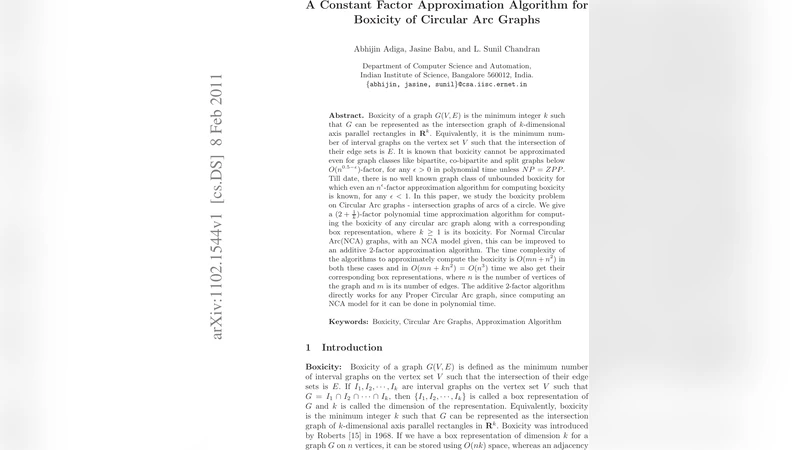
Boxicity of a graph $G(V,E)$ is the minimum integer $k$ such that $G$ can be represented as the intersection graph of $k$-dimensional axis parallel rectangles in $\mathbf{R}^k$. Equivalently, it is the minimum number of interval graphs on the vertex set $V$ such that the intersection of their edge sets is $E$. It is known that boxicity cannot be approximated even for graph classes like bipartite, co-bipartite and split graphs below $O(n^{0.5 - \epsilon})$-factor, for any $\epsilon >0$ in polynomial time unless $NP=ZPP$. Till date, there is no well known graph class of unbounded boxicity for which even an $n^\epsilon$-factor approximation algorithm for computing boxicity is known, for any $\epsilon <1$. In this paper, we study the boxicity problem on Circular Arc graphs - intersection graphs of arcs of a circle. We give a $(2+\frac{1}{k})$-factor polynomial time approximation algorithm for computing the boxicity of any circular arc graph along with a corresponding box representation, where $k \ge 1$ is its boxicity. For Normal Circular Arc(NCA) graphs, with an NCA model given, this can be improved to an additive 2-factor approximation algorithm. The time complexity of the algorithms to approximately compute the boxicity is $O(mn+n^2)$ in both these cases and in $O(mn+kn^2)= O(n^3)$ time we also get their corresponding box representations, where $n$ is the number of vertices of the graph and $m$ is its number of edges. The additive 2-factor algorithm directly works for any Proper Circular Arc graph, since computing an NCA model for it can be done in polynomial time.
💡 Research Summary
The paper addresses the long‑standing open problem of efficiently approximating the boxicity of circular‑arc (CA) graphs. Boxicity is the smallest integer k such that a graph can be represented as the intersection of k interval graphs, equivalently as the intersection graph of axis‑parallel k‑dimensional boxes. Prior work has shown that for many graph families (bipartite, co‑bipartite, split) no polynomial‑time algorithm can achieve an approximation factor better than O(n^{0.5‑ε}) unless NP = ZPP, and no ε‑approximation with ε < 1 is known for any class with unbounded boxicity.
The authors first develop a structural decomposition for any CA graph. By selecting an arbitrary point p on the circle, the vertex set is split into two cliques A and B (those arcs covering p and those that do not). Vertices in each clique are ordered according to the clockwise distance of their right endpoints from p, yielding a numbering that satisfies the “Bi‑Consecutive Adjacency Property”: for any i∈A and j′∈B, adjacency forces a consecutive interval relationship in the numbering. Using this ordering, they construct an auxiliary graph H* whose vertices correspond to edges of the original graph and whose edges encode the presence of an induced 2K₂. They prove that when the complement of the original graph is a co‑bipartite CA graph, H* is a comparability graph.
A key combinatorial insight is that for a bipartite graph H, the boxicity of its complement G equals the minimum chain‑cover number ch(H). Moreover, when H is chordal bipartite (the case for complements of co‑bipartite CA graphs), ch(H) equals the chromatic number χ(H*). Consequently, computing χ(H*) yields the exact boxicity of G. The authors show that χ(H*) can be obtained in O(mn + n²) time by exploiting the comparability structure, dramatically improving over the naïve O(n⁶) bound that would result from generic perfect‑graph coloring.
For a general CA graph (not necessarily co‑bipartite), the authors partition the graph into two subgraphs G₁ and G₂, each of which is a co‑bipartite CA graph after suitable edge deletions. Applying the exact algorithm to each part gives boxicities k₁ and k₂. Since the original graph’s boxicity k satisfies k ≤ k₁ + k₂ ≤ (2 + 1/k)·k, the algorithm achieves a (2 + 1/k)‑factor approximation in polynomial time.
When a Normal Circular‑Arc (NCA) model is supplied, the graph already avoids “circle‑cover” pairs, allowing a simpler decomposition that guarantees |k₁ − k₂| ≤ 2. Hence an additive‑2 approximation (i.e., a “+2” factor) is obtained in O(mn + n²) time. Proper Circular‑Arc (PCA) graphs are a subclass of NCA graphs; since an NCA model can be computed for PCA graphs in polynomial time, the same additive‑2 result holds for them.
Finally, the authors describe how to construct an explicit k‑dimensional box representation from the interval representations of the subgraphs. This step runs in O(mn + kn²) = O(n³) time, where k is the true boxicity.
In summary, the paper delivers the first polynomial‑time approximation algorithm for the boxicity of CA graphs with a provable (2 + 1/k) multiplicative guarantee, and an additive‑2 guarantee for NCA (and thus PCA) graphs. It introduces a novel use of the Bi‑Consecutive Adjacency Property and the comparability‑graph transformation to reduce the computational complexity from exponential‑ish to near‑cubic, providing both theoretical insight and practical tools for graph representation and visualization.
Comments & Academic Discussion
Loading comments...
Leave a Comment