Higher-order corrections to the relativistic perihelion advance and the mass of binary pulsars
Notice: This research summary and analysis were automatically generated using AI technology. For absolute accuracy, please refer to the [Original Paper Viewer] below or the Original ArXiv Source.
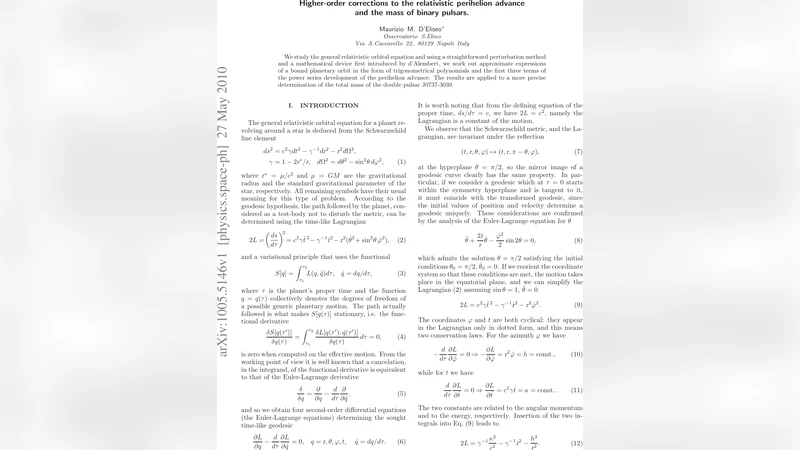
We study the general relativistic orbital equation and using a straightforward perturbation method and a mathematical device first introduced by d’Alembert, we work out approximate expressions of a bound planetary orbit in the form of trigonometrical polynomials and the first three terms of the power series development of the perihelion advance. The results are applied to a more precise determination of the total mass of the double pulsar J0737-3039.
💡 Research Summary
The paper revisits the relativistic orbital equation derived from the Schwarzschild metric and develops a systematic perturbative solution that goes beyond the usual first‑post‑Newtonian (1PN) treatment of perihelion advance. Starting from
\
Comments & Academic Discussion
Loading comments...
Leave a Comment