Type Classes for Mathematics in Type Theory
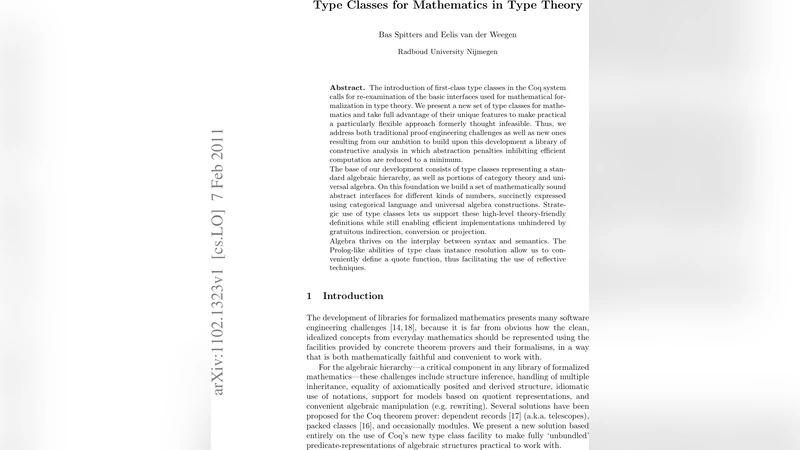
The introduction of first-class type classes in the Coq system calls for re-examination of the basic interfaces used for mathematical formalization in type theory. We present a new set of type classes for mathematics and take full advantage of their unique features to make practical a particularly flexible approach formerly thought infeasible. Thus, we address both traditional proof engineering challenges as well as new ones resulting from our ambition to build upon this development a library of constructive analysis in which abstraction penalties inhibiting efficient computation are reduced to a minimum. The base of our development consists of type classes representing a standard algebraic hierarchy, as well as portions of category theory and universal algebra. On this foundation we build a set of mathematically sound abstract interfaces for different kinds of numbers, succinctly expressed using categorical language and universal algebra constructions. Strategic use of type classes lets us support these high-level theory-friendly definitions while still enabling efficient implementations unhindered by gratuitous indirection, conversion or projection. Algebra thrives on the interplay between syntax and semantics. The Prolog-like abilities of type class instance resolution allow us to conveniently define a quote function, thus facilitating the use of reflective techniques.
💡 Research Summary
The paper investigates how the newly introduced first‑class type class mechanism in Coq can be used to redesign the traditional algebraic hierarchy and related mathematical interfaces. The authors begin by reviewing Coq’s core features, especially the distinction between the Prop sort for logical propositions and the computational sort, and they emphasize the importance of separating proof‑irrelevant data from computational data to enable efficient program extraction.
They then critique the conventional “bundled” representation of algebraic structures, where carriers, operations, and axioms are packed into a single record. While convenient for notation, bundling creates serious difficulties when multiple inheritance is required, when sharing of components across structures is needed, and when projection paths become unwieldy. To overcome these issues, the authors propose a fully “unbundled” approach based on type classes. Each algebraic concept—semiring, ring, field, etc.—is expressed as a type class, and concrete instances are registered as global hints. Coq’s proof‑search engine automatically resolves class constraints, providing a Prolog‑like inference mechanism that handles structure inference, multiple inheritance, and canonical naming without manual bookkeeping.
The paper also revisits setoid equality and rewriting. By integrating setoid notions into the type‑class framework, the authors obtain automatic setoid rewriting while preserving the flexibility lost in Ssreflect’s canonical‑representation approach.
Beyond pure algebra, the authors embed fragments of category theory and multi‑sorted universal algebra into the same class hierarchy. This enables them to define abstract interfaces for the natural numbers (as an initial semiring), the integers (as an initial ring), and the rational numbers (as a field of fractions) in a uniform, reusable way. Implementations can be swapped without altering proofs, which is crucial for the ultimate goal of building a certified constructive analysis library with efficient exact real arithmetic.
A particularly novel contribution is the definition of a “quote” function for algebraic terms using type classes, allowing reflective techniques and meta‑programming within Coq. The authors also discuss an attempted sequence interface, noting current limitations in Coq’s instance resolution that hinder its practical use.
In conclusion, the work demonstrates that Coq’s first‑class type classes provide a powerful, flexible foundation for formalizing mathematics while retaining computational efficiency. The approach is portable to other type‑theory based proof assistants that support type classes, suggesting a broad impact on the design of future formal mathematics libraries.
Comments & Academic Discussion
Loading comments...
Leave a Comment