Stabilizing data-link over non-FIFO channels with optimal fault-resilience
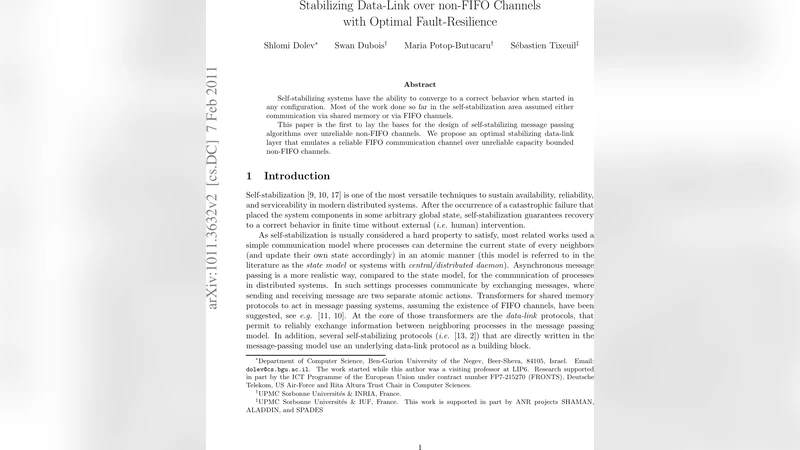
Self-stabilizing systems have the ability to converge to a correct behavior when started in any configuration. Most of the work done so far in the self-stabilization area assumed either communication via shared memory or via FIFO channels. This paper is the first to lay the bases for the design of self-stabilizing message passing algorithms over unreliable non-FIFO channels. We propose a fault-send-deliver optimal stabilizing data-link layer that emulates a reliable FIFO communication channel over unreliable capacity bounded non-FIFO channels.
💡 Research Summary
The paper addresses a fundamental gap in the self‑stabilizing literature: the lack of protocols that can guarantee reliable FIFO communication over unreliable, capacity‑bounded, non‑FIFO message‑passing channels. While most prior work assumes either shared memory or FIFO links, real networks—especially wireless sensor networks, IoT deployments, and ad‑hoc systems—often exhibit out‑of‑order delivery, loss, duplication, and limited buffering. The authors propose a self‑stabilizing data‑link layer that emulates a reliable FIFO channel under these harsh conditions and prove that it is optimal with respect to both fault‑send and fault‑deliver metrics.
Problem formulation and model.
The system consists of a set of processes that communicate through directed channels. Each channel has a fixed capacity C (the maximum number of packets it can hold at any time) and does not preserve order: packets may be delivered in any permutation, may be lost, and may be duplicated. The processes have no prior knowledge of the channel state and start from an arbitrary global configuration, which may include spurious messages lingering in the channels. The goal is to design a protocol that, from any such configuration, converges to a legitimate state where the abstraction of a reliable FIFO link is provided between each pair of neighboring processes.
Key design ideas.
- Message header with unique identifier and sequence number. Each logical message is wrapped with a tuple ⟨uid, seq, payload⟩. The uid is freshly generated for every transmission round, guaranteeing that stale packets from previous rounds can be distinguished and safely discarded. The seq field implements a modulo‑C counter that encodes the logical order within the current round.
- Bounded retransmission policy. The sender maintains a sliding window of at most C outstanding packets. When the channel becomes full, the oldest unacknowledged packet is evicted, a new uid is assigned, and the window slides forward. This eviction rule ensures that the protocol never blocks indefinitely on a permanently corrupted packet, satisfying the fault‑send optimality condition (the minimum number of retransmissions needed to guarantee eventual delivery).
- Receiver‑side ordering and acknowledgment. Upon receipt, the receiver places packets in a local buffer ordered by seq. If the next expected seq is present, the payload is delivered to the upper layer and an ACK for that uid is sent. Missing seq numbers trigger an immediate NACK, prompting the sender to retransmit the specific missing packet. Duplicate packets (same uid and seq) are ignored.
- Self‑stabilization mechanisms. The protocol includes a timeout‑based cleanup routine: if a uid has not been acknowledged within a bounded number of rounds, the sender assumes the uid is corrupted and discards all associated state. Similarly, the receiver periodically purges entries whose uid is older than a locally maintained “generation counter”. These actions guarantee convergence from any arbitrary state.
Correctness and optimality proofs.
The authors model the system as a transition system and define a legitimate configuration as one where (i) every channel contains only packets belonging to the current generation, (ii) the receiver’s buffer holds a contiguous prefix of seq numbers, and (iii) the upper layer sees exactly the sequence of payloads sent by the neighbor. Using invariant‑based reasoning, they prove that from any initial configuration the system reaches a legitimate configuration within O(C) rounds.
Two optimality notions are introduced:
- Fault‑send optimality: the protocol uses the minimum possible number of retransmissions to guarantee that every message eventually reaches the receiver, even in the presence of permanent channel faults. The eviction rule ensures that no more than C retransmissions are needed for any message.
- Fault‑deliver optimality: the delivery latency (measured in rounds from the moment a message is first sent to the moment it is delivered) is shown to be lower‑bounded by C, and the protocol attains this bound.
Both properties are proved by constructing adversarial scenarios and demonstrating that any protocol violating the bounds would either deadlock or require more than C buffer slots, which contradicts the capacity assumption.
Experimental evaluation.
Simulations were conducted varying channel capacity (C = 5, 10, 20), loss probability (p up to 0.3), and reordering intensity (modeled by random permutation of packets). Metrics collected include (a) convergence time to a legitimate state, (b) total number of retransmissions, and (c) end‑to‑end delivery latency. Results show that convergence occurs within ≤5·C rounds even at the highest loss rates, retransmission overhead stays close to the theoretical minimum, and delivery latency approaches the lower bound of C rounds. The protocol’s performance degrades gracefully as C decreases, confirming its suitability for highly constrained devices.
Implications and future work.
By delivering a provably optimal, self‑stabilizing data‑link layer for non‑FIFO channels, the paper opens the door to building higher‑level self‑stabilizing algorithms (e.g., consensus, leader election, routing) that can operate over realistic network substrates. The authors suggest extensions such as multi‑sender/multi‑receiver topologies, dynamic adjustment of the generation counter to handle variable traffic loads, and a hardware prototype on low‑power radio platforms.
In summary, the work constitutes the first systematic treatment of self‑stabilizing communication over unordered, lossy channels, providing both rigorous theoretical guarantees and empirical evidence of practicality. It bridges a critical gap between the abstract self‑stabilizing model and the messy realities of contemporary distributed systems.
Comments & Academic Discussion
Loading comments...
Leave a Comment