Group extensions over infinite words
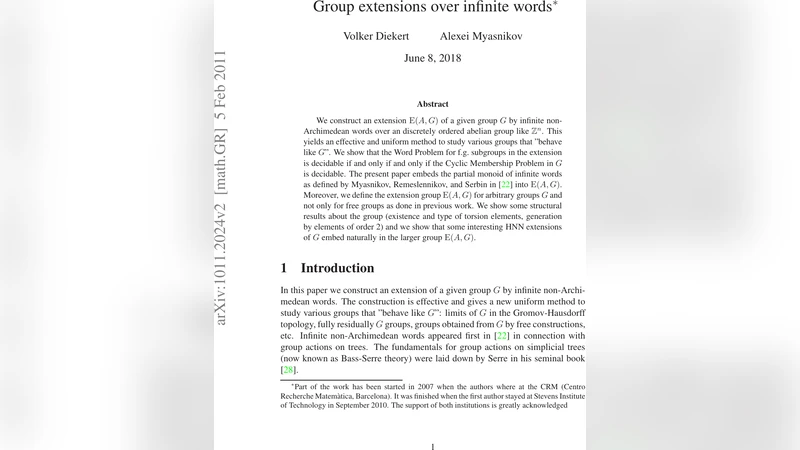
We construct an extension $E(A,G)$ of a given group $G$ by infinite non-Archimedean words over an discretely ordered abelian group like $Z^n$. This yields an effective and uniform method to study various groups that “behave like $G$”. We show that the Word Problem for f.g. subgroups in the extension is decidable if and only if and only if the Cyclic Membership Problem in $G$ is decidable. The present paper embeds the partial monoid of infinite words as defined by Myasnikov, Remeslennikov, and Serbin (Contemp. Math., Amer. Math. Soc., 378:37-77, 2005) into $E(A,G)$. Moreover, we define the extension group $E(A,G)$ for arbitrary groups $G$ and not only for free groups as done in previous work. We show some structural results about the group (existence and type of torsion elements, generation by elements of order 2) and we show that some interesting HNN extensions of $G$ embed naturally in the larger group $E(A,G)$.
💡 Research Summary
The paper introduces a novel construction that extends any given group (G) by means of infinite non‑Archimedean words defined over a discretely ordered abelian group (A) (typically (\mathbb Z^n)). These infinite words are functions from (A) to a finite alphabet, equipped with a length function taking values in (A) and a natural concatenation operation that respects the order on (A). By pairing such words with elements of (G) and defining a twisted multiplication, the authors obtain a new group denoted (E(A,G)). Formally, an element of (E(A,G)) is a pair ((w,g)) where (w) is an infinite word and (g\in G); multiplication is given by ((w_1,g_1)(w_2,g_2) = (w_1\cdot g_1(w_2), g_1g_2)), where (g_1(w_2)) denotes the pointwise action of (g_1) on the letters of (w_2). This construction generalizes the earlier work of Myasnikov, Remeslennikov, and Serbin, which was restricted to free groups, to arbitrary base groups (G).
A central algorithmic result is the equivalence between the decidability of the Word Problem for finitely generated subgroups of (E(A,G)) and the decidability of the Cyclic Membership Problem in (G). The latter asks, given (g\in G) and a cyclic subgroup (\langle h\rangle), whether (g) belongs to (\langle h\rangle). The authors prove that if one can solve the cyclic membership problem in (G), then any word in (E(A,G)) can be reduced to a normal form effectively, yielding a decision procedure for the Word Problem in all finitely generated subgroups of (E(A,G)). Conversely, a solution to the Word Problem in (E(A,G)) can be used to decide cyclic membership in (G), establishing a precise computational correspondence.
The paper also embeds the partial monoid of infinite words (W(A,G)) (as defined by Myasnikov et al.) into (E(A,G)) via the injective map (\iota(w) = (w,1_G)). This shows that the algebraic structure studied previously for free groups is naturally present inside the more general extension, allowing all earlier results to be transferred to the broader setting.
Structural investigations reveal several noteworthy properties of (E(A,G)). The group always contains involutions (elements of order 2) that generate the whole group, and the presence of torsion elements of higher order is tied to the order structure of (A). In particular, if (A) contains non‑trivial elements of finite order, then (E(A,G)) may exhibit torsion of the same order; otherwise, torsion is limited to involutions. The authors give explicit constructions of such elements and analyze their centralizers.
A further significant contribution is the natural embedding of certain HNN‑extensions of (G) into (E(A,G)). Given an isomorphism (\phi: H \to K) between subgroups of (G), the associated HNN‑extension (G*_{\phi}) can be realized inside (E(A,G)) by interpreting the stable letter as a specially chosen infinite word. The defining relation (t^{-1} h t = \phi(h)) holds in (E(A,G)) because the action of the infinite word on the letters reproduces the conjugation prescribed by (\phi). This embedding demonstrates that (E(A,G)) is sufficiently rich to contain many classical constructions while preserving the algorithmic properties inherited from (G).
The paper concludes with a discussion of potential extensions, including cohomological aspects of (E(A,G)), connections to automatic groups, and the possibility of replacing (A) by more general non‑Archimedean ordered groups. Overall, the work provides a unified framework that blends infinite combinatorial objects with group extensions, yielding both deep structural insights and practical decision procedures that link the complexity of the extended group directly to that of the original group (G).
Comments & Academic Discussion
Loading comments...
Leave a Comment