Australia Telescope Compact Array Radio Continuum 1384 and 2368 Mhz Observations of Sagittarius B
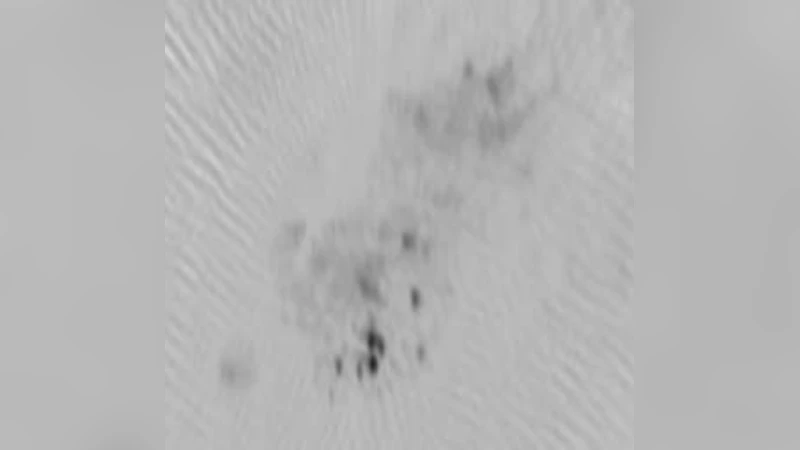
We present images of the Sagittarius (Sgr) B giant molecular cloud at 2368 and 1384 MHz obtained using new, multi-configuration Australia Telescope Compact Array (ATCA) observations. We have combined these observations with archival single-dish observations yielding images at resolutions of 47" by 14" and 27" by 8" at 1384 and 2368 MHz respectively. These observations were motivated by our theoretical work (Protheroe et al. 2008) indicating the possibility that synchrotron emission from secondary electrons and positrons created in hadronic cosmic ray (CR) collisions with the ambient matter of the Sgr B2 cloud could provide a detectable (and possibly linearly polarized) non-thermal radio signal. We find that the only detectable non-thermal emission from the Sgr B region is from a strong source to the south of Sgr B2, which we label Sgr B2 Southern Complex (SC). We find Sgr B2(SC) integrated flux densities of 1.2+/-0.2 Jy at 1384 MHz and 0.7+/-0.1 Jy at 2368 MHz for a source of FWHM size at 1384 MHz of ~54". Despite its non-thermal nature, the synchrotron emission from this source is unlikely to be dominantly due to secondary electrons and positrons. We use polarization data to place 5-sigma upper limits on the level of polarized intensity from the Sgr B2 cloud of 3.5 and 3 mJy/beam at 1384 and 2368 MHz respectively. We also use the angular distribution of the total intensity of archival 330 MHz VLA and the total intensity and polarized emission of our new 1384 MHz and 2368 MHz data to constrain the diffusion coefficient for transport of the parent hadronic CRs into the dense core of Sgr B2 to be no larger than about 1% of that in the Galactic disk. Finally, we have also used the data to perform a spectral and morphological study of the features of the Sgr B cloud and compare and contrast these to previous studies.
💡 Research Summary
The authors present a detailed radio continuum study of the Sagittarius B (Sgr B) giant molecular cloud complex using the Australia Telescope Compact Array (ATCA) at 1384 MHz and 2368 MHz. By combining new multi‑configuration ATCA data with archival single‑dish measurements (Parkes), they achieve high‑resolution images of 47″ × 14″ at 1384 MHz and 27″ × 8″ at 2368 MHz. The work is motivated by the theoretical prediction of Protheroe et al. (2008) that hadronic cosmic‑ray (CR) collisions with the dense gas in Sgr B2 should generate secondary electrons and positrons, which in turn would emit detectable synchrotron radiation, possibly with a measurable linear polarization component.
The observational strategy involved careful calibration, flagging of radio‑frequency interference, and multi‑scale CLEAN imaging to recover both compact and extended emission. The resulting total‑intensity maps reveal the intricate thermal structure of Sgr B, but non‑thermal emission is essentially absent across the bulk of the cloud. The only source exhibiting a clear non‑thermal spectrum is a region located south of the main Sgr B2 core, which the authors designate as the Sgr B2 Southern Complex (SC). For SC they measure integrated flux densities of 1.2 ± 0.2 Jy at 1384 MHz and 0.7 ± 0.1 Jy at 2368 MHz, corresponding to a spectral index α ≈ 0.6 (S ∝ ν⁻α). The source has an angular size of roughly 54″ (FWHM) at 1384 MHz, indicating a moderately extended structure rather than a point‑like object.
Polarization analysis yields 5σ upper limits on the polarized intensity of 3.5 mJy beam⁻¹ at 1384 MHz and 3 mJy beam⁻¹ at 2368 MHz for the entire Sgr B region. These limits are well below the level expected if the synchrotron emission were dominated by secondary electrons (which would typically show a polarization fraction of order 10 %). Consequently, the authors argue that the detected non‑thermal emission from SC is unlikely to arise from secondary particles; instead, it may be associated with a relic supernova remnant, a localized acceleration site, or magnetic reconnection processes that energize primary electrons.
A key part of the paper is the constraint placed on the diffusion coefficient of the parent hadronic CRs as they attempt to penetrate the dense core of Sgr B2. By comparing the angular distribution of the 330 MHz VLA data (which trace lower‑energy electrons) with the new 1384 MHz and 2368 MHz total‑intensity and polarization maps, the authors infer that the effective diffusion coefficient inside the core must be ≤ 1 % of the canonical Galactic‑disk value (D₀ ≈ 10²⁸ cm² s⁻¹). This severe suppression is consistent with expectations for a region of very high gas density (n ≳ 10⁶ cm⁻³) and strong magnetic fields (B ≈ mG), which can trap CRs and limit their transport. The reduced diffusion also explains why the predicted secondary‑electron synchrotron signal remains below the detection threshold of the current observations.
The discussion places these findings in the context of previous radio, infrared, and gamma‑ray studies of Sgr B. The authors note that earlier low‑frequency surveys hinted at possible non‑thermal components, but the higher resolution and sensitivity of the ATCA data clarify that such components are confined to limited regions like SC. They also compare their diffusion constraints with those derived from gamma‑ray observations of the Galactic Center, finding broad agreement that CR propagation is highly inhibited in the central molecular zone.
In conclusion, the study demonstrates that, despite the theoretical plausibility of a detectable synchrotron signature from secondary electrons in Sgr B2, the actual non‑thermal radio emission is weak, spatially limited, and not dominated by secondary particles. The stringent polarization limits and the derived diffusion coefficient of ≤ 0.01 D₀ provide valuable quantitative constraints on CR transport in extreme environments. The authors recommend future observations with next‑generation facilities such as the Square Kilometre Array (SKA) or the ngVLA, which will offer the required sensitivity, frequency coverage, and polarimetric fidelity to finally detect or rule out the elusive secondary‑electron synchrotron component in the Galactic Center’s most massive molecular clouds.
Comments & Academic Discussion
Loading comments...
Leave a Comment