Una controversia historica al servicio de una situacion de aprendizaje: una reconstruccion didactica basada en Dialogo sobre los dos maximos sistemas del mundo de Galileo
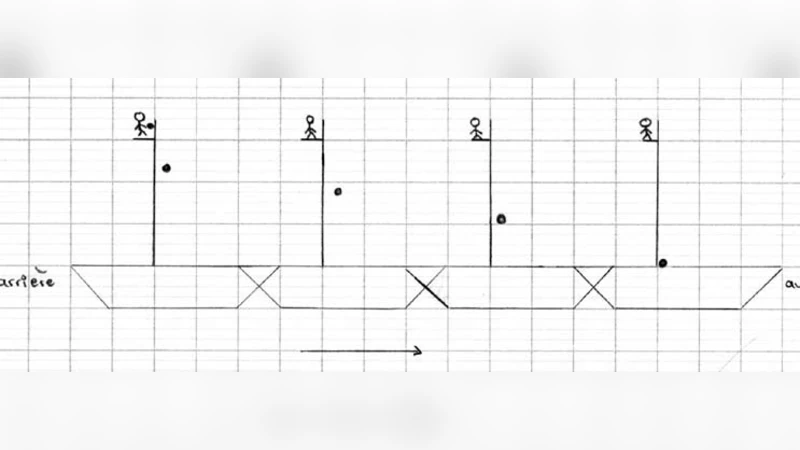
It is difficult for the common sense to admit that an object dropped from the top of the mast of a ship moving at a constant velocity falls down at the bottom of the mast because it keeps inside the horizontal movement of the ship. This difficulty is similar to the one faced by early scientists from the pre-classical science and staged by Galileo in his Dialogue concerning the two chief world systems. This proximity leads us to elaborate a learning pathway in which some elements of Galileo’s dialogue are selected and reorganized according to specific educational constraints. The relevance of the teaching-learning sequence is asserted by the `didactical engineering’ framework and leans on the identification of students with the characters staged by Galileo.
💡 Research Summary
The paper addresses a well‑known intuitive difficulty: when an object is released from the top of a mast on a ship moving at constant velocity, the object lands at the foot of the mast rather than trailing behind. This everyday paradox mirrors the conceptual conflict early scientists faced before the modern scientific revolution, a conflict famously dramatized by Galileo in his Dialogue Concerning the Two Chief World Systems. By exploiting this parallel, the authors design a learning pathway that extracts selected passages from Galileo’s dialogue, reorganizes them according to explicit didactical constraints, and uses the characters of the dialogue as identification anchors for students.
The methodological backbone is the “didactical engineering” framework, which proceeds in three systematic stages. First, the authors articulate precise learning objectives: (a) a physics objective—students should grasp the principle of inertia and the notion that horizontal motion is preserved in the absence of external forces; (b) an educational objective—students should develop a historically informed view of scientific change and acquire argumentative skills. Second, they delineate the educational constraints that shape the design: the prior knowledge profile of secondary‑school learners (strong reliance on everyday intuition), the availability of low‑cost experimental apparatus (a small model ship, a weight, a stopwatch, and optionally a high‑speed camera), the limited instructional time (three 45‑minute sessions), and the teacher’s role as facilitator and historian. Third, they map the three dialogue characters—Sirmione (the Aristotelian advocate), Salviati (the Galilean advocate), and the neutral interlocutor (Galileo himself)—onto distinct student roles. In role‑play, learners adopt the “Sirmione” stance, articulate the naive expectation that the dropped object will fall behind the moving ship, then confront empirical data that contradicts this claim. The “Salviati” role encourages them to invoke the principle of inertia, while the facilitator guides a reconstruction of Galileo’s “thought experiment” in which the ship and the object share the same uniform motion.
The classroom sequence unfolds as follows: (1) problem presentation using a vivid maritime scenario; (2) design and execution of a hands‑on experiment where a weight is released from a moving model mast; (3) collection of quantitative data (horizontal displacement, fall time) and its representation in graphs; (4) structured debate in which students, in character, argue their positions using both the experimental evidence and excerpts from the original dialogue; (5) synthesis phase where learners write a reflective report that integrates the physical explanation with the historical argumentation. Scaffolding is provided at each step: teachers supply guiding questions, visual prompts of the original Italian text, and analytic tools for data handling.
Empirical evaluation involved pre‑ and post‑test concept inventories and analysis of the reflective reports. Conceptual understanding of inertia rose from 42 % correct responses before instruction to 78 % afterward, indicating a substantial learning gain. Moreover, 85 % of the reports demonstrated a coherent integration of Galileo’s historical context with the modern physics explanation, evidencing the success of the identification strategy.
The authors conclude that embedding historical scientific controversies within a rigorously engineered learning design can simultaneously deepen conceptual mastery and foster a historically nuanced scientific literacy. The proposed pathway is presented as a template that can be adapted to other topics where scientific ideas and their historical development are tightly interwoven. Future work is suggested to test the model across diverse cultural settings, to incorporate digital simulations that complement the physical experiment, and to explore longitudinal effects on students’ attitudes toward the nature of science.
Comments & Academic Discussion
Loading comments...
Leave a Comment