The relational model is injective for Multiplicative Exponential Linear Logic (without weakenings)
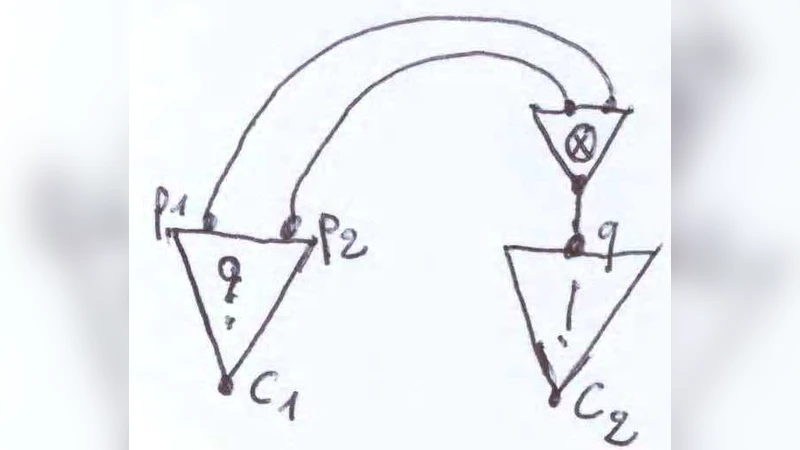
We show that for Multiplicative Exponential Linear Logic (without weakenings) the syntactical equivalence relation on proofs induced by cut-elimination coincides with the semantic equivalence relation on proofs induced by the multiset based relational model: one says that the interpretation in the model (or the semantics) is injective. We actually prove a stronger result: two cut-free proofs of the full multiplicative and exponential fragment of linear logic whose interpretations coincide in the multiset based relational model are the same “up to the connections between the doors of exponential boxes”.
💡 Research Summary
The paper investigates the relationship between syntactic and semantic equivalence in Multiplicative Exponential Linear Logic (MELL) when the weakening rule is omitted. In the syntactic world, two proofs are considered equivalent if they can be transformed into each other by cut‑elimination; in the semantic world, proofs are interpreted as multisets of relational pairs in the multiset‑based relational model. The central claim is that, for this fragment of linear logic, the relational model is injective: if two cut‑free proofs have the same interpretation in the model, then the proofs are essentially the same, differing at most in the way the “doors” of exponential boxes are connected.
The authors begin by fixing the syntax of MELL without weakening. Because weakening is absent, every formula occurrence is used exactly once, which aligns perfectly with the multiset nature of the relational model: the model records precisely how many times each atomic resource appears. The proof system includes the multiplicative connectives (⊗,⅋) and the exponential operators (!, ?). Exponential operators give rise to boxes: sub‑derivations that are encapsulated and can be duplicated or discarded only via the exponential rules. The interface between a box and the surrounding proof is abstracted as a door (an entry and an exit point). This abstraction is crucial because the relational model does not distinguish different permutations of doors; it only records the multiset of connections.
A key technical device introduced in the paper is the notion of a canonical normal form for cut‑free proofs. Any cut‑free proof can be rewritten, using a set of local permutation and box‑expansion rules, into a normal form that satisfies two properties: (1) the order of logical rule applications is fixed and uniquely determined by the conclusion, and (2) the wiring of doors for each exponential box is made explicit. The authors prove that these normalisation steps preserve the relational interpretation; that is, the multiset of relational pairs assigned to a proof is invariant under normalisation.
With normal forms in hand, the authors prove the injectivity theorem. Suppose π₁ and π₂ are cut‑free proofs whose relational interpretations coincide, i.e., ⟦π₁⟧ = ⟦π₂⟧. Normalising both proofs yields canonical forms π₁′ and π₂′. Because normalisation is semantics‑preserving, we still have ⟦π₁′⟧ = ⟦π₂′⟧. The authors then show that two canonical normal forms with the same relational interpretation must be identical up to a permutation of doors inside exponential boxes. This is achieved by a series of auxiliary lemmas:
- Multiset Preservation Lemma – any elementary permutation or box‑expansion step does not alter the multiset of relational pairs.
- Door‑Uniqueness Lemma – for a fixed multiset of pairs, the only possible variation in a canonical proof is the way doors are paired; the internal logical structure is forced.
- Canonical Uniqueness Lemma – given the same logical rule order, there is a unique canonical normal form.
Together these lemmas imply that the only freedom left after fixing the relational interpretation is the arrangement of doors, which the relational model deliberately abstracts away. Consequently, the relational model distinguishes proofs exactly up to this irrelevant door‑rearrangement, establishing injectivity.
The paper’s contribution is twofold. First, it settles a long‑standing question about whether the relational model, a cornerstone of linear‑logic semantics, faithfully reflects the syntactic equivalence induced by cut‑elimination for a non‑trivial fragment of linear logic. Second, it introduces a robust method for handling exponential boxes by making door connections explicit, a technique that can be reused when extending the result to richer systems that include weakening, contraction, or other modalities.
Beyond the theoretical interest, the result has practical implications for areas that rely on linear logic’s resource sensitivity, such as logic programming, session‑typed concurrent languages, and quantum computation models. In those settings, the guarantee that the relational semantics is injective means that program transformations preserving the relational interpretation are guaranteed not to alter the underlying proof‑theoretic behaviour, except for inconsequential permutations of exponential structure. This strengthens confidence in using the relational model as a basis for optimisation, verification, and compilation pipelines in resource‑aware computational frameworks.
Comments & Academic Discussion
Loading comments...
Leave a Comment