Biequivalences in tricategories
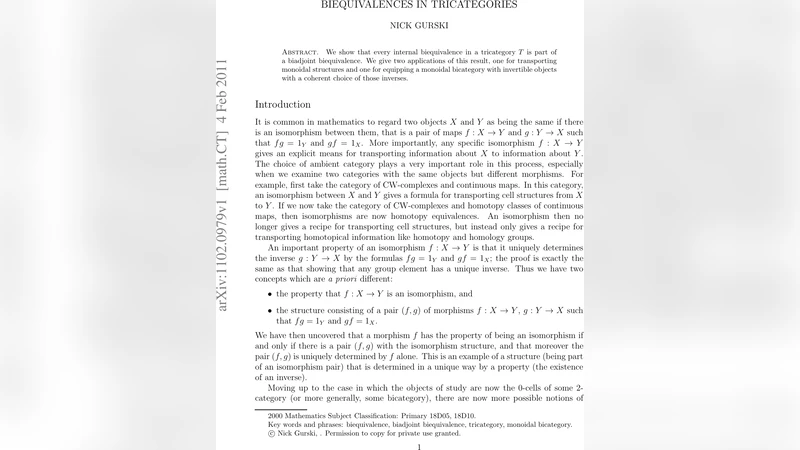
We show that every internal biequivalence in a tricategory T is part of a biadjoint biequivalence. We give two applications of this result, one for transporting monoidal structures and one for equipping a monoidal bicategory with invertible objects with a coherent choice of those inverses.
💡 Research Summary
The paper “Biequivalences in tricategories” establishes a fundamental result in higher‑dimensional category theory: in any tricategory (T), every internal biequivalence can be completed to a biadjoint biequivalence. A biequivalence is a 1‑cell that admits a weak inverse together with invertible 2‑cells satisfying the usual triangle identities; a biadjoint biequivalence adds the extra data of invertible 3‑cells that witness the adjunction at the level of 2‑cells and satisfy higher coherence conditions. The author proves that the extra 3‑cell data always exists, so any biequivalence automatically carries a full biadjoint structure.
The proof proceeds in three stages. First, the special case (T=\mathbf{Bicat}) (the tricategory of bicategories, homomorphisms, pseudo‑natural transformations, and modifications) is handled directly. Here a biequivalence can be characterized either as a functor with a weak inverse or as a functor that is essentially surjective and locally an equivalence. Using these characterizations together with the well‑known fact that every equivalence in a bicategory extends to an adjoint equivalence, the author constructs the required 3‑cells and checks the biadjoint axioms. The calculations are extensive but are streamlined by the coherence theorem for bicategories.
Second, the author shows a “local embedding” transfer principle: if a tricategory functor (F\colon S\to T) satisfies a suitable embedding condition (preserving objects, 1‑cells, 2‑cells and 3‑cells locally and being essentially surjective), and if every biequivalence in (T) is part of a biadjoint biequivalence, then the same holds in (S). The proof lifts the 3‑cell data from (T) back along (F), using the uniqueness of weak inverses and the coherence of the embedding.
Third, the result is extended to arbitrary tricategories by exploiting the Yoneda embedding. Any tricategory (T) embeds fully and faithfully into the functor tricategory (\mathbf{Tricat}(S,T)) for a suitable (S) (often a representable or a small generating sub‑tricategory). Since the functor tricategory is a tricategory of bicategories, the first step applies; the embedding satisfies the local embedding hypothesis, so the property propagates back to (T). The argument relies heavily on the coherence theorem for tricategories: every diagram in a free tricategory commutes, which allows the author to avoid writing out massive pasting diagrams and to refer to “the obvious coherence”.
Two significant applications are presented. The first concerns transport of monoidal structures across biequivalences. Given a biequivalence (F\colon X\to Y) between monoidal bicategories, one can choose a weak inverse (G\colon Y\to X) and use the full biadjoint data to define a tensor product on (Y) by pulling back the tensor on (X) along (F) and (G). The 3‑cell components of the biadjoint biequivalence provide the necessary associators, unitors, and higher coherence cells on (Y), guaranteeing that the transported structure satisfies all monoidal bicategory axioms. The method extends without essential change to braided, sylleptic, and symmetric monoidal bicategories.
The second application deals with Picard 2‑categories, i.e., monoidal bicategories in which every object is weakly invertible. The author shows that any Picard 2‑category is triequivalent to one equipped with a coherent choice of inverses for each object. This is achieved by viewing the free Picard‑2‑category monad as a 3‑dimensional monad and proving a 3‑dimensional idempotency property: applying the monad twice yields an equivalent structure. Consequently, the forgetful functor from “coherent Picard 2‑categories” (with chosen inverses) to ordinary Picard 2‑categories is a triequivalence. Moreover, any monoidal functor between Picard 2‑categories can be upgraded to preserve the chosen inverses up to equivalence.
Overall, the paper clarifies the relationship between biequivalences and biadjoint structures in the tricategorical setting, provides robust tools for transporting higher algebraic structures, and resolves the coherence problem for inverses in weakly invertible monoidal bicategories. The techniques rely on a blend of explicit construction (in the (\mathbf{Bicat}) case), abstract transfer principles, and deep coherence results for tricategories, offering a template for future work on higher monads, higher categorical algebra, and applications in topology and quantum algebra.
Comments & Academic Discussion
Loading comments...
Leave a Comment