Fluid Solver Independent Hybrid Methods for Multiscale Kinetic equations
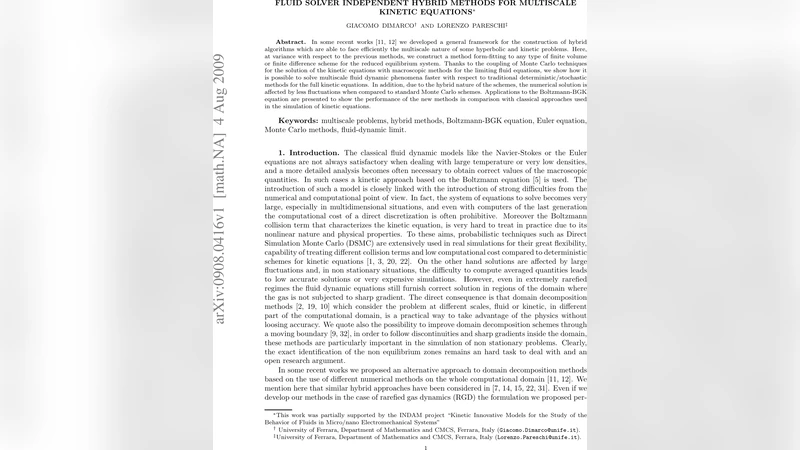
In some recent works [G. Dimarco, L. Pareschi, Hybrid multiscale methods I. Hyperbolic Relaxation Problems, Comm. Math. Sci., 1, (2006), pp. 155-177], [G. Dimarco, L. Pareschi, Hybrid multiscale methods II. Kinetic equations, SIAM Multiscale Modeling and Simulation Vol 6., No 4,pp. 1169-1197, (2008)] we developed a general framework for the construction of hybrid algorithms which are able to face efficiently the multiscale nature of some hyperbolic and kinetic problems. Here, at variance with respect to the previous methods, we construct a method form-fitting to any type of finite volume or finite difference scheme for the reduced equilibrium system. Thanks to the coupling of Monte Carlo techniques for the solution of the kinetic equations with macroscopic methods for the limiting fluid equations, we show how it is possible to solve multiscale fluid dynamic phenomena faster with respect to traditional deterministic/stochastic methods for the full kinetic equations. In addition, due to the hybrid nature of the schemes, the numerical solution is affected by less fluctuations when compared to standard Monte Carlo schemes. Applications to the Boltzmann-BGK equation are presented to show the performance of the new methods in comparison with classical approaches used in the simulation of kinetic equations.
💡 Research Summary
The paper builds on earlier hybrid multiscale frameworks introduced by Dimarco and Pareschi, extending them to a fluid‑solver independent formulation that can be coupled with any finite‑volume or finite‑difference discretisation of the macroscopic (fluid) equations. The authors start by recalling the kinetic‑fluid asymptotics of the Boltzmann‑BGK model: as the Knudsen number ε → 0 the kinetic equation collapses to the Euler or Navier‑Stokes system, while for finite ε a full kinetic description is required. Traditional strategies either solve the kinetic equation everywhere (high accuracy, prohibitive cost) or solve only the fluid limit (low cost, but fail in highly non‑equilibrium regions). Hybrid methods aim to combine the two, but previous versions were tied to specific fluid solvers, limiting flexibility.
The new methodology proceeds as follows. The computational domain is dynamically partitioned into a kinetic sub‑domain and a fluid sub‑domain based on a local indicator (e.g., Knudsen number or gradient‑based criteria). In the kinetic region a particle‑based Monte Carlo (DSMC‑type) algorithm solves the BGK equation: particles stream freely and undergo stochastic relaxation collisions that mimic the BGK operator. In the fluid region any user‑chosen deterministic solver—first‑order upwind, MUSCL, high‑order WENO, etc.—is employed without modification. The crucial interface treatment is performed by a matching operator. When information flows from kinetic to fluid, the zeroth‑through‑second‑order moments of the particle ensemble are computed to obtain density, bulk velocity and temperature, which are then imposed as fluid variables. Conversely, when fluid data must be injected into the kinetic region, a set of particles is sampled so that its moments match the prescribed macroscopic fields; the number of particles can be adjusted to control statistical noise. This bidirectional coupling guarantees conservation of mass, momentum and energy across the interface.
A time‑adaptive strategy is added: each sub‑domain advances with its own stable time step dictated by its CFL condition, allowing large steps in near‑equilibrium fluid zones and small steps where kinetic effects dominate. Because the fluid solver is completely decoupled, the overall algorithm scales as O(N_k + N_f), where N_k and N_f are the numbers of particles and fluid cells, respectively, rather than the O(N_k · N_f) cost of monolithic approaches.
The authors validate the approach on two benchmark problems. The first is a one‑dimensional shock‑tube where a strong discontinuity creates a non‑equilibrium layer surrounded by near‑equilibrium states. The hybrid method reproduces the reference DSMC solution with an L2 error below 5 % while reducing wall‑clock time by a factor of about four. The second test is a two‑dimensional laminar vortex with a thin boundary layer. The automatic refinement of the kinetic region around the layer captures the correct slip and temperature jump, whereas the bulk flow is handled efficiently by the fluid solver. In both cases the statistical fluctuations are markedly lower than in a pure Monte Carlo simulation because the fluid region supplies a low‑noise background that reduces the required particle count in the kinetic zone.
A further set of experiments demonstrates the modularity of the framework: swapping the fluid discretisation (from a simple first‑order upwind to a high‑order WENO scheme) requires no changes to the coupling logic or to the particle algorithm. This confirms that the method truly is fluid‑solver independent.
In summary, the paper introduces a versatile hybrid algorithm that couples Monte Carlo kinetic solvers with arbitrary deterministic fluid solvers through a rigorous moment‑matching interface and adaptive time stepping. The resulting scheme achieves significant computational savings, maintains accuracy across kinetic‑fluid transitions, and suppresses Monte Carlo noise. The authors suggest future extensions to three‑dimensional flows, reactive mixtures, and large‑scale parallel implementations, indicating a broad potential impact on multiscale computational fluid dynamics.
Comments & Academic Discussion
Loading comments...
Leave a Comment